
The Evolution Of The Peeping Tom
A cinematic journey through the world of voyeurism


The concept of the Peeping Tom archetype, a prevalent motif in folklore and cinema for decades, has not only entertained but also reflected and influenced societal norms. But he wasn't always the disgusting character we know and hate today. So what happened to Tom, and why did our perception of the once humorous character change over time? Let's find out.
His Origin Story
The phrase Peeping Tom originates from the legend of Lady Godiva.
Lady Godiva was a noblewoman from the 11th century, married to Leofric, a prominent Earl of Mercia and Lord of Coventry. According to folklore, Godiva was greatly distressed by Leofric's heavy taxes burdening the people of Coventry and persistently pleaded with him to give the citizens a break.
Leofric, who quickly became tired of her constant requests for tax relief, exhaustingly proposed that he would consider lowering taxes if she rode naked, on horseback, through the centre of the town.

Naturally, Lady Godiva was horrified by this proposal, but she followed through, fuelled by a deep resolve and love for the people.
As the tale goes, Godiva confidently hops onto her horse and gracefully makes her way through the streets of Coventry's town centre, her flowing locks serving as her only shield of modesty.
Before setting off on her historic horseback ride, Lady Godiva asks the people of Coventry to stay indoors and avert their gaze as she passes by. However, one individual named Tom cannot resist the temptation and peeks through his window for a cheeky glimpse of a naked Godiva.
Unfortunately for Tom, this act of voyeurism came with severe consequences. According to various iterations of the story, Tom was either instantly struck blind or died as punishment. Thus, the idiom Peeping Tom emerged, forever tied to creepy voyeuristic behaviour.
A Brief History of the Peep Show
Fast-forward a few centuries, and we reached the 19th century when bustling streets and fairs characterised Europe. Performers, jugglers, and dancers competed for the spotlight. However, it was the newcomer to the scene, the peep show, that quickly grabbed the public's attention.
And capture their attention it did! Thanks to a captivating device known as the Mutoscope, audiences experienced a delightful break from their daily lives as they gazed through a small opening into a magical realm.

Much like a flipbook, the Mutoscope created the illusion of motion by displaying a rapid sequence of still images. These images were mounted on a circular drum that resembled a Rolodex, a rotating card file device. Each reel held about 850 frames, providing roughly one minute of viewing entertainment. The public would peer through a single lens while turning a handle, animating hundreds of black-and-white images and bringing them to life.
As the 20th century rolled around, peep shows had firmly established themselves as a staple of public amusement.
What was unique about these machines was their ability to lure people in from all walks of life. Whether you were an aristocrat, middle class, or solidly working class, there was something for everyone, from humorous tales and serious historical reenactments to picturesque journeys to far-off places.
And for those searching for something a little more sultry, peep shows also had plenty of provocative and naughty reels to entice their audience.
One reel in particular left a lasting impression: What the Butler Saw. In this risqué short, a butler catches a glimpse of a woman undressing through a keyhole. This cheeky reel became so iconic that Mutoscopes themselves were often nicknamed "What-the-Butler-Saw machines" in the UK.
As a side note, the phrase "What the Butler Saw" entered British popular culture vernacular after the 1886 divorce scandal of Lord Colin Campbell and Gertrude Elizabeth Blood.
The trial, which featured accusations of infidelity on both sides, centred on whether their butler could have indeed observed Lady Colin Campbell's scandalous interactions with other men through the dining room's keyhole.
Voyeurism in Early Cinema
With the arrival of cinema, the charm of static peep shows began to lose its hold, as film, bursting with movement and energy, brought something fresh and irresistible to audiences.
And leading the charge were the iconic Lumière brothers, Auguste and Louis, often hailed as the fathers of cinema. Their groundbreaking 1895 short film Workers Leaving the Lumière Factory was a simple yet mesmerising glimpse into everyday life.
As the title suggests, the one-minute documentary shows workers heading out through the main gate of the Lumière factory in Lyon, France. In our modern world, this clip would seem dull and pointless, but for moviegoers of the late 19th century, the commonplace became remarkable as daily life was captured in a manner never seen before. People found it impossible to turn away.
Once the novelty of filming the every day was satiated, the creative, and creatively voyeuristic juices began flowing. Yet, it's interesting to note that many early short films portrayed voyeurs not as sinister figures but as bumbling, curious troublemakers. Their antics and inevitable comeuppance offered audiences a hearty laugh while wrapping things up with a karmic twist.
The 1905 short film Peeping Tom in the Dressing Room perfectly exemplifies this scenario. In it, a young man leers through a peephole in the wall separating two dressing rooms and secretly watches two women, one of whom is getting dressed. However, two men catch the Peeping Tom in the act and escort him to the dressing room, where the women playfully beat him with their powder puffs. I'm sure he totally learnt his lesson after that beatdown!
Turning to European shores, Par le trou de la serrure (What Is Seen Through a Keyhole), produced by Pathé Frères and directed by Ferdinand Zecca in 1901, brought a sharper edge to voyeuristic comedy. This French silent short follows an impish hotel porter who peeks through the keyholes of various rooms, leading to a cascade of discoveries.
Here's a rundown of what he sees:
- A woman combing her hair.
- A woman removing false breasts and a wig, revealing themselves as transgendered - a progressive, though controversial, depiction for the time.
- A playful romantic encounter between a man sipping champagne and a woman sitting on his lap.
The comedy culminates in the fourth room, where his spying is cut short by an angry guest who catches him in the act and throws the hotel porter down the stairs.
Aside from its risqué humour, Par le trou de la serrure is notable for breaking new ground in cinematography. Zecca experimented with editing techniques during filming, mixing close-ups with broad shots to make the tale more immersive during the filming.
Hitchcock and the Peeping Tom
By the mid-20th century, Peeping Tom underwent a dramatic facelift. Tom had levelled up and evolved from a comic or naively curious character into one with a more frightening, psychological edge. Voyeurism became popular among filmmakers to explore moral issues, societal fears, and personal vulnerability. However, few directors executed it better or more profoundly than Alfred Hitchcock.
Let's start by looking at Hitchcock's 1960 classic film Psycho. In one notable scene, we observe the main character, Norman Bates, spying on motel guest Marion Crane through a hidden peephole as she prepares to shower.
At first glance, Norman's actions may appear typical of a classic Peeping Tom. But if you peer a little closer, one can see that, unlike the voyeuristic protagonists in previous decades' films, Norman's actions reveal his profound loneliness and emotional scars.
From dressing up as his mother to killing to keep her secret, Hitchcock employs voyeurism as a doorway into Norman's damaged psyche, a psyche sculpted by years of abuse from his dominating and manipulative mother.
Hitchcock also tackled voyeurism in his 1954 quintessential masterpiece, Rear Window. While the film strikes a different tone than Psycho, Rear Window is just as gripping and similarly deals with themes of privacy, morality, and observation.
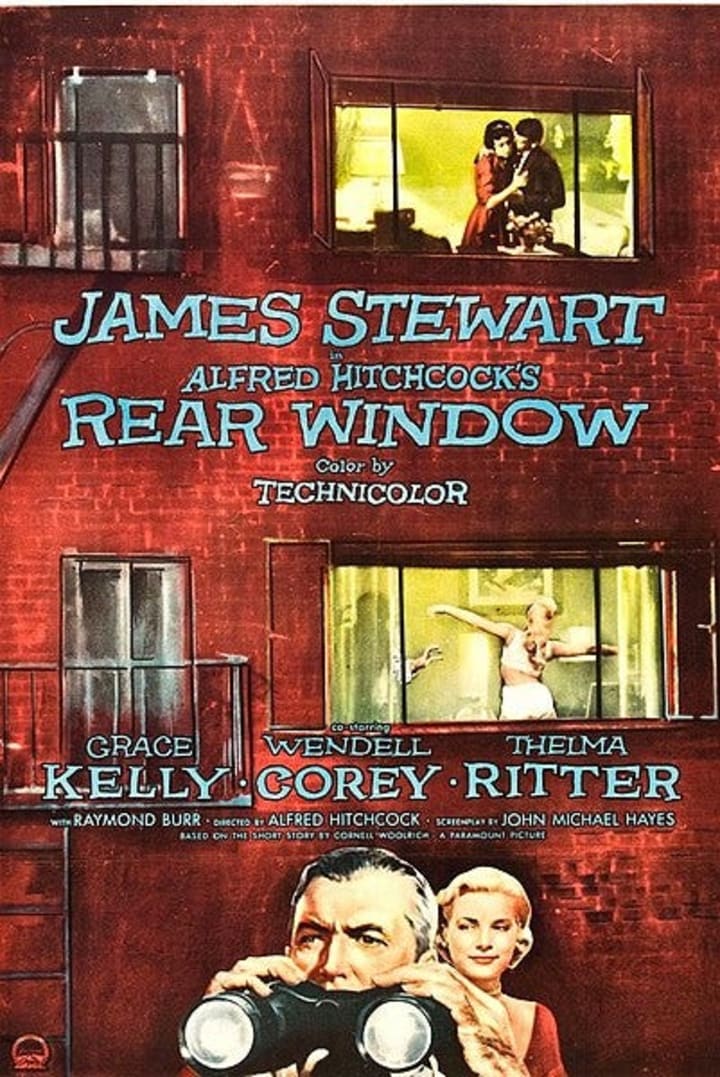
At the heart of the film is L.B. "Jeff" Jeffries, a photojournalist played by James Stewart. Stuck in his apartment with a broken leg, Jeffries finds himself passing the time by spying on his neighbours through their windows. What starts as harmless people-watching quickly escalates into something much darker when he suspects one of his neighbours has committed murder.
Hitchcock masterfully pulls you into the story, and as we follow Jeff's gaze, we too are eager to unravel the mystery. But with all the excitement, there are also some tougher questions to think about. Is Jeff justified in invading another's privacy? Does witnessing a serious crime absolve you of criticism from your own dubious actions? Of course, Hitchcock does not let us in on the answers, ensuring the suspense sticks around even after the movie's conclusion.
The Rise of Surveillance Culture
While Hitchcock addressed voyeurism through character-driven fiction, later decades of film and media have focused on the societal impact of surveillance culture.
This is brilliantly demonstrated in 1998's award-winning movie, The Truman Show. The film invites us into the carefully crafted world of Truman Burbank, an average guy living what seems to be an utterly charming life in the picture-perfect seaside town of Seahaven.
But here's the catch: Truman doesn't realise that his entire world is a meticulously controlled illusion. His family, wife, friends, neighbours, and even the quaint town itself are all part of an elaborate set. He's unknowingly the star of a 24/7 reality TV show broadcast live to over a billion people worldwide.
Without revealing too much, Truman starts to make connections when minor things go wrong, eventually realising that his life isn't what it seems.
Truman's plight is especially relevant today because it parallels our willingness to trade privacy for visibility. Whereas Truman was forced to live in the public eye, modern society has embraced the spotlight, with platforms like Instagram, TikTok, and YouTube normalising the concept of willingly sharing our private lives and daily routines. Surveillance is no longer imposed but instead selected and even appreciated.

Television has also done its part to muddle the issue around surveillance. Shows like Gossip Girl and Pretty Little Liars feature characters who use surveillance to achieve power or uncover truths. Whether it's the mysterious "A" or the titular "Gossip Girl," these characters know all and see all. Culminating in shows filled with secret recordings, blackmail, stalking, the leaking of private information, characters snooping on one another's lives, and perhaps most disturbingly, a group of high school students who record teenage girls through bedroom windows.
While morally problematic, the activities are rarely explicitly criticised in the story. Instead, they keep the drama dense and the plots interesting.
The Horrors of Comedy
By the 1980s and 90s, the Peeping Tom trope had come full circle and was once again incorporating voyeurism into the fabric of comedy.
However, there was nothing funny about these peepers! As if some kind of character blueprint was circulating, these Toms often embody obsessive behaviour and flagrantly ignore the concept of privacy. Yet, their actions were rarely condemned. Rather, these cheeky misfits were often rewarded with laughter from the audience instead of facing any sort of meaningful consequence.
Take American Pie, a film firmly nested in pop culture's comedic canon. One of its most infamous sequences shows Nadia, a foreign exchange student, unknowingly being videotaped while changing and later masturbating. While this conduct could and should easily be labelled predatory, the film focuses on the humorous fallout, transforming the act into a source of amusement, a rite of passage, and a "boys will be boys" attitude rather than a serious violation of privacy.
Similarly, 1984's Revenge of the Nerds takes this breach to a higher level. The nerds discreetly install cameras in a sorority house, allowing them to spy on ladies at their most intimate moments. What should be a blatant invasion of privacy becomes a humorous plot device disguised as clever scheming by the underdogs.
The appeal and effect of these types of movies are even more insidious as they frequently target young, emotionally sensitive viewers. Films like Porky, American Pie, and The Girl Next Door are aimed squarely at teenagers exploring their boundaries, relationships, and morality. When such activities are portrayed as normal or praiseworthy in comedic storylines, young viewers may internalise these distorted ideas, making them less likely to value "no" as an unbreakable barrier or recognise privacy violations in private or public arenas.
Gender Dynamics and Objectification
As the adage goes, nothing exists in a vacuum, and voyeurism is no exception.
Peeping Tom and voyeuristic stories often intersect with gender dynamics and tend to paint women as nothing more than eye candy for men. The guy watching usually gets all the focus, while the woman is just there, reduced to her looks. This mirrors a bigger problem in society, where the male perspective takes the lead, reinforcing old-school stereotypes that strip women of their independence and being.
Few films capture this essence better than 1999's American Beauty. At the story's core is Lester Burnham, played by Kevin Spacey, a middle-aged man living in the suburbs who develops an obsession with Angela, his daughter's teenage friend. An obsession that started when he first laid eyes on her during a routine high school basketball game.
To set the scene, it's halftime, and the cheerleaders have the floor. Lester is bored and disinterested. Until now. Until he sees Angela. Through slow-motion movements and a surreal score, we see Angela through Lester's eyes. The bowler hat, her intense stare, the caress of her body, and the sway of her hips are all presented with a disturbing mixture of infatuation, fantasy, and voyeuristic anxiety. The effect is a hypnotic invitation to experience Angela not as a person, but as a carefully orchestrated object of desire.
Some flicks try to shake things up, like 2011's Horrible Bosses, where Jennifer Aniston's character is a sexually aggressive boss. It flips the usual "guy as voyeur" setup; nevertheless, the play for laughter obscures the deeper commentary on power dynamics. Instead of challenging the issue, it risks trivialising such behaviour, especially since the humour makes it hard to thoroughly critique this new role reversal.
Then there's Twilight, which brings a different, but no less disturbing, spin on voyeurism. Everyone who's seen the movie will no doubt remember the brooding, sparkly vampire Edward Cullen watching Bella Swan while she sleeps. This action is meant to be interpreted as a demonstration of his love, and in fact, many viewers perplexingly perceived the gesture as heartfelt and romantic. Nonetheless, it's hard to ignore the unease that comes with this breach of privacy disguised as affectionate care.
The Impact on Society
Over the past two decades, reality television and the rise of social media have significantly reshaped the concept of privacy, pushing personal boundaries into the public domain.
Shows like MILF Manor, Sister Wives, or the iconic Real Housewives series have drawn millions of viewers with their ability to offer a voyeuristic glimpse into the lives of "ordinary" people. These shows thrive on exposing personal conflicts, heartbreaks, relationship drama, and milestones. Nothing is off-limits, and as such, they have normalised the idea that private lives are entertainment fodder and a pathway to fame and validation.
On the bright side, at least reality TV is confined to scheduled episodes and fragmented snapshots of someone's world. Social media, on the other hand, is an entirely new level of voyeurism.
Between Instagram reels, TikTok diaries, live broadcasts, and YouTube shorts, these platforms do their best to shatter the boundaries between public and private life.
Make-up routines, gym rituals, heartbreak, secrets, cheating confessions, and weird family traditions are no longer for private consumption. All this and everything else you can think of are now being meticulously documented and shared in a race for likes, followers, and fleeting validation.
Now, when viewers see reality stars or influencers reaching success, popularity, and validation by oversharing, it subtly suggests that the decline of personal limits is not only natural but aspirational. Such representations change society's expectations and lead to a situation whereby the concept of permission for what is private or public becomes dubious.
Despite the dire situation, there is still hope! We can counteract this voyeuristic culture by being alert and critically analysing what we consume as media users. So, the next time you scroll through your feeds or binge a new show, look between the lines. Is this show or content fostering a culture of respect, or do they blur boundaries for the sake of entertainment? Every decision counts, and we all have a part to play in shaping what happens next.
About the Creator
Chelsea Rose
I never met a problem I couldn't make worst.
Keep reading
More stories from Chelsea Rose and writers in Geeks and other communities.
Life Is Short. Have An Affair
Ashley Madison: Sex, Lies & Scandal, the latest Netflix original, delves into the murky realm of online adultery and reveals startling facts about the notorious website that caused a stir in the history of the internet. From suicides to lying YouTubers and a mysterious hacking team, this captivating three-party docuseries explores the meteoric rise and spectacular fall of Ashley Madison, leaving no stone unturned.
By Chelsea Rose2 years ago in Geeks


Comments (1)
"We've become a nation of Peeping Toms." - Lisa in "Rear Window" 🔭 Honestly, I don't think it's going away any time soon. We all want to look.