
The Evolution of AI in Video Games: From Simple Scripts to Adaptive NPCs
Discover How Video Game AI Has Progressed from Basic Enemy Scripts to Sophisticated, Player-Adaptive NPCs

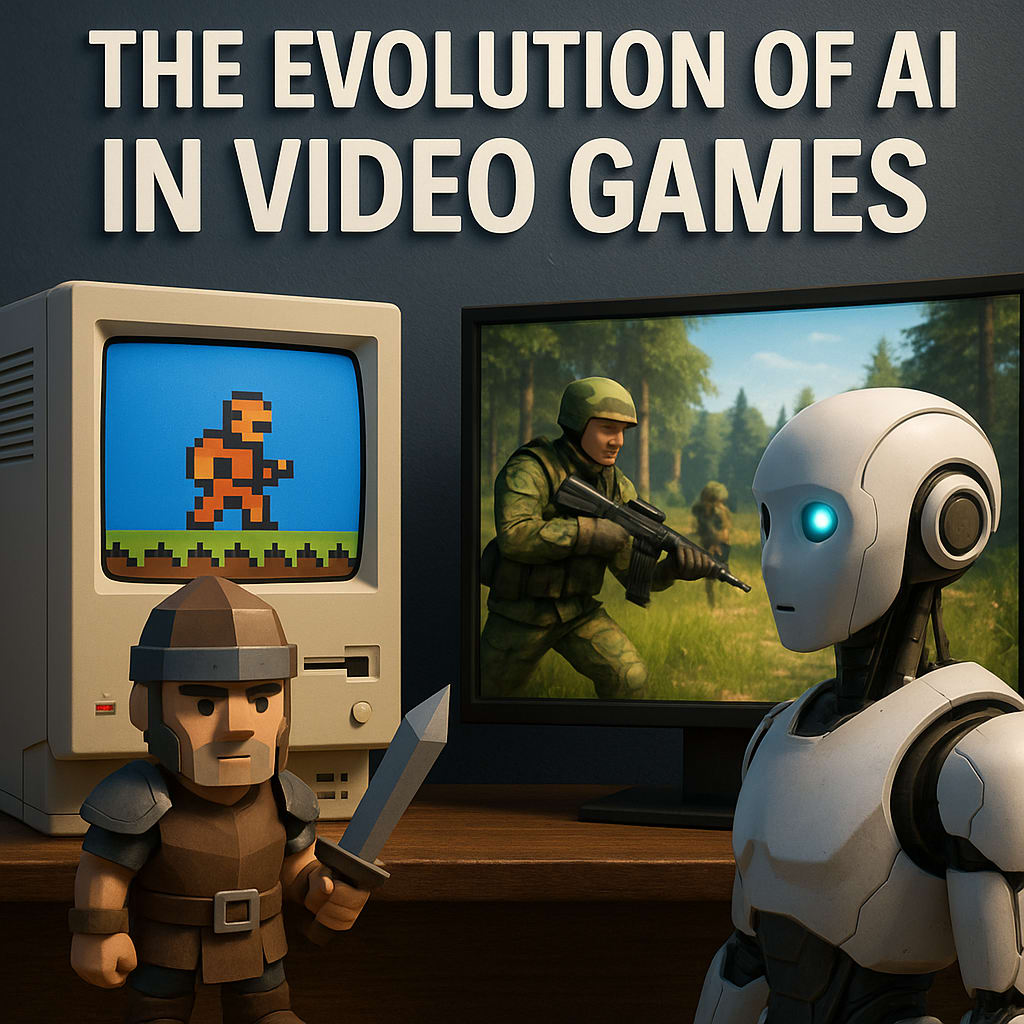
Artificial intelligence (AI) has come a long way in video games. From the earliest days of simple scripted behavior to today's dynamic, adaptive non-playable characters (NPCs), AI has continuously reshaped the way we experience interactive digital worlds. In this long-form article, we'll dive deep into the history, milestones, current capabilities, and the future of AI in gaming.
Early Days: Rule-Based Systems and Scripted Behaviors
In the early stages of video game development, AI was rudimentary. Games like Pong (1972) and Space Invaders (1978) relied on simple, deterministic rules to dictate enemy behavior. These early systems used basic if-then logic, where enemies would react in predictable ways based on the player's input or position.
For example, in Pac-Man (1980), each ghost followed a specific algorithm: Blinky directly chased the player, Pinky tried to ambush, Inky used a combination strategy, and Clyde behaved randomly. Although limited, these AI patterns added challenge and depth to the game.
Scripted AI behavior became the norm in the 1990s, with NPCs and enemies programmed to follow fixed paths or actions in response to triggers. While this approach allowed for more complex scenarios, it lacked flexibility and often resulted in predictable gameplay.
The Rise of Finite State Machines and Decision Trees
To overcome the limitations of hardcoded behaviors, developers began using finite state machines (FSMs). An FSM allows an AI entity to switch between a finite set of states (e.g., patrol, chase, attack, retreat) based on conditions. This made enemy behavior appear more lifelike and varied.
Decision trees further expanded AI capabilities by evaluating a hierarchy of conditions to determine actions. Games like Half-Life (1998) used decision trees to create NPCs that responded to the player's actions in more nuanced ways, such as taking cover, calling for help, or retreating.
These systems marked a significant step forward, enabling more realistic and responsive behaviors without requiring complex computation.
The Influence of Machine Learning and Neural Networks
While traditional AI in games relied heavily on human-authored logic, the 2000s and 2010s saw the rise of machine learning (ML) in gaming research and experimental projects. ML allows AI to learn from data rather than being explicitly programmed.
In academic settings and indie projects, researchers experimented with training agents using reinforcement learning. For example, OpenAI’s agents learned to play Dota 2 at a high level by playing thousands of matches against themselves.
Neural networks have also been used to model player behavior, enabling games to adapt dynamically. Although not yet widespread in commercial games due to computational demands, these techniques point to a future where AI could learn and evolve alongside players.
Adaptive AI and Procedural Systems in Modern Games
Modern game AI focuses not just on reactive behavior but also on adaptation and personalization. Games like Left 4 Dead (2008) featured the "AI Director," a system that adjusted enemy spawns and pacing based on the player's performance to maintain a balanced challenge.
Open-world games like Red Dead Redemption 2 and The Elder Scrolls V: Skyrim feature AI systems where NPCs follow daily routines, react to the player's actions, and interact with each other. These emergent behaviors create a more immersive world.
Procedural generation also plays a role in AI evolution. Titles like No Man's Sky and Minecraft use algorithms to generate worlds and populate them with creatures or characters exhibiting autonomous behaviors.
Social and Emotional AI
Another frontier in game AI is the simulation of social and emotional interactions. In The Sims series, AI agents form relationships, experience emotions, and make decisions based on personality traits.
Games like Cyberpunk 2077 and Detroit: Become Human aim to create emotionally engaging NPCs by combining branching narratives with emotional state modeling. These systems strive to make interactions feel more human and impactful.
Challenges and Ethical Considerations
Despite advancements, several challenges remain. Balancing AI complexity with performance constraints is critical, especially for real-time applications. Developers must also ensure that AI behaviors remain fair and enjoyable.
Ethical considerations are also emerging. As AI becomes more autonomous, questions arise around player manipulation, consent in data-driven personalization, and representation in AI-driven characters.
The Future: Generative and Self-Learning AI
Looking ahead, generative AI holds significant promise. Tools like ChatGPT and AI Dungeon have demonstrated the potential for AI-driven storytelling and dialogue generation, enabling NPCs to engage in more natural and unscripted conversations.
Self-learning AI could eventually lead to NPCs that genuinely adapt to individual players over long-term gameplay, offering personalized experiences that evolve over time.
Moreover, AI is starting to assist developers themselves, automating tasks like QA testing, procedural content generation, and even co-writing narrative content.
The evolution of AI in video games mirrors the evolution of the medium itself: from rigid, rule-based systems to adaptive, immersive, and increasingly human-like agents.
As technology continues to advance, the line between player and character, script and spontaneity, will blur even further. Understanding and harnessing this evolution is key to crafting the next generation of truly intelligent games.
About the Creator
Richard Bailey
I am currently working on expanding my writing topics and exploring different areas and topics of writing. I have a personal history with a very severe form of treatment-resistant major depressive disorder.
Keep reading
More stories from Richard Bailey and writers in Geeks and other communities.
Dynamic Difficulty Adjustment: Crafting Personalized Gaming Experiences
In the ever-evolving world of video games, player experience reigns supreme. One of the most transformative trends in recent years is Dynamic Difficulty Adjustment (DDA) — a system that tailors gameplay challenge in real-time based on player performance.
By Richard Bailey10 months ago in Geeks
The Politics of Playing Dress-Up
Well, to start off I'd like to say a happy world book day to all who celebrate. I know I haven't really posted anything on my socials about it but I'm not a jubilant kind of person. I lay low most of the time. Let's start off with a popular anecdote from the vaults...
By Annie Kapur5 days ago in Geeks
Why I Watched The Wilde Girls Twice - And Why It's Becoming a Cult Favorite
There is a certain kind of film experience my inner geek recognizes instantly. It's the moment I finish watching something and instead of moving on, my brain stays inside the movie. The tone lingers. The rhythm sticks and I am randomly reacting with the words and voice of the movie's characters. The music keeps replaying in my head for no logical reason.
By Clara Whitmore6 days ago in Geeks



Comments
There are no comments for this story
Be the first to respond and start the conversation.