
The Devil in the Flesh by Raymond Radiguet
Why It's a Masterpiece (Week 87)

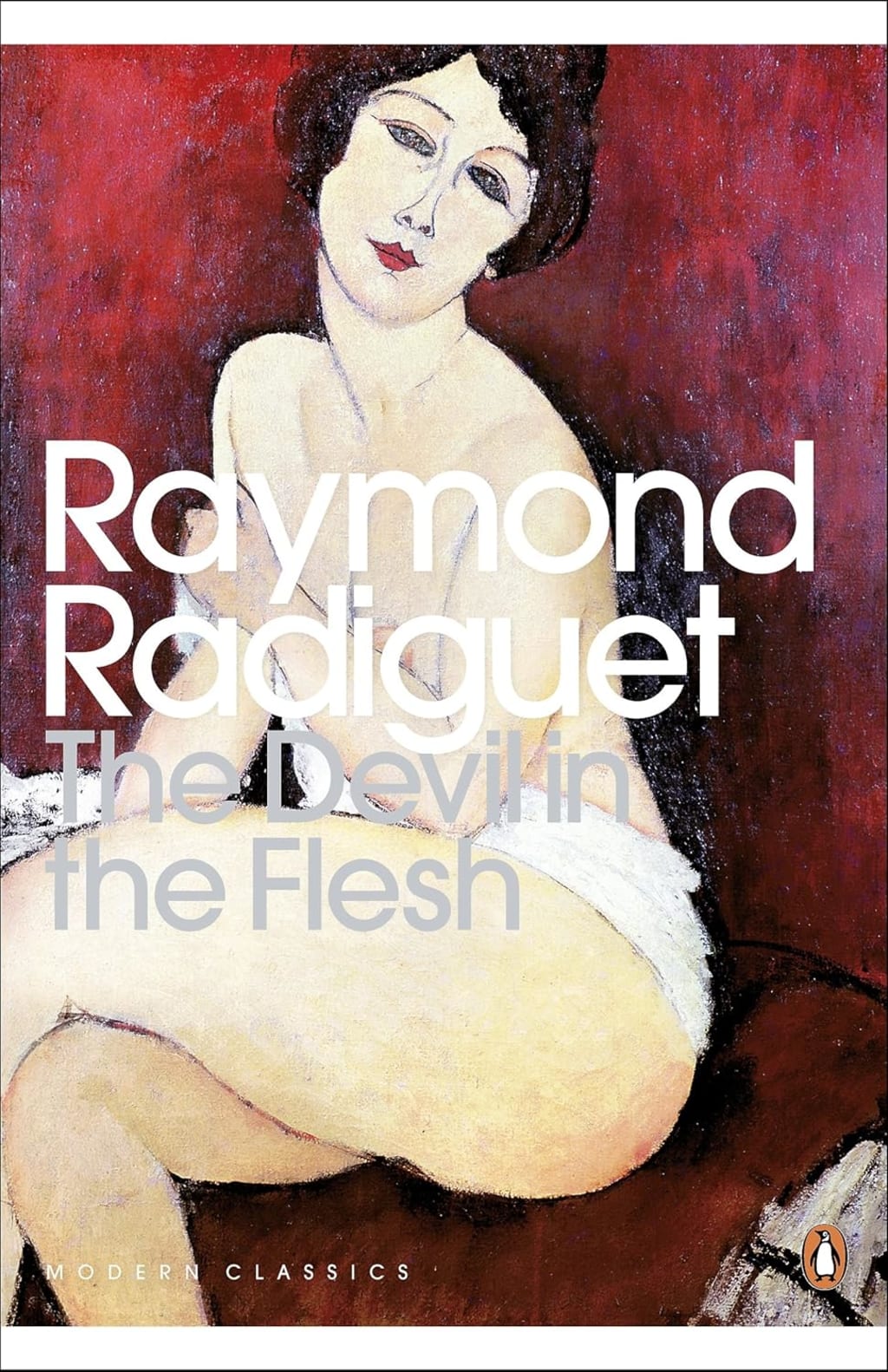
Content Warning: This book tells the tale of an adult's romantic and sexual relationship with a minor. If you are aware of any minor who is in the same danger, contact the police or your local crisis centre.
The Devil in the Flesh (Le Diable au corps), written by Raymond Radiguet, was first published in 1923 and quickly became one of the most controversial novels of its time. Radiguet, an oddball French writer, penned the novel when he was still a teenager, and it was released shortly before his death at the age of 20. His early death, combined with the novel’s scandalous content made it even more controversial than perhaps the late author wanted it to be.
The novel is partly autobiographical, drawing from Radiguet’s own experiences. It tells the story of a passionate and illicit love affair between a sixteen-year-old boy and an older married woman during World War I. At the time of its publication, its themes of adultery, youthful rebellion, and the defiance of societal norms shocked many readers. France, still scrambling from the war, found the novel’s unsentimental portrayal of love and betrayal particularly provocative. Some critics viewed it as a disrespectful critique of the suffering endured by soldiers at the front, while others praised its psychological depth and maturity.
Radiguet was deeply influenced by 19th-century French literature, particularly Stendhal and Flaubert, as well as the emerging modernist movement. His mentor, Jean Cocteau, played a crucial role in shaping Radiguet’s literary career and promoting his work.
Despite backlash, The Devil in the Flesh is now regarded as a linguistic masterpiece of the psychological slow-burn, noted for its prose and exploration of youthful passion. It remains a powerful, controversial, and divisive work of French literature.
Plot
The novel is narrated by an unnamed 16-year-old boy, who recounts his affair with Marthe, a young woman married to a soldier fighting in World War I. The narrator, precocious and self-assured, meets Marthe in a small French town, and despite the age difference, the two develop a strong attraction.
At first, their meetings are innocent, but the relationship quickly becomes physical and obsessive. While Marthe hesitates, torn between her duty as a wife and her passion for the narrator, the boy remains reckless and insistent, revelling in the power he holds over her. Their affair takes place against the backdrop of war, yet the narrator remains completely detached from its realities, focusing solely on his personal desires.
As their relationship deepens, Marthe becomes pregnant, further complicating their situation. Though the narrator claims to love her, his self-absorption and immaturity become more apparent. He enjoys the secrecy and thrill of the affair but fails to fully grasp the consequences. Unlike Marthe, who is torn by guilt and societal pressure, the narrator remains emotionally distant, treating the affair as an exciting personal conquest.
As the war comes to an end, Marthe’s husband, Jacques, is set to return, and she becomes increasingly desperate. The pregnancy, which was once a symbol of their love, now threatens to destroy her life. The novel takes a tragic turn when Marthe dies in childbirth, leaving the narrator with a deep but ultimately shallow sense of loss. His final reflections reveal that, while he experienced passion, he never truly understood love.
Through this devastating conclusion, The Devil in the Flesh exposes the recklessness of youthful desire, the cruelty of emotional detachment, and the inevitable consequences of forbidden passion.
Into the Book

Recklessness and Selfishness in Youth:
The narrator embodies the recklessness and selfishness of youth. He sees love as an experiment, viewing his relationship with Marthe as a source of excitement rather than a genuine emotional connection. His arrogance is evident when he declares: “I was never jealous, because I never feared losing what I had taken.”
This reveals his sense of entitlement—he believes Marthe belongs to him, not out of love, but because he enjoys wielding power over her emotions. His emotional detachment is most evident after Marthe’s death, when he acknowledges her passing with more intellectual curiosity than grief. Radiguet presents youth not as innocent, but as dangerously self-absorbed, exposing the cruelty of a narrator incapable of true remorse.
“ We derive our greatest pleasures not from novelty but from familiarity."
- The Devil in the Flesh by Raymond Radiguet
Love and Dominance:
Rather than portraying love as a noble, selfless emotion, Radiguet presents it as a struggle for dominance. The narrator enjoys the affair because it allows him to control Marthe’s happiness and despair. He admits: “Marthe was in love with the idea of love, and I was in love with my own power over her.”
This dynamic highlights the one-sided nature of their passion. Unlike Marthe, who is emotionally invested, the narrator is obsessed with his own experience of love, making their relationship inherently imbalanced. Radiguet critiques romantic idealism, suggesting that love is often driven by selfish desires rather than genuine devotion.
“The source of sorrows lies not in leaving life, but in leaving that which gives it meaning.”
- The Devil in the Flesh by Raymond Radiguet
Individual Crisis/National Crisis:
Despite being set during World War I, the war remains a distant, almost irrelevant backdrop. The narrator is indifferent to the national crisis, seeing the war only as a convenience that removes Marthe’s husband from the picture. He states: “War was a strange thing—important to others, but merely a setting for my private world.”
This reflects the author's subversive approach, in which personal desires overshadow national struggles. The war serves only to intensify the scandal of Marthe’s betrayal, yet the narrator remains utterly detached from its consequences. By stripping war of its heroic or patriotic meaning, Radiguet reinforces his novel’s theme: love and desire exist in a selfish, enclosed universe, untouched by greater moral concerns.
“Happiness thinks only of itself.”
- The Devil in the Flesh by Raymond Radiguet
Why It's a Masterpiece
The Devil in the Flesh is considered a masterpiece because of its psychological complexity, extreme but beautiful prose, and raw portrayal of love. Radiguet’s ability to depict a morally ambiguous protagonist (one who is both fascinating and deeply unsettling) was revolutionary.
Unlike conventional love stories, this novel strips romance of idealism, exposing its darker, selfish undercurrents. It is a brilliant psychological evaluation of the emotion of love however, it instills worry in us today because of the use of minors to tell this story.
The novel’s controversial themes, particularly war-time adultery, shocked post-war France. However, the author's skill was undeniable. His writing, though minimalist and lacking in atmosphere, carried vast emotional weight, making every scene feel both intimate and unsettling. It is almost like reading a psychological thriller at times as you're lost in the mind of the main character.
Ultimately, The Devil in the Flesh is a masterpiece because it challenges readers to confront the uncomfortable realities of love, power, and morality. Not all of it is nice and picturesque...
Conclusion

I have enjoyed this novel in the past because of the intensity of the psychology it portrays. It doesn't deal with things at the surface, but instead it climbs down into the reckless, selfish and often brooding, unhinged and chaotic mind of the youthful man in love - though he doesn't quite understand what that means. It is perhaps the most telling when it comes to the horrific terrors of youthful desire - things that are both familiar and unfamiliar at the same time.
Next Week: Bastard Out of Carolina by Dorothy Allison
About the Creator
Annie Kapur
I am:
🙋🏽♀️ Annie
📚 Avid Reader
📝 Reviewer and Commentator
🎓 Post-Grad Millennial (M.A)
***
I have:
📖 280K+ reads on Vocal
🫶🏼 Love for reading & research
🦋/X @AnnieWithBooks
***
🏡 UK
Keep reading
More stories from Annie Kapur and writers in Geeks and other communities.
Book Review: "Paris Stories" ed. by Shaun Whiteside
I was cleaning out parts of my room recently and I came across a stack of dusty books beneath my bed. They've probably been there for around 3-4 years and so, I decided to pick some of them out. I recall reading these books but honestly, there is no reason why I can't revisit them, especially when they are part of the Everyman series. I was quite surprised the first time I read it because the book definitely took all of the things you think about when you hear 'Paris' and initially it goes 'no, not really'. But I've got used to it and I've been able to analyse the way in which the extract which depicts a massacre fits into the whole history of Paris. Let's take a look...
By Annie Kapur3 months ago in Geeks
Jay Kelly - A Netflix Movie Review
Are you running to something or from something? Jay Kelly is a 2025 film about a famous movie actor who is beginning to have doubts about his career. While on the train to his next job, Jay reflects on his life, confronting his past and present.
By Marielle Sabbag3 days ago in Geeks




Comments
There are no comments for this story
Be the first to respond and start the conversation.