
The Complete Biography of Cassandra Harris (Part 1)
The 1st installment of the most complete biography of the actress and model Cassandra Harris (the original "Mrs. Pierce Brosnan") online.

Introduction
Those who remember her at all tend to fall into two categories: die-hard Pierce Brosnan fans (especially those old enough to remember the Remington Steele era), and James Bond enthusiasts. Those in the former group will know her as the late wife of the now-Hollywood heavyweight, while those in the latter category will remember her as the fake countess opposite Roger Moore.
In spite of her ravishing beauty as well as a life story that is every bit as intriguing as that of a character from a Hollywood script, her presence has largely been for their eyes only.
From the seaside village of Avalon Beach, Australia amid the cessation of the second world war to the "woman behind the curtain" of her husband's career in Hollywood, Cassandra Harris was a multi-faceted character of her own making. While she would never make it big time as an actress herself, Pierce Brosnan might not be the Pierce Brosnan we all know had she not come along.
This is the first installment of the biography of Cassandra Harris.
The Early Years
In the most immortalizing image most have of her today, Cassandra Harris is clad in a long blue gown and diamond jewelry, traipsing through a casino as the Austrian mistress Countess Lisl. Just moments later, however, our protagonist (Bond... James Bond) learns of her double life; she's actually from Liverpool, and lives in a modest beach house on the shores of Corfu.
This was not the first time nobility of questionable repute, against real life on a picturesque seaboard, would find its way into Cassandra's background. Friends from her childhood would recall her often claiming that she had an aristocratic mother, and Cassandra herself was even once quoted as saying that her "noble origins did not mean much in Australia because it's such an egalitarian society."
It turns out, though, that while she may have had a penchant for storytelling and stretching the truth on occasion, there is, indeed, a German baron in Cassandra's lineage - several, actually - by the name of von Stieglitz, even if a bit further up the family tree than she may have let on (they would have been her 4th and 5th great-grandfathers, respectively).
While the old family lure caught her fancy, it had no bearing on her upbringing. The family she would know firsthand began with a builder named Walter Waites, who was serving in the Australian Army. He was known to friends as Wally, and originally hailed from Melbourne, Victoria. In 1940, he married Roma Alfreda (nee Atkinson), a native of Narrandera, in the Riverina region of New South Wales, who worked as a hairdresser.
The couple had two daughters, welcoming the first of whom the month the Japanese bombed Pearl Harbor, on December 15, 1941. They named her Sandra Colleen. Her younger sister was called Diane.
Young Sandra (as she was called then) would spend her early years in Sydney, in the suburbs of Glebe and Blackheath, before moving with her family to the nearby seaside town of Avalon, on the Northern Beaches peninsula. Avalon takes its name from Arthurian Legend, after the paradisal final resting place of King Arthur, and by all accounts - as well as a quick glance at the photos - the land was aptly named. Its crystalline shores against mammoth triassic cliff formations are the heart of its ambiance.


It was a "true blue" (that is, authentically Australian) childhood within these confines. Some of Sandra's fondest memories would be made over Christmas holidays which, Down Under, fell in the middle of summer.
"I remember the heat, the countryside, and the pure white beaches," she would later recount. "And I also recollect - and it seems ludicrous now - at noon we all trooped inside to stuff ourselves with the traditional Christmas lunch." Preceding this big feast, children would spend the morning outdoors in search of the elusive and rare "Black Prince" cicada - a kind of cricket, which flourished in the area. "It was a real triumph if you found a black prince," she said.
One particular holiday, when she was about ten years old, Sandra and her family stumbled upon more than just a black prince. "On Christmas Eve," she said, "some kangaroos came into our garden and knocked down all the vegetables. In the morning when my father inspected the damage, he found one tiny baby kangaroo, about two feet long, that had been left by its mother for some reason. He brought it indoors and told me that Santa had sent it to me as a present."
Sandra proceeded to wear an enormous apron with a giant pocket in front all through Christmas. The "baby 'roo," as she called it, kept jumping into her apron pocket as if she were its mother. "Those are the kind of memories which make Christmases past so precious," she reminisced.
It wasn't all idyllic and carefree, however. Usually, when discussing her childhood, Cassandra would describe it as troubling and uncertain - once even said it was "painful to some extent." This would primarily be a reference her parents' divorce around 1950. It left her mother with a modest income while Sandra, longing for attention, began to develop an enchantment with movies and theatre. She recalled how on one occasion, she innocently approached the box office attendant at a local cinema and asked him, "What do I have to do to be a film actress?"
Sandra's first acting appearance on any stage, according to her For Your Eyes Only biography, was to portray a weasel in a children's play at a local Sydney theatre. It was around this time when Sandra - supposedly - began her formal training at Sydney's prestigious Independent Theatre, which she would pass on her way to school.
"All my life, I'd wanted to act but somehow I'd never discussed it with my mother," Sandra told the Australian Women's Weekly in 1971. "And I didn't know stage schools for children even existed. They told me at the theatre that parents paid fees for their children's classes, and I knew my mother couldn't afford the fees, so I decided to try for a scholarship."
In a crafty stratagem, Sandra phoned the theatre posing as her mother and claiming to have a talented daughter. She was granted an audition, for which she performed a speech of Oberon's from Shakespeare's Midsummer Night's Dream, and was accepted for classes with Independent's founder and director Doris Fitton "everyday after school."
This was all news to Independent Theatre historian Benita Harvey Brebach, however, though not necessarily total fabrication. While Sandra's name appears nowhere in the Independent's records, these saved files mainly chronicle the theatre's headliner shows. Said Brebach, "She may have studied acting there and appeared in student and children's productions, but no major productions."
Surely, any small girl who recites Shakespeare with poise and convincingly impersonates her mother over the phone would impress as a fine young actress. Then again, Sandra's worst habit, according to her closest friends, was her propensity for storytelling, usually fueled by personal fantasies.
Whatever the validity of Sandra's stint at the Independent Theatre, the major productions she had envisioned would be a long way off. Her family reality, however, saw some improvement when her mother remarried in 1952, to a Sydney native named Ronald David Gleeson, who was a machinist by trade. Both Sandra and her sister Diane assumed their stepfather's surname, and the new marriage would also bring them a new sister, Christine.
As a teen, Sandra attended Narrabeen Girls High School (now Narrabeen Sports High School) from 1955 to 1957. In her second year, she received the honors of "History Prize," and "Most Improved Girl," but left at the end of her third year upon passing the Intermediate Certificate Examination, an exit exam enabling students to leave high school before completing graduation.
Summers were usually spent with her family at a popular holiday resort called Palm Beach, also part of Sydney's Northern Beaches region. It was there where Sandra would meet her best friend in her teenage years, Denice Reynolds.
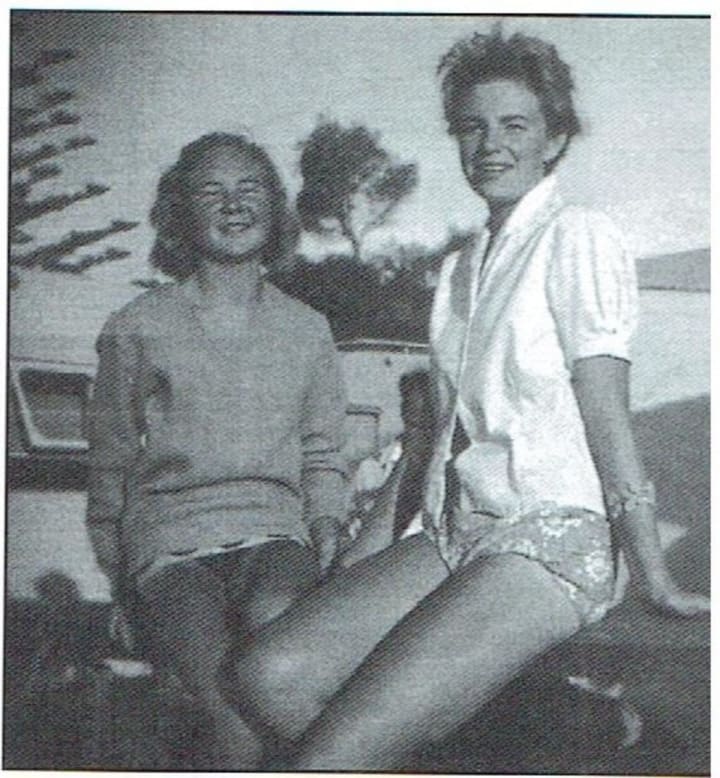
"We spent most of our time in the sea or on the beach," Reynolds (now McDougall) would later recall. She would go onto describe Sandra exuberantly and as a person who, unlike most adolescents, already knew what she wanted to do with her life. "She was popular, full of life, loyal to her friends, and adventurous. Nothing got her down. She got on well with her mother and stepfather, and if there was a party, it would usually be at her house because her parents were very relaxed about that sort of thing."
Sandra had confided in Denice about her career goals, which centered around her childhood dreams of acting and modeling. "She certainly had the face and figure for it," Denice said. "She was tall and slender with long legs and a beautiful facial structure."
Professional Beginnings and a First Romance
Sandra had been working for a real estate agent after leaving high school, and decided to finally make a serious attempt at fulfilling her childhood dreams.
In 1960, Sandra enrolled in Sydney's National Institute of Dramatic Art (NIDA). The now-world class training institution was the first of its kind in Australia, and with teaching having begun in 1959, Sandra was among its first class of trainees.
Her first year at NIDA was marked by playing minor roles in several student productions, however, in July of 1962, she managed to score the lead in a production of Thornton Wilder's Skin of Our Teeth. The show would be directed by Norman Philbrick, a visiting American professor from Stanford University. A review of the play in the Tharunka Kensington stated the following: "Sandra Gleeson had the biggest part, and her only problem was to sustain the 'exuberance' - she almost did." Sustaining exuberance at this time would have been no easy feat; Sandra would lose her mother to ovarian cancer just a few weeks after giving this performance.
While at NIDA, Sandra met Bill Firth, an aspiring architect who was taking a building course at the affiliated University of New South Wales. Firth would go onto become a well-known Sydney architect and businessman, but not without first falling head over heels for the striking thespian from Avalon. According to him, the two met through a friend. "She wanted to borrow some tights, so I lent her a pair of my sister's and then asked her out," he said.

Meanwhile, Sandra remained at NIDA for two more plays, one of which starred her as Abigail Williams in a closed-circuit production of Arthur Miller's The Crucible. She then dropped out before the end of the course. After exiting the NIDA, Sandra made her television debut, in 1963, in a Sydney production of the British play, The Long Sunset. Following, she and Bill Firth would marry in 1964, on the heels of her first paid acting gig as the sexy German airline stewardess in an adaptation of the French comedy, Boeing, Boeing. The show premiered in Sydney's Palace Theatre.
Boeing, Boeing's featured role was played by British luminary Peter Jones, famous for starring in the BBC sitcom, The Rag Trade. He would later remember Sandra as "a delightful girl."
For Sandra's new husband, however, living with her could be just as maddening as it was delightful. "I loved Sandra very dearly at first," he later recollected, "but she wasn't averse to stretching the truth and this landed her in all sorts of trouble. I found it difficult to cope with because you never quite knew what was for real."
Best friend Denice Reynolds recalled similar interactions. "The further Sandra went in life, the greater her imagination grew," she said. "In every interview I read, she had knocked at least eight or nine years off her age. I learned to take a lot of what she said with a pinch of salt."
Following a successful run in Sydney, Boeing, Boeing subsequently toured the country, visiting Melbourne, Brisbane, Adelaide, and Perth. Though the long-awaited beginnings of a dream come true for Sandra, her new itinerate lifestyle proved an additional nail in the coffin for her marriage. "It wasn't much fun being on my own in Sydney with Sandra hundreds of miles away," Bill Firth said. The couple divorced, but remained friends.
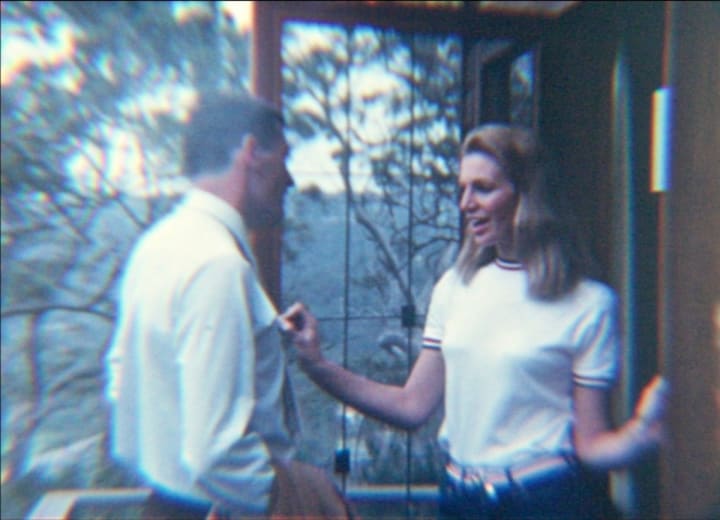
Despite the woes of her personal life, Sandra's professional life seemed to be on the rise. She landed a part in the popular Australian talk show, Beauty and the Beast, in which "Beast" Stuart Wagstaff, along with an all-female panel, discussed problems presented to them by viewers. She was also cast as the female lead in a short film of Tasmanian director David Baker entitled Five Days. Her role was of the girlfriend of an American GI on leave from Vietnam.
An unruly imagination and stretching truths would soon prove far from Sandra's biggest sin when she shocked her country's then-conservative television chiefs by filming one scene running nude across the moonlit shores of Avalon Beach with her co-star. Even though it was but a five-second fragment, it was enough to get her fired from her role on the Beauty and the Beast panel.
"I received a letter saying I was sacked," Sandra would later reveal. "I couldn't believe it because the picture was really a very tender, romantic love story - and we weren't actually naked anyway, we wore body stockings."
Still, she was frequently hounded about the risqué scene, and by the late sixties, with her career at a standstill, Sandra decided to take her talents to "swinging" London.
Proceed to Parts 2 - 4
About the Creator
Liesl Grunewald
6G NOLA Native . Dancer, Diver, & Martial Artist for life . Aspiring athletics & movement polymath . Creative techie . Slightly reformed neurotic.
Keep reading
More stories from Liesl Grunewald and writers in Geeks and other communities.
12 Things You Didn't Know About Australian Actress Cassandra Harris
Anyone who knows me knows that I have written extensively on the subject of Australian actress Cassandra Harris on numerous occasions. It is therefore pretty well-established that Cassandra Harris is one of my favorite people in showbusiness.
By Liesl Grunewaldabout a year ago in Geeks
Robert Carradine and his Brothers have a lasting Hollywood legacy
Robert Carradine was a beloved entertainer The death of Robert Carradine at 71 has shocked the entertainment industry and his fans. His brother, Keith Carradine, revealed that the actor dealt with bipolar disorder and died by suicide on February 23.
By Cheryl E Preston4 days ago in Geeks
I was in a Toxic Relationship, with my Workplace
“You got that?” My ex yelled. His hands were balled into fists at his side. At six foot three, he towered over me. A normal person would have been afraid, but I looked up a video of George Lopez repeatedly saying, “I got this,” and showed it to him. I had grown used to this treatment, so much so that I didn’t blink when he ripped the phone from my hand and threw it across the room.
By Jade M.a day ago in Confessions


Comments
There are no comments for this story
Be the first to respond and start the conversation.