
The Brothers Karamazov by Fyodor Dostoevsky
Why It's a Masterpiece (Week 101)


Background and Context:
As you all know by now, one of my top five favourite books of all time is 'The Brothers Karamazov' and I urge anyone who has not yet read this book to read it. I do not care if it takes you a whole lifetime - I really do urge you to read it.
I first read this book in my teens and I am embarrassed to say that it took me a little over a month to read the whole thing because I had a notebook at hand and I needed to look up and connections between characters. But I have to tell you that when I finished it, I was astounded. This is one of the most important books ever written, especially concerning our own times. I have read it a few times over since and written about it in various articles previously.
These include:
- 10 Great Scenes from 'The Brothers Karamazov'
- A Reading Experience of 'The Brothers Karamazov'
And others...
So, without further introduction - let's take a look at why this book is considered a masterpiece.
The Brothers Karamazov by Fyodor Dostoevsky
Published in 1880, The Brothers Karamazov was Fyodor Dostoevsky’s final novel and is widely considered his magnum opus. It was written over the course of two years and originally serialised in The Russian Messenger before being published in full. The novel synthesises many of Dostoevsky’s recurring themes: faith, free will, morality, guilt, and the nature of evil, into a complex and profound narrative.
In 1880, The Brothers Karamazov was published as Dostoevsky's final novel - widely considered today as being his magnum opus. It was serialised by The Russian Messenger before being published in full two years' or so later. It was penned during a turbulent period of Russian history and of course, many of the themes look into Dostoevsky's own wrestling with faith and nihilism. Being exiled to Siberia, almost dying out there, losing his wife and child and his gambling addiction add fuel to the fire of several of the main themes and ideas of the novel. His philosophical outlook is definitely critiqued in conversations between characters - the three sons representing in my opinion, three different sides of the author's own personality.
Plot
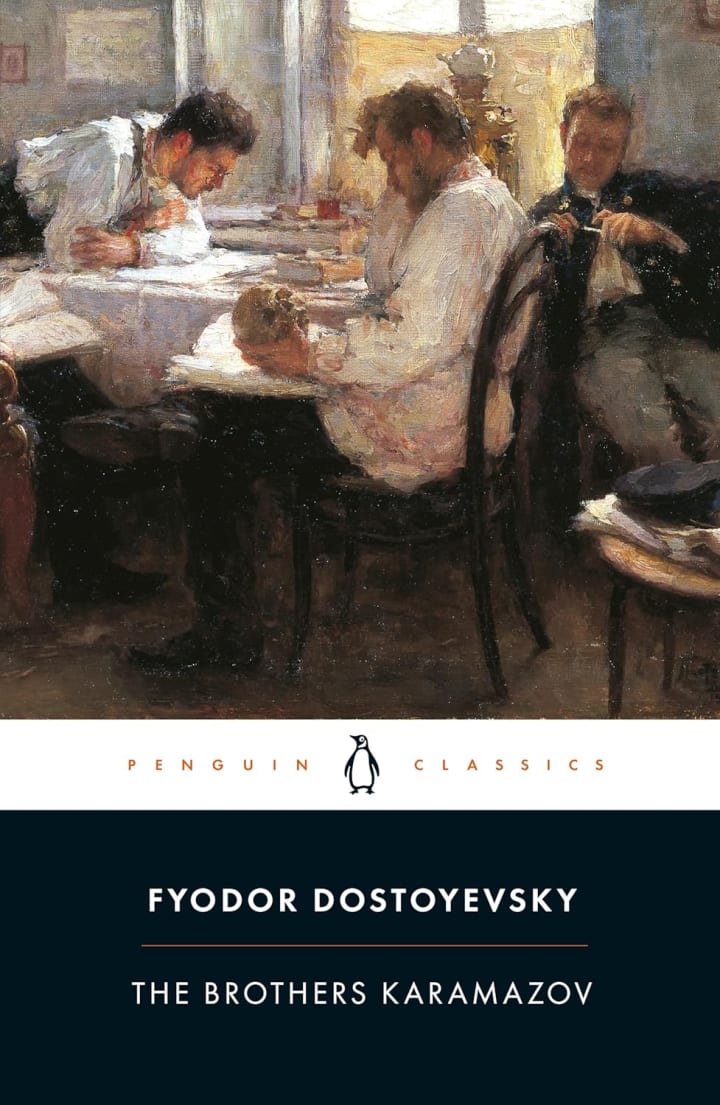
The novel is set in 19th-century Russia and follows the lives of the three Karamazov brothers: Dmitri (Mitya), Ivan, and Alexei (Alyosha), along with their cruel and debauched father, Fyodor Pavlovich Karamazov. The story explores the brothers' conflicting worldviews, their relationships with their father, and a murder that shakes their world.
The novel opens with a detailed account of Fyodor Pavlovich Karamazov, a lecherous and greedy landowner who neglects his sons. His first two wives die under tragic circumstances, and his children are largely raised by servants and family friends. Dmitri, the eldest son, is born to Fyodor’s first wife, while Ivan and Alyosha are the children of his second. The three brothers reunite in their hometown as Dmitri disputes his inheritance with Fyodor.
Dmitri is impulsive and passionate, driven by emotion rather than reason. He is engaged to Katerina Ivanovna, a proud and intelligent woman, yet he becomes obsessed with Grushenka, a seductive and manipulative woman who is also pursued by his father. Meanwhile, Ivan is a rationalist and atheist, tormented by existential questions about God and morality. Alyosha, the youngest, is a novice monk and deeply spiritual, embodying Christian faith and compassion - the beating heart of the novel.
A key early scene takes place at the local monastery, where the Karamazov family meets the revered Elder Zosima. The elder serves as a spiritual guide for Alyosha, advocating love and forgiveness. During the meeting, tensions explode in which Dmitri and Fyodor openly argue, and Dmitri physically attacks his father. This foreshadows all the violence that is set to happen and creates the stage for the later tragedy.
Dmitri, desperate for money, demands his inheritance from Fyodor, believing it rightfully his. However, Fyodor refuses, partly to assert control and partly because he too, desires Grushenka. The rivalry between father and son grows with Dmitri growing increasingly erratic. At the same time, Ivan and Alyosha engage in philosophical discussions about faith and morality.
One of the novel’s most famous sections is Ivan’s philosophical tale, The Grand Inquisitor. In this parable, Ivan imagines an encounter between Jesus Christ and the leader of the Spanish Inquisition, who argues that humanity prefers security and control over true spiritual freedom. This scene encapsulates Ivan’s belief that God, if He exists, has abandoned the world, allowing suffering to reign unchecked.
Ivan’s ideas deeply unsettle Alyosha, who struggles to reconcile his faith with the horrors of human suffering. Meanwhile, Dmitri spirals further into desperation, stealing money from Katerina Ivanovna and behaving erratically.
One night, Fyodor Pavlovich is brutally murdered in his home. Suspicion immediately falls on Dmitri, who had been seen acting violently toward his father and had publicly declared his hatred for him. Circumstantial evidence, including a missing sum of money, further implicates him.
However, the true murderer is revealed to be Smerdyakov, Fyodor’s illegitimate son and a resentful, cynical servant. Smerdyakov, inspired by Ivan’s nihilistic beliefs, believes he is justified in killing Fyodor. However, instead of confessing, he manipulates Ivan, subtly implying that Ivan himself is morally complicit in the crime.
Dmitri is arrested and put on trial. Despite his protests of innocence, he is convicted due to overwhelming evidence, including a secret conversation in which he seemed to admit guilt. Ivan, tormented by guilt and his role in shaping Smerdyakov’s worldview, descends into madness. He visits Smerdyakov, who finally confesses, but before Ivan can present this revelation in court, Smerdyakov commits suicide.
The trial becomes a spectacle, with competing narratives about Dmitri’s character and the nature of justice itself. Despite Ivan’s attempt to exonerate Dmitri, the court finds him guilty, sentencing him to hard labor in Siberia.
Alyosha, devastated by his brother’s fate, remains steadfast in his belief in love and redemption. He becomes a mentor to a group of young boys, particularly a dying child named Ilyusha, whose faith in goodness and dignity deeply affects Alyosha. The novel closes with Alyosha delivering a speech on the importance of kindness, memory, and hope.
Though the story ends on a tragic note, Alyosha’s role as a moral compass provides a sense of hope, suggesting that goodness and faith endure even in a world of suffering.
Into the Book
Faith vs. Intellect:
One of the central philosophical conflicts in The Brothers Karamazov is the tension between religious faith and intellectual skepticism. Alyosha represents faith, while Ivan represents doubt and rationalism. The novel does not offer a simple resolution but rather presents both perspectives in their full complexity, leaving readers to wrestle with the question of whether faith is a necessary foundation for morality.
The most famous articulation of this debate occurs in The Grand Inquisitor. In this story, Christ returns to Earth during the Spanish Inquisition, but instead of being welcomed, he is arrested. The Grand Inquisitor argues that humanity does not truly want freedom or faith but rather security and control.
Here, Ivan’s Grand Inquisitor suggests that the Church has replaced Christ’s message of free will with a system designed to comfort people rather than challenge them. Ivan uses this argument to demonstrate that God’s existence (or lack thereof) makes no difference because human beings prefer authority over true spiritual struggle.
Alyosha, however, does not respond with intellectual argument but rather with an act of love: he kisses Ivan, mirroring Christ’s silent response to the Inquisitor in the story. This moment shows Dostoevsky’s ultimate belief that faith cannot be intellectually proven or argued; it must be lived through love, compassion, and humility.
The novel suggests that while doubt is intellectually powerful, it can lead to despair. Ivan, unable to reconcile his rational mind with moral responsibility, ultimately descends into madness, whereas Alyosha, through his faith, becomes a figure of hope and redemption.
“We have corrected Thy work and have founded it upon miracle, mystery, and authority. And men rejoiced that they were again led like sheep, and that the terrible gift that had brought them such suffering was, at last, lifted from their hearts.”
The Brothers Karamazov by Fyodor Dostoevsky
Free Will vs Determinism:
Another core philosophical question in the novel is whether human beings have free will or whether they are bound by determinism: be it psychological, social, or intellectual. Dostoevsky argues that ideas have real consequences and that intellectual detachment from morality can lead to destruction.
There is something about the way in which Ivan uses his ideas to dismantle the very question of religious belief within any argument. However, while Ivan presents it all as a theoretical idea, Smerdyakov takes it as a justification for action. Smerdyakov, Fyodor’s illegitimate and resentful son, internalises Ivan’s philosophy and ultimately murders Fyodor, believing that if there is no God, then there are no moral consequences.
Ivan is horrified when Smerdyakov later confesses to the murder and claims that Ivan was his true inspiration:
“It was you who said it, sir, and no one else.”
This moment forces Ivan to confront the consequences of his ideas. While he did not physically commit the murder, his philosophy shaped Smerdyakov’s actions, making him complicit. Ivan's intellectual skepticism, once a source of power and superiority, now becomes his downfall. His descent into madness suggests that a purely rational approach to life (one that denies moral responsibility) leads to chaos and self-destruction.
Contrasting to this, Alyosha’s worldview is rooted in love and responsibility. He chooses to act rather than detach himself from life’s moral struggles, showing that true freedom lies not in rejecting morality but in embracing it through compassion and action.
“If God does not exist, then everything is permitted.”
- The Brothers Karamazov by Fyodor Dostoevsky
Passion and Desire:
Dostoevsky explores the theme of unbridled passion and desire through the Karamazov family, especially Dmitri and Fyodor. Both men are ruled by their appetites; whether for money, power, or women, which ultimately leads to their downfall.
Dmitri, the most impulsive of the brothers, is often described as having inherited the “Karamazov nature,” a reference to the family’s tendency toward recklessness and passion. He is torn between two women: Katerina, who represents duty and stability, and Grushenka, who represents sensual pleasure. His obsession with Grushenka mirrors his struggle with his own base desires.
This reflects the novel’s exploration of human weakness. Dmitri does not resist his passions but instead embraces them, even when they lead him to ruin. He embodies Dostoevsky’s idea that sin is not just an abstract concept but a real force that consumes those who do not resist it.
Fyodor Pavlovich, the father, serves as a grotesque warning of what happens when desire is left unchecked. He is selfish, hedonistic, and amoral, caring only for his pleasures. His mistreatment of his children and pursuit of Grushenka lead directly to his murder, demonstrating that unchecked greed and lust ultimately destroy the individual.
On the other hand, Alyosha offers a different model: one of restraint, selflessness, and love. He resists the corrupting force of the Karamazov nature, choosing a path of spiritual devotion rather than indulgence. His role in the novel suggests that redemption is possible, but only through conscious moral effort.
“I am a Karamazov… when I fall into the abyss, I go headlong. I may even be glad to go.”
- The Brothers Karamazov by Fyodor Dostoevsky
Why It's a Masterpiece

What sets The Brothers Karamazov apart as a literary masterpiece is its ability to blend philosophy, theology, psychology, and storytelling into a single, cohesive work. Dostoevsky does not merely present abstract ideas, he embeds them within deeply human struggles, making his characters vehicles for profound existential questions.
The Brothers Karamazov is beginning to make a resurgence amongst the social media users as the phrase 'mob-justice' becomes evermore problematic. There's something deeply disturbing when we start to consider these books only for what they offer in the way of realities, especially when our realities concern the deepest problems they have to depict. I am still glad for people starting to pay more attention to this book though.
Conclusion
Even more than a century after its publication, The Brothers Karamazov remains relevant. The questions it raises about morality, faith, and human nature continue to challenge and inspire readers. Dostoevsky does not provide easy answers but instead forces us to confront the complexities of existence.
Ultimately, the novel’s final message, embodied in Alyosha’s speech to the children at Ilyusha’s funeral, is one of hope:
“You must know that there is nothing higher and stronger and more wholesome and good for life in the future than some good memory, especially a memory of childhood, of home.”
Here, Dostoevsky suggests that while life is filled with suffering and moral struggle, human beings are not doomed. Love, kindness, and faith in one another provide the only true path forward.
In this way, The Brothers Karamazov is not just a novel, it is a philosophical and spiritual journey, a book that lingers in the mind long after its final pages are turned. And every time I read it, even a small part of it, again - it gives me shivers.
Other Masterpieces:
- Crime and Punishment by Fyodor Dostoevsky
- East of Eden by John Steinbeck
- The Stranger by Albert Camus
Next Week: The Ballad of Peckham Rye by Muriel Spark
About the Creator
Annie Kapur
I am:
🙋🏽♀️ Annie
📚 Avid Reader
📝 Reviewer and Commentator
🎓 Post-Grad Millennial (M.A)
***
I have:
📖 280K+ reads on Vocal
🫶🏼 Love for reading & research
🦋/X @AnnieWithBooks
***
🏡 UK
Keep reading
More stories from Annie Kapur and writers in Geeks and other communities.
Book Review: "The Lost Art of Silence" by Sarah Anderson
Silence is a lost art, I think we can all agree. In the age of over-consumption we have distractions all the time and even when we think we have silence, we don't actually have it. There are many people who are afraid of silence, people who play music all the time, or watch television in the background of doing absolutely anything at all. The true nature of silence has therefore been lost on us. We no longer sit there with our boredom and with our thoughts out of a fear of them transgressing to a place much worse. Reflection is past, revelation is fiction.
By Annie Kapurabout 2 hours ago in Geeks
Christian Harrison
In modern professional tennis, not every impactful career follows the same path. Some players rise through explosive singles success, while others build their reputation through resilience, teamwork, and mastery of doubles. Christian Harrison and Neal Skupski represent two such journeys—distinct in background and style, yet connected by a shared commitment to the sport.
By Saboor Brohi about 3 hours ago in Geeks



Comments
There are no comments for this story
Be the first to respond and start the conversation.