
The Big "I" Word
Echoes of the year's lessons
When my husband walks into a room, the TV goes on. If the TV isn't on he looks at you very suspect. He's peering at you with pure concern in his eyes, "What's wrong?". It took me a long time to get use to this. I remember one time he came in and I was lying on the couch in the dark. I still smile at his reaction. He said almost fearful, "Are you okay? What's going on? Why is the TV off? Why are you being weird?". I started laughing. I am the millennial in our relationship. Of all the weird things I could do in a day, this was not one I would have thought of as weird.
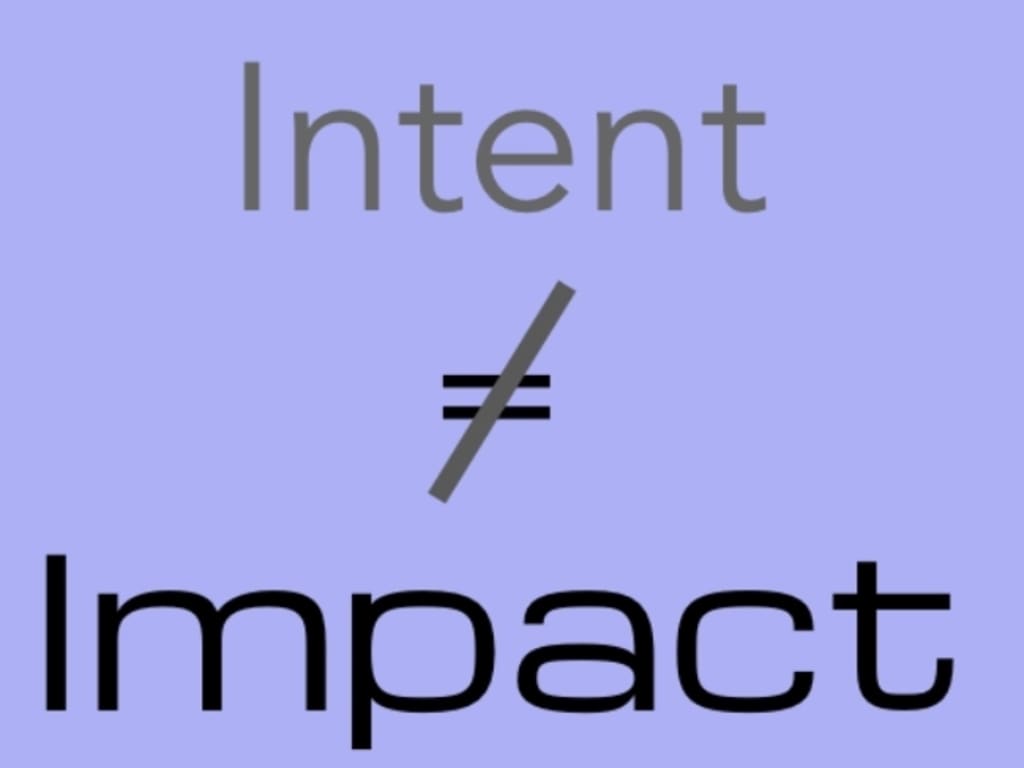
This year, when he would turn the television on it would typically be on the Big Bang Theory. Season 8 episode 11 stands out. The first time, I watch it and laugh along as I went about doing other things. The second time, I watched a little more. The third time, I decided to watch it fully. This episode, at it's heart is a comical look at the idea of intent. Intent in different social contexts.
There are three main storylines running through the episode. First, is Amy's Victorian holiday dinner celebration. Second, Sheldon deciding to get Amy a gift inorder to outgift her and make her feel bad. Lastly, Leonard, Raj and Wolowitz are working in a lab where a bird gets in and contaminates it.
Amy's authentic Victorian themed dinner is as expected by the viewer. Penny, often thinks and says what most in the audience would think. She is less than thrilled with the dinners activities. Amy at one point introduces parlor games, one of which is blowing a ball of wool off the table after it is set in the center. They are all subjected to eating fig pudding as well. Although Sheldon is suppose to come off as rude, when criticizing the pudding because he thinks it is made of raisins instead of fig, he is at least honest. Penny tells Leonard she is bored and wants him to hurry. Although, it is kind and unselfish for her to go along with the dinner party since it is different from her own interests, it's not exactly kind. Penny is still judgy and slightly inauthentic. Her intent is to not hurt her friends feelings, but ultimately would if it were known. It is a social situation we have all been in. As annoying as Sheldon can be, it should also cause a little jealousy that a person or character can be so truthful and authentic without offending his friends. He has the closest relationships because everyone knows he has good intent in general, which is why they are not mad.
However, this idea is counter to his other portrayal in the episode. That of a cruel selfish gift giver. Except, that underlining his cruel intent is a desire for Amy to better understand how he feels. In a way you can feel for him a bit. Although his desire to outgift her is funny, there is very mean intent behind his beautiful present. He hopes to catch her off guard and destroy her joy. By the end, we learn Amy has prepared for this, or possibly had the same idea, or just really is a kind person. She has given Sheldon a tin with his meemaw's cookies. She made them after getting the recipe from his Meemaw. Sheldon is moved, much like the grinch. Both Sheldon and Amy end up happy. So, very bad intent presented a very positive outcome. The audience is left wondering if the original intent matters at all. Should we still be somewhat offended? Would we? Or is that just Sheldon? What does intent matter in life? Should it be ignored if the outcome is positive?
Lastly, the boys in the lab. Although I find this scene exceptionally funny. The camera shows them in the lab pondering leaving and eliminating the possibility of getting caught and then flashes to them singing jingle bells in unison in the car, now on the way to Amy's party. Again, we are introduced to a complicated look at intent. On one hand it's completely selfish and irresponsible of them. On the other hand it is completely self protective and loving. They innocently and accidently let a bird in and are just trying to get to the party with loved ones who have been waiting for them. It's wrong, but understandable. The lab and the next person needing to use it becomes someone else's problem. Most people would agree with Penny's thinking. If you can get away with it, why not just leave? The boys, all so innocent, need Penny to even think up such an idea. It is often easier to self convince if someone else brings up an idea and blame can be shared or passed between members of a group. Even though, ultimately, each person decides for themselves.
As funny as this episode is to watch, the issues surrounding intent are not so funny in practice. I decided to look up quotes about intent and see if I could gain any other insights. These are some of the quotes I found....
"The smallest deed is better than the greatest intention."
"At the end of the day, if you feel like you're a good person, and your intentions are good, then that's all that matters."
Madison Beer
"The evil that is in the world almost always comes of ignorance, and good intentions may do as much harm as malevolence if they lack understanding."
Albert Camus
"Good intentions can often lead to unintended consequences. It is hard to imagine a law intended for the workforce known to Henry Ford can serve the needs of a workplace shaped by the innovations of Bill Gates."
Tim Walberg
"A garden requires patient labor and attention. Plants do not grow merely to satisfy ambitions or to fulfill good intentions. They thrive because someone expended effort on them."
Liberty Hyde Bailey
And most famously.....
"The road to hell is paved with good intentions"
It is interesting if you apply each of these quotes individually to the lens you watch or think about this episode with. The boys in the lab are always the one's that come out as the most wrong. Penny is showing understanding, Sheldon put in a lot of work, the boys are lazy and I suspect have the most costly consequence for their mistake.
Intent is tricky. It can be confused and hard to judge because life is not black and white. It is complicated. Further complicated because we can lie to ourselves, so we become blind to the actual consequences of our own intentions. Maybe we should hope for small deeds because that is more attainable as a way of achieving good intent. Often we presume to think we know someone's intent. Intent, implying it was decided before. However, often we will never know true intent. I would also argue sometimes actions have no intent either way. Is careless or thoughtless or indifferent an intent? Things are complicated and becoming convoluted. At this point, I decided sometimes it's best to not think too hard and over analyze. Strive for small good deeds, hope for good intentions, if you fail, ask for forgiveness and try to do better. Or, learn to laugh about poor intent and look at it differently and move on. Postponing your judgment until the ultimate judgment day. I never expected a deep dive like this from a comedy show, but it was a needed thought exercise at the time. What do you think?
Sent via the Samsung Galaxy S24, an AT&T 5G smartphone
About the Creator
Keep reading
More stories from simplicity and writers in Geeks and other communities.
The Conceptual Planet: Into Outer Space-Micah's Story
Everything looked sanitized under the iridescent light. The light was harsh and unforgiving. So unflattering, it eliminated any need to be concerned with looks. Everyone looked bad under it. The dark circles under his eyes were worn as badges of commitment. He almost felt proud they were there. He was the fittest he had ever been in his life in preparation of this trip. She would be shocked to see him this way. If he wasn't in his suit the light would have illuminated his muscles, but hidden away he was a middle aged man wearing his years on his face. His wifes disappearance had aged him. Most days he didn't give a thought to his appearance. She had allowed him to get comfortable. Now, the word was just a symbol of a feeling he could only just remember. There was no one else for him, of that he was certain. Her goals were now his own. Her work, her legacy was important.
By simplicityExclusive • about a year ago
A Knight of the Seven Kingdoms Series Review (Season 1)
As one of the biggest properties in fantasy, A Song of Ice and Fire remains immensely popular with audiences. After reaching far into the past with House of the Dragon, a second spin-off was on the cards. A Knight of the Seven Kingdoms serves up a bite-sized slice of action and drama, but it still claims a spot among the best small-screen titles.
By Robert Cain4 days ago in Geeks
Book Review: "The Great Shadow" by Susan Wise Bauer
There was no reason why I would choose this book to read apart from the fact it had an interesting subtitle and the cover looked quite telling. I like it when the cover to a book looks like it has been worked on to hide things within. I also ended up reading the blurb to the book only to realise it was not only nonfiction, but the topic was about to be expanded upon in a whole host of ways. From how survival instincts move us from cold to hot and back to cold environments all the way through to why children were dying at a similar rate as adults in some cases. We are taken through a look at how sickness, once treated as an individual thing, moved to a group thing and thus, came to change the way we buy things and spend our lives. The COVID pandemic may have taught us somewhat about that, but who knew our everyday consumerism is coated with a deep fear of getting sick?
By Annie Kapurabout 11 hours ago in Geeks


Comments
There are no comments for this story
Be the first to respond and start the conversation.