
Thank You, Gon
or: if gon freecss has no fans, i’m long gone from this precious earth

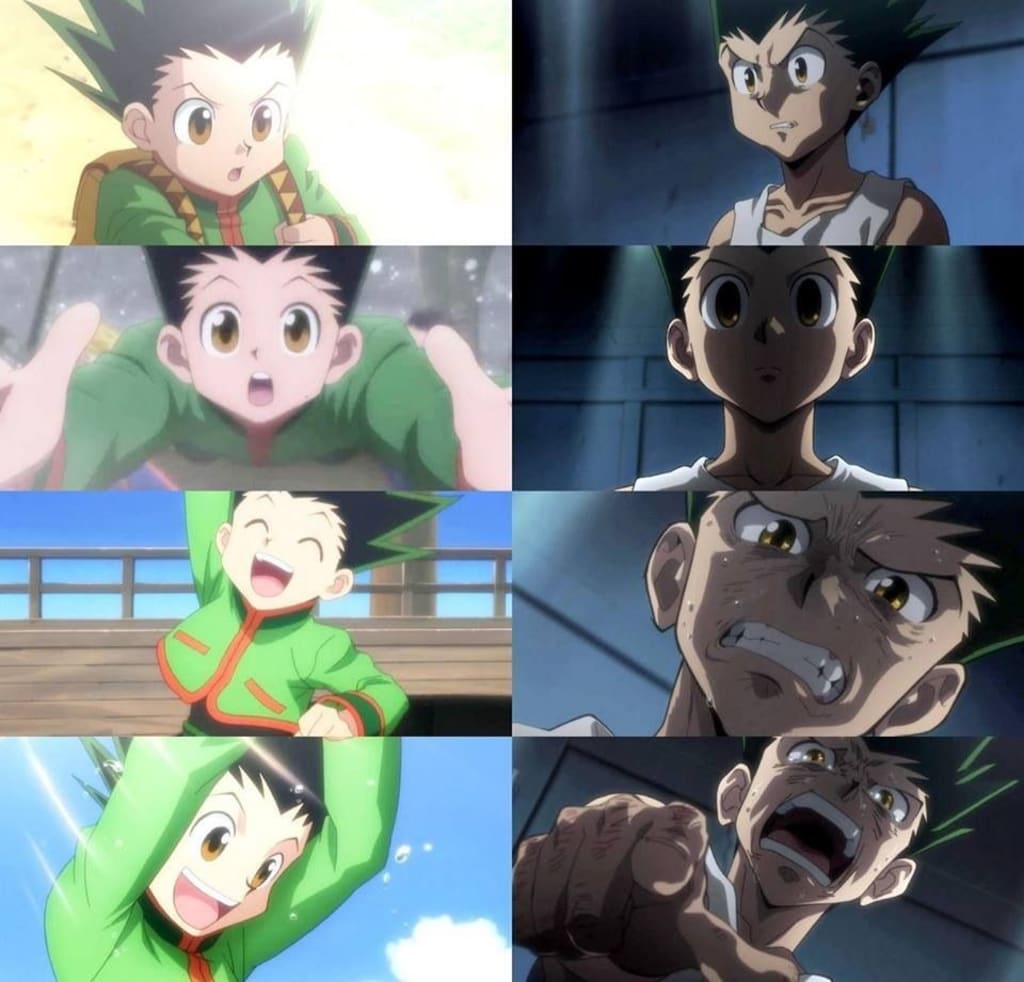
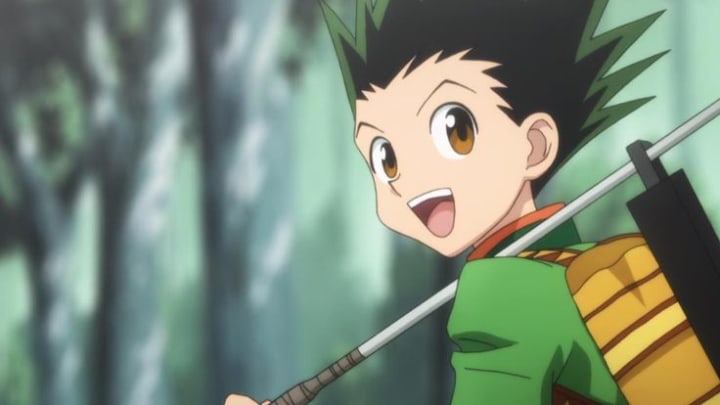
On the surface, Gon from Hunter x Hunter can be seen as a victim of typical main character syndrome.
He’s cheerful, optimistic, and happy-go-lucky. He’s determined. He’s naïve and dim-witted. His outfit color scheme is neon green, making him pop out from everybody else. He has a bunch of super anime-esque special skills that average people don’t have: he’s fast, he’s inhumanely agile, he’s super in tune with nature. He can speak with and make friends with almost any creature. Everyone in his world is able to take a single glance at him and know that, in classic shonen fashion, the very great, very important Hunter Ging Freecss is his father.
And his sense of smell is so good that he can even… sniff out a laxative someone put in his drink to attempt to put him out of commission during the Hunter exam?
Yeah, don’t ask.
But upon taking a closer look, we can see that Gon actually isn’t a typical main character at all.
This can be construed many ways. It can mean Gon isn’t a carbon copy of any one or other main character, and this is true; he is very distinctly himself, to the point where we understand as viewers why people around him find him so fascinating and special. Gon also is not, and never becomes, the strongest character in the show, not even close—and that’s pretty unique for a main character in a shonen anime like this. An interesting aspect about Hunter x Hunter is that the power climb Gon and Killua undergo is not insanely unreasonable. They learn about the magic of Nen slowly over many seasons with the help of several strong Hunters, some friend and some foe. Now, this is still a shonen anime, so obviously they are still child prodigies. But we as viewers are immediately faced with the reality that there are many, many characters stronger and endlessly more skilled than either of them.
But these qualities and details aren’t what set Gon aside from other main characters the most. What truly sets Gon aside from all the rest is this single, solitary fact:
He’s not a good person.
(And I love him for it. But that’s for later.)
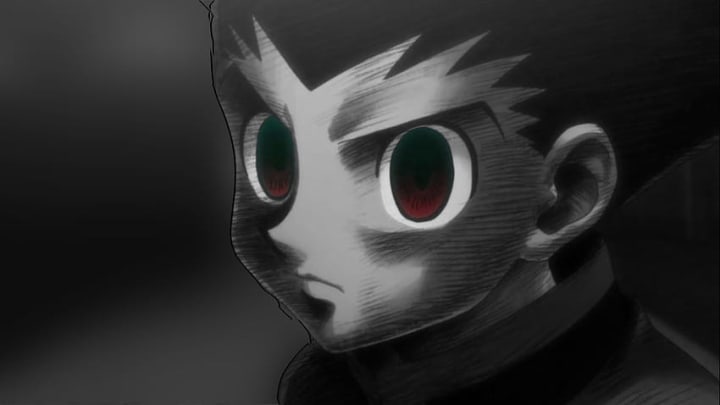
A classic shonen main character is almost always a hero. They seek to save people and protect their friends and worlds, and when tasked with difficulties, they push and persevere no matter what. They overcome for others, not just for themselves. They are almost always selfless, and they are almost always, to their core, “good”.
I am here to make the argument that Gon is not, in fact, good. This is not to say he’s a bad person; some people make that argument, but I personally don’t believe it to be true. Rather, I believe Gon Freecss falls somewhere in the morally grey spectrum, which makes for very unique characterization. It also makes his initially simple-seeming character a lot more interesting.
So let’s talk about it: what makes Gon, the cheery, smiley main character of an innocent shonen anime, immoral?
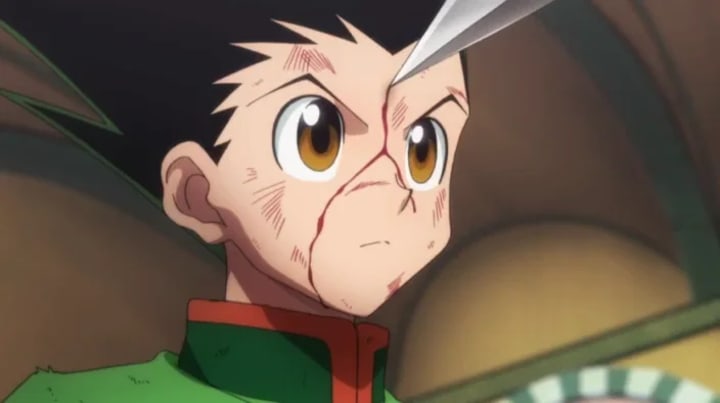
Looking through the lens of moral critique, even from the show’s very first arc, Gon is… kind of weird. He comes across various times throughout the anime as, at the very least, an emotionally unstable individual. This was something I’d never really noticed on a second rewatch of the show, or even really on a third. But it’s very evident that something, somewhere, is not quite right with this kid. He doesn’t process emotions in a way many would consider normal, in in his universe. He is hyper-emotional and quick to action based on these feelings, as if fear, doubt, and anxiety are not feelings that exist for him.
For our first example, let’s look at Gon’s main goal: he wants to find his dad.
This is, on its face, understandable. Gon was told by his friend Kite that his dad was a great Hunter, one of the world’s very best, so Gon feels proud to be connected to him. He really looks up to this man he hears about from people he respects, and Ging soon becomes representative of success, prosperity, and freedom in Gon’s mind. But it is quite abnormal, or at the very least strange, that Gon holds and expresses absolutely zero resentment or sadness over the fact that his father abandoned him as a child and set off for the sake of his own goals, even though Gon is very aware of this. Even when he finds a message from his father saying if Gon ever does track him down, “he’ll bolt” (because he’s the worst), this only spurs Gon on and drives him to become more motivated to find his dad.
In itself, this does not prove anything about Gon’s morality. It does not prove anything other than the fact that Gon is still very much a child, blind to everything except the things that he wants. But it is the first example we see of Gon’s interesting emotional approach to certain things, and his potential delusion in the way he sees the world. It is also the first we see of his determination, and how far he is willing to go to do what he feels he has to do.
Gon’s strange emotional perception also comes through as early as around the eighth episode, when he witnesses his friend Killua violently kill an opponent by ripping his heart out. Killua is a member of the Zoldyck family, the most famous assassin family in the world. Gon’s reaction to this murder, and to learning about Killua’s past where he killed for his family, is odd, because he is completely unfazed by either.
By no means should this have been normal to Gon, who grew up isolated in a small lake town. As far as we know, Gon had never before witnessed the murder of another human being.
But Killua is Gon’s friend. This means that, to Gon, Killua is a good person. Killua is on Gon’s side, and Gon likes Killua. Whereas other people are horrified or at least shocked by Killua’s actions, Gon bypasses these emotions without even meaning to simply because he already sees Killua in a good and positive light. He accepts him fully and completely, and this includes his murderous side. When Killua kills, it’s okay. It aligns with Gon’s morality just fine, and it genuinely does not bother him in the slightest.
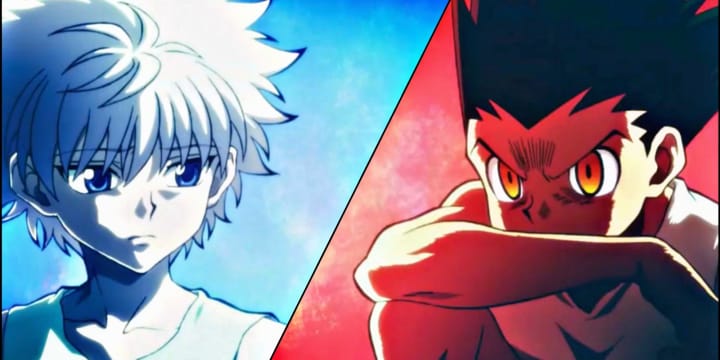
The first glimpse of Gon’s anger issues that we get, however, is somewhat even more compelling than Gon’s apathy towards murder. We can argue he has this apathy because he knows Killua doesn’t like killing; he never felt openly bad about it that we see, but he had left his family because he was bored of it, and it had left him with an emptiness. And Killua’s opponent would have killed him first; Killua had to kill him. And it’s not his fault his family ingrained so much murder knowledge into him. So Gon finally has a friend and accepts him as he is—so what? Yeah, yeah. I get it.
We see our first glimpse of Gon’s rage in this first arc as well, after Gon’s new best friend Killua is manipulated and mildly brainwashed by his cruel, controlling older brother’s powers to give up becoming a Hunter and return home to his family and start killing again.
Hopefully I’m not losing you guys—this is still an anime, after all. Crazy stuff happens; don’t worry about it.
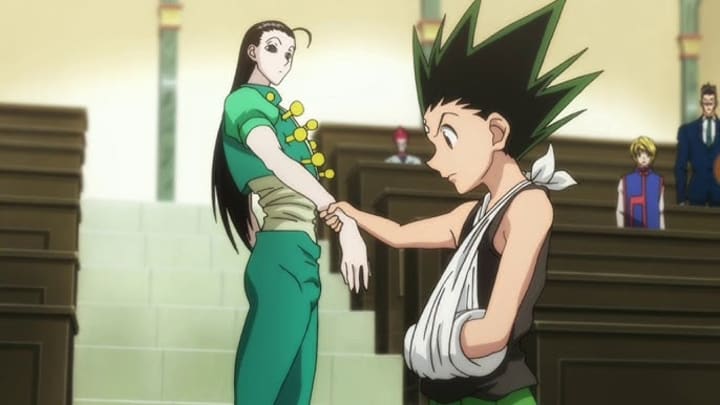
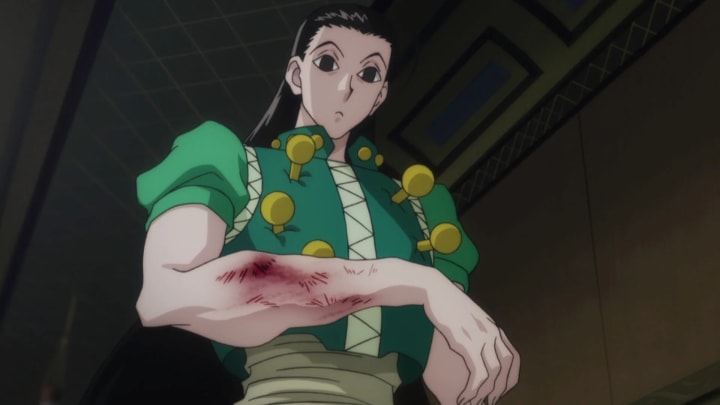
So Gon goes right up to him and… breaks his arm?
Here’s the thing.
For so much of the anime, Gon’s rage and moments of immense fury, even when followed by violence, are justified—because it’s leveled against people who are morally worse than he is. Should we really be against Gon for breaking the arm of Killua’s evil, evil, definitely evil older brother? No, of course not. In fact, most watchers of the show were certainly on Gon’s side in that moment, including myself. But let’s ask ourselves: is this normal? Is a normal response, when angry about something that has happened, to go up to the person that infuriated us and just break their arm? Arguably, no—this is not a normal thing to do. Arguably, it can even be considered a deranged thing to do. And yet, since Gon’s early inklings of immense, unhealthy anger and violent behaviors align with the right side of our perceived moralities, it never seems like a big deal. It’s fine that Gon wants to find his awful dad—he’s just an optimistic kid. It’s fine that Gon is cool with Killua being a killer—Killua’s his friend. It’s fine that Gon breaks someone’s arm—that someone was mean to his friend. But how many exceptions can we make before questioning Gon and his own morality itself? Why is he the way that he is?
It all comes down to the hypocrisy we begin to see reflected so much in Gon as the episodes come and go. The truth is that Gon only cares about immorality when he does not personally like the one carrying it out. Gon holds no anger towards his father for abandoning him because his father, in his mind, is a great person. He holds no anger towards his friend Killua for killing several people during the Hunter Exam or in his past, because he likes Killua, so Killua is also a good person in Gon’s mind. All these characters are multi-faceted, so Gon is not fully wrong in believing any of these things, especially not as a young boy.
But his hypocrisy and biases towards the people around him become increasingly evident. For instance, he comes across the criminal Chrollo, the leader of the Phantom Troupe responsible for killing the clan of Gon’s close friend Kurapika; Gon despises him immediately and only sees a bad person in front of him. He demands to know how Chrollo can kill people who have nothing to do with him, despite the fact that Killua has done the same countless times.
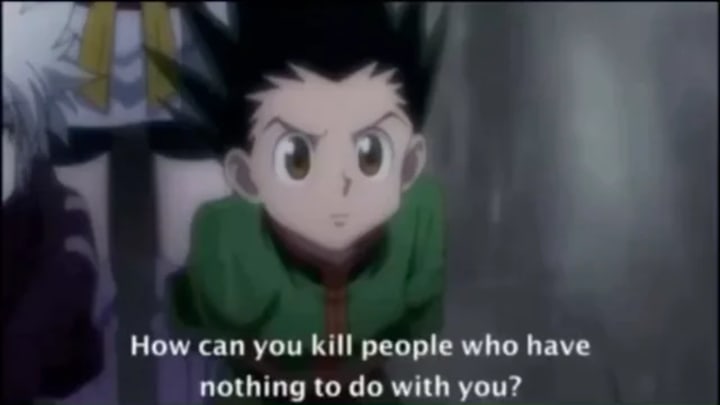
Killua’s older brother Illumi, who is also a bad person in Gon’s mind, faces the brunt of Gon’s violent anger because Gon has marked him as a bad and evil person. Gon passes judgement on others based on his personal perceptions of them and whether he likes them or not, not based on an actual sense of morality. Despite the fact that Gon has this gray sense of morality, he himself only sees people in shades of black and white, as good or evil, with no exceptions.
This becomes a problem.
In the Chimera Ants arc, a very long, very iconic arc of Hunter x Hunter with potentially its strongest and most mature plot and character writing to boot, Gon’s friend Kite is maimed by a dangerous character called Neferpitou, one of the three Royal Guards to the king of the ants; all three are immensely powerful. Upon seeing Kite, terribly injured and looking and acting jarringly strange, Gon is under the impression that this monster Pitou has captured and is controlling Kite, and his goal immediately becomes to “return Kite back to normal.” Unbeknownst to Gon, Pitou has actually killed Kite, and they are only puppeteering his corpse as a sort of punching bag for other Chimera ants to practice fighting against. It’s pretty grim and gruesome stuff.
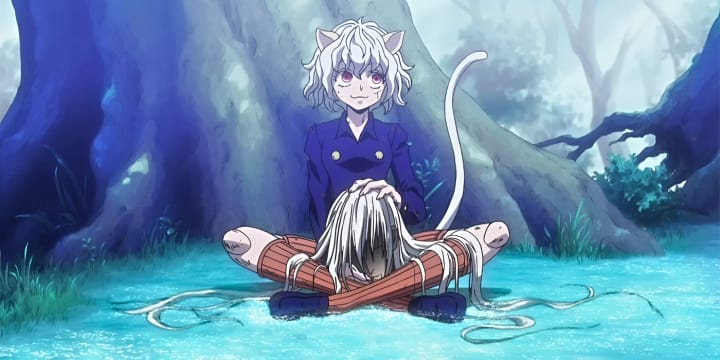
There’s this big plot point in this arc about Meruem, the king of the Ants, and how he is humanized by a young woman named Komugi. Meruem starts off from his birth as an absolute menace. He believes in the “might is right” philosophy, his arrogance leads him to mistreat and hurt his people and even kill his own mother, and he sees humans as a food source that is inferior to the race of the Ants due to their lesser physical might. The egotistical Meruem soon begins to read and educate himself to become intellectually superior to humans as well. He plays and defeats the world champions of every single board game before viciously killing them after they lose to him, but it is the last game he has learned that he is incapable of mastering. The Gungi world champion, a blind woman named Komugi, is his opponent, and he is unable to defeat her. His continuous defeats by this small, pathetic creature make him question his own worth and meaning, and as he speaks to her and gets to witness her genius, he begins to see her value. They begin as tense opponents before they end up becoming friends, tied together by the beauty of the game.
While all of this is happening, while King Meruem (who is a giant turtle-looking bug by the way—because this is an anime, don’t worry about it) is slowly yet surely changing for the better, enlightened by the talents and gifts of humanity that do not come through violence or cruelty, Gon experiences a paralleled yet vastly differing change—it is a descent into rage, into the “inhuman” and yet very human all the same.
Gon finally tracks down Neferpitou and demands that they come and fix his friend Kite. But Neferpitou, upon the time Gon intrudes, has been tasked by the King with healing Komugi, who was hurt in an attack meant for Meruem. Pitou tells Gon as much—that they were given an order by the King to heal this girl—and Gon responds by saying the next time Neferpitou speaks before spoken to, he’ll kill the girl himself.
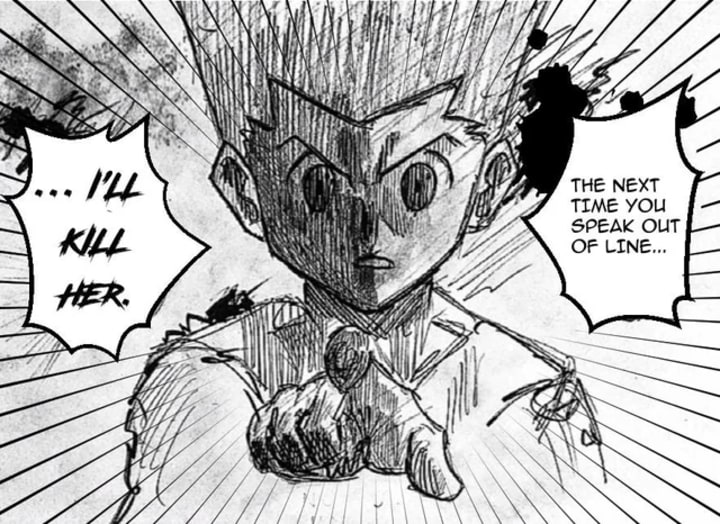
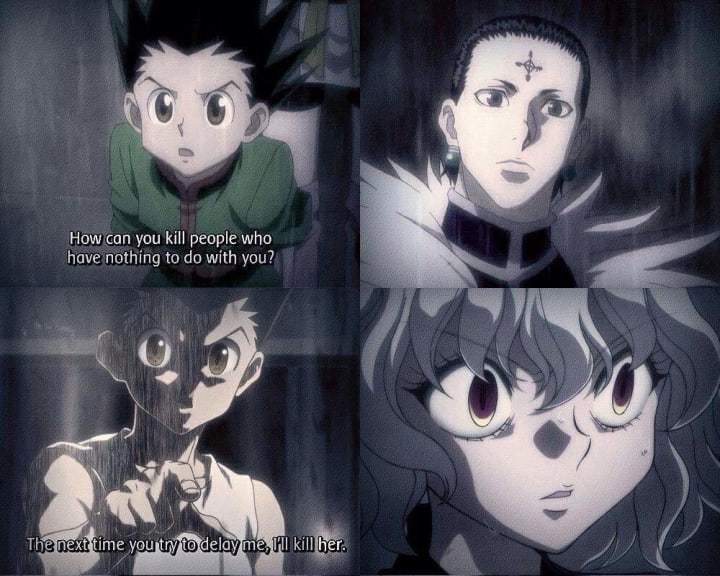
I cannot put into words how shocking this scene was. I also cannot put into words how tense and phenomenally written the episode where Gon waits for Pitou to finish healing Komugi is. He’s just sitting there, menace pouring off of him, as two powerful Royal Guards stand there at his mercy, fearing the intensity of his will. This little boy, this sweet, cheerful kid, has now become the ultimate threat. Neferpitou is now the one trying to save an innocent life, while Gon threatens them and tells them to make it quick or he will kill the girl. It is immensely awesome and powerful and painful and intense, and it’s a crazy shift in his character arc. He even ends up yelling at Killua, accusing him of not caring about Kite at all, who escapes from the situation to fight another Royal Guard dude and clear his head.
Up to this point, Gon has never killed anyone before. He’s had his moments of violent retaliation, and he’s also always been ready to jump to violent conclusions if the time calls for it—in a not-so-great show of friendship but a rather intense show of trust, he basically knowingly allowed Killua to decimate his own hands by holding a ball for Gon to magically blast in their to-the-death match of dodgeball with a murderer and his team in a video game that actually takes place somewhere in the real world (anime—don’t ask), and in a test of strength, when asked by his older teammate Morel to envision that it was he himself who had hurt Kite, Gon became so disillusioned and deluded in his own rage that he nearly killed Morel by accident; only Killua could stop him.
But this is the first time a real death threat has been given to another character by Gon. And even more strikingly, the character he does threaten to kill is a completely innocent, injured, and unconscious young woman who hasn’t done anything wrong. And he means it. Gon is so driven to save his friend that he would absolutely murder an innocent bystander to get it done.
And Gon does become a killer. When Neferpitou finishes healing Komugi and leads Gon to Kite, they tell Gon that Kite has been dead the entire time. So Gon uses all his will and potential as a Hunter to turn into a stronger, older version of himself and absolutely molecularize Neferpitou. (Anime—do not ask.) It’s awesome, and it’s deeply tragic at the same time.
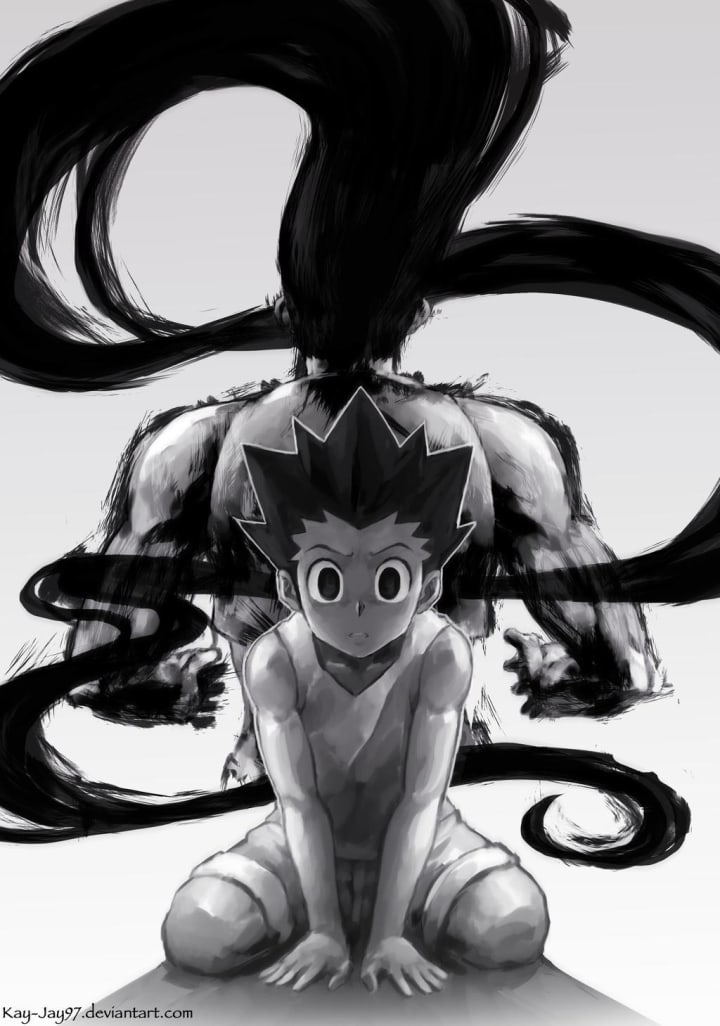
All in all, I think a lot of grace deserves to be given to Gon. Like Killua, who has committed worse crimes than Gon would have in that moment (albeit for less selfish reasons), Gon is a broken child dealing with things he should not have to. He’s figuring himself out in a world full of killers and monsters and manipulative people. Gon’s questionable, dubious sense of personal morality makes the anime a lot more mature and enjoyable for watchers who seek complex characterization.
Gon is a bit of a controversial character, but for the most part he is loved and appreciated for his depth and uniqueness as a main character. I know that I personally absolutely ended up loving Gon and the dark turn his character and the story decide to take in the Chimera Ants arc. Gon proves a protagnost does not have to be a perfect person in order to hold weight and be beloved in the anime community.
—
This little series “Thank You, __” is just me gushing about anime characters I like, because I want to. And because Vocal is awesome for letting me.
You can check out my previous installment here:
(I’d love to do another one on Makima—I don’t love this one a lot. I was trying to avoid spoilers and really only focused on the mildly feminist lens on her position in the story instead of her actual character, so stay tuned!)
Thank you so much for reading! ♥️
About the Creator
angela hepworth
Hello! I’m Angela and I enjoy writing fiction, poetry, reviews, and more. I delve into the dark, the sad, the silly, the sexy, and the stupid. Come check me out!
Keep reading
More stories from angela hepworth and writers in Geeks and other communities.
The Dark World of Madoka Magica
This piece will contain mild spoilers for the 2011 animated Japanese show Puella Magi Madoka Magica. The year was 2021, and COVID-19 was running our everyday lives. (I’m currently writing this with COVID-19 this very second in our good year 2024–how ironic is that?)
By angela hepworthabout a year ago in Geeks
The Rachels - 2025
Much to my surprise, I have kept a list of the films I‘ve seen this year. I daresay it isn’t complete. There will be films that snuck in on a late night in front of the TV that I would’ve forgotten to note. Or others, that I went to watch at the cinema, but then had a red wine and promptly forgotten about. But it’s not a bad approximation of the films I’ve seen this year. In total, there are 53 films listed, so an average of one a week and one for good luck.
By Rachel Robbins20 days ago in Geeks



Comments (7)
WOW! What an amazing insight on Gon! Shonen isn't my favorite Genre but I did think Gon was one of the best Shonen lead characters I have seen by far. He has a lot of depth and growth in the show. He does start with some power but you also see him work hard to develop that power (I hate when the main character starts as the most powerful person in the show) and even after all of his training he still isn't even close to the most powerful When Killua ripped out his opponent's heart I was shocked, but Gon didn't even seem phased. You explained his point of view perfectly. Even though I just finished watching HXH I want to watch it again after reading this insight, I feel as if I missed a lot.
Killua and his assassin family reminded me of the assassin family in your series Starlight Manor! Sorry I forgot the characters names 😅 For what it's worth, I forget the names of my own characters 😅😅 I love the fact that Killua literally has Kill in his name! Like how cool is that? Also, I don't feel anything wrong with Gon breaking Illumi's arm. I have anger issues and often have to urge to do things like that. But I manage to stop myself. I wish I had the guts to do so like Gon 🤣🤣🤣🤣🤣🤣🤣🤣 And God, if I was Gon and was told that Kite was dead the whole time, that would be the time I unleash my fury. Like I wouldn't care for consequences. I felt sad that Gon still thinks his father is a good person and is still looking for him despite leaving and the letter. Loved reading this so much!
Great insight on the character. Might check this anime out later.
I agree with Jamye, great character analysis! I haven't watched hxh in sooo long, I used to have a crush on Killua back when I watched it 😭😭😂😂
I loved this very in-depth character analysis of a chaotic good character, which if we are honest is all of us. I’m tempted to look up this series when I have time.
Gon's actually one of my husband's favourite anime characters. Like you we like his offbeat vibe.
You have introduced me to the world of anime. I've heard of it, but never realized just how deep the characters are. A virtual soap opera of sorts, only more believable...even though they are virtual entities. My 70 year old brain mostly "kept up," but it wasn't easy...lol Your analysis of the chaos within each of them was fantastic. My mind veered off and intertwined with an episode of Dr. Phil I recently saw about biometric engineering. Those driving the new technology were not formally educated, but worked from a garage and experiment on themselves. Not yet quite reality, but not totally scientifically useful...but soon. I was fascinated, but some audience members were appalled at some of their creations and methodology...such as making a dog glow in the dark.