
Swann’s Way by Marcel Proust
Why It’s a Masterpiece (Week 30)


Marcel Proust faced rejection from multiple publishers, including André Gide at the prestigious publishing house Gallimard. Determined to see his work in print, Proust financed the publication of "Swann's Way" himself through Grasset, a less renowned publisher, in November 1913. Despite its initial modest print run and mixed reviews, "Swann's Way" gradually gained critical acclaim. Influential figures such as literary critic Jean Cocteau and novelist Léon Daudet praised the book, helping it gain a wider readership and critical recognition.
Following the success of "Swann's Way," Gallimard recognised its earlier mistake and acquired the rights to Proust’s work. Proust's subsequent volumes of "In Search of Lost Time" were published by Gallimard, cementing his status as one of the leading literary figures of the 20th century.
Before the publication of "Swann's Way", Marcel Proust had published a few works, including essays and translations, but he was largely known in literary circles for his social connections rather than for any significant achievements. His struggle to publish was marked by personal and financial challenges, reflecting his intense dedication to his literary vision despite repeated setbacks. However, the success of "Swann's Way" led to the subsequent publication of the remaining volumes of "In Search of Lost Time" (also known as "Remembrance of Things Past"), which spanned seven volumes. He continued to work on the series until his death in 1922, leaving an indelible mark on literary history and securing his place as one of France's greatest novelists.
Plot
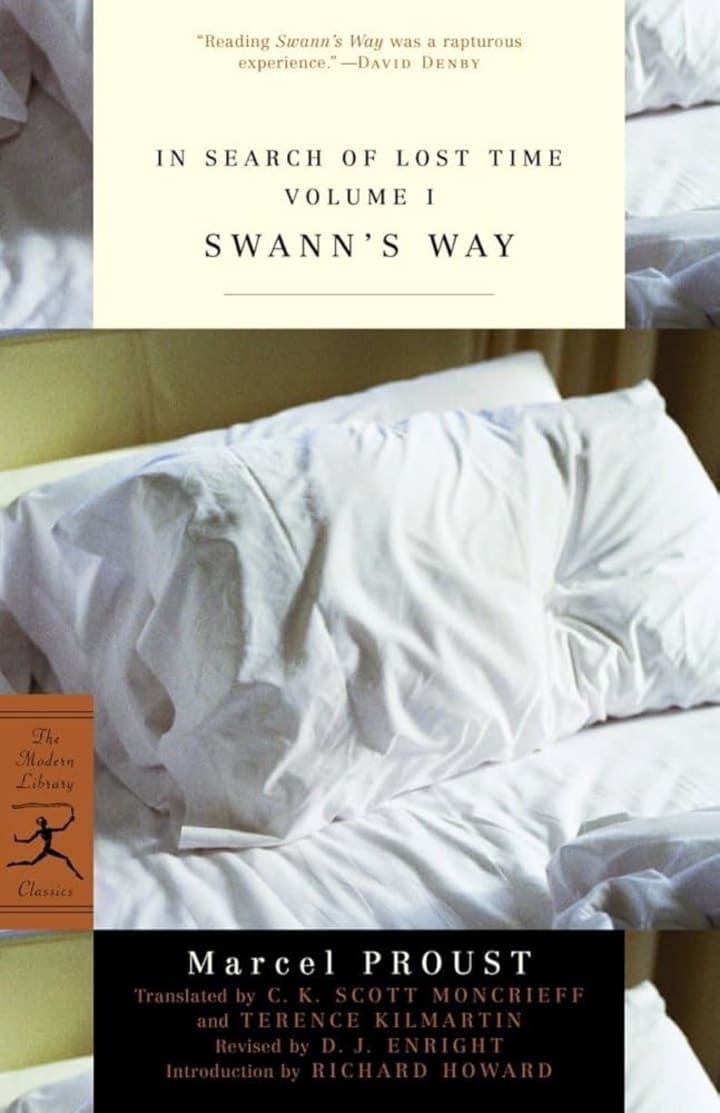
The novel begins with the narrator recounting his childhood memories of staying at his family's country home in Combray. These memories are triggered by the taste of a madeleine dipped in tea. He reflects on his family’s daily routines and the social life in Combray, detailing the people they interacted with, including family members and neighbours.
A significant portion of his childhood memories revolves around his deep attachment to his mother and his anxiety over securing a goodnight kiss from her. Charles Swann, a family friend and wealthy socialite, is introduced. The narrative shifts to Swann's life and his own romantic entanglements. Swann becomes infatuated with Odette de Crécy, a somewhat dubious figure in Parisian society. Despite not finding her conventionally attractive, he is drawn to her.
Swann spends time in the social circle of the Verdurins, a bourgeois couple who host gatherings of artists and bohemians. This group initially welcomes Swann, but tensions arise due to his relationship with Odette. Swann’s love for Odette grows into an all-consuming obsession. He becomes increasingly jealous and paranoid, fearing her infidelity. Swann eventually realizes that Odette does not truly love him and that his obsession has brought him more pain than happiness. Despite this realisation, he continues the relationship out of inertia and habit.
The narrative returns to Marcel, who begins to develop his own infatuations and romantic longings, hinting at themes that will be explored in later volumes. Throughout "Swann's Way," Proust weaves the themes of memory and time, illustrating how past experiences shape the present. Marcel’s reflections on his childhood and Swann’s love affair highlight the complexity of human emotions and relationships.
Into the Book

There are many different themes in the book but I think that the most important theme (obviously, according to the title of the series of volumes) is memory and time. Proust explores how memories can be involuntarily triggered by sensory experiences, revealing the non-linear nature of time.
This theme underscores the idea that the past is never entirely forgotten but remains intertwined with the present. Proust suggests that our current identity is a cumulative product of past experiences, which can resurface unexpectedly and reshape our understanding of ourselves. he famous madeleine episode illustrates this theme vividly. When Marcel dips a madeleine into tea, the taste evokes a flood of memories from his childhood in Combray, demonstrating how a simple sensory experience can unlock profound recollections and connect different moments in time.
“One cannot change, that is to say become a different person, while continuing to acquiesce to the feelings of the person one has ceased to be.”
- Swann's Way by Marcel Proust
Another theme is obsession through love. Proust examines how love can evolve into an all-consuming obsession that causes significant emotional turmoil. The novel portrays love as a powerful force that can both elevate and devastate individuals. Swann's relationship with Odette exemplifies how infatuation can lead to jealousy, paranoia, and ultimately, self-destruction. This analysis reveals Proust's nuanced understanding of love as a complex and multifaceted emotion.
Swann’s intense and obsessive love for Odette drives him to irrational jealousy and constant anxiety about her fidelity. Despite recognizing her flaws and infidelities, Swann remains trapped in his obsession, unable to extricate himself from the painful relationship, showcasing the destructive potential of obsessive love.
“In his younger days a man dreams of possessing the heart of the woman whom he loves; later, the feeling that he possesses the heart of a woman may be enough to make him fall in love with her.”
- Swann's Way by Marcel Proust
One more theme in this text is social class - a theme that is very important in masses of French novels of the same time period. Proust keenly observes the social dynamics and class structures of his time, depicting the complexities of social status, reputation, and the desire for acceptance within French society.
The novel highlights the superficiality and rigidity of social hierarchies, showing how social aspirations and the pursuit of prestige shape individuals' behaviors and relationships. Proust critiques the societal pressures that compel people to conform to certain standards, often at the expense of their true selves.
Swann, despite his wealth and connections, navigates the precarious boundaries of high society and the bourgeoisie. His interactions with the Verdurins' social circle demonstrate how social acceptance is often contingent on conforming to the group's expectations, illustrating the theme of social class and its impact on personal identity and relationships.
“the comfort of reclusion, the poetry of hibernation”
- Swann's Way by Marcel Proust
Why It's a Masterpiece

"Swann's Way" has had a profound impact on modern literature, influencing countless writers and literary movements. Its innovative techniques and themes have been widely studied and emulated. It's exploration of subjective experience and its narrative innovations paved the way for modernist literature and beyond. Proust’s work has inspired authors to experiment with form and delve deeper into the human psyche.
Writers such as Virginia Woolf, James Joyce, and Vladimir Nabokov have acknowledged Proust's influence on their own work. The introspective, fragmented narrative style seen in "Swann's Way" can be traced in their novels, which similarly explore the complexities of consciousness and time.
Conclusion

I was in my teens when I first read "Swann's Way" and it was only after that by a year or so that I decided to read the rest of the volumes of that series. I hope that you too, decide to give this mamouth series a try even if it takes you a very long time, at least you can say you read and enjoyed it. I'll see you next Saturday for yet another episode of 'Why It's a Masterpiece'.
Next Week: Tortilla Flat by John Steinbeck
About the Creator
Annie Kapur
I am:
🙋🏽♀️ Annie
📚 Avid Reader
📝 Reviewer and Commentator
🎓 Post-Grad Millennial (M.A)
***
I have:
📖 280K+ reads on Vocal
🫶🏼 Love for reading & research
🦋/X @AnnieWithBooks
***
🏡 UK
Keep reading
More stories from Annie Kapur and writers in Geeks and other communities.
Book Review: "K." by Roberto Calasso
I have been rather busy and so, that is why some of you may have seen my commenting on posts has dropped. I've recently started my new job and I always get home tired. On top of this, I have not really been going out anywhere and so, I've been stuck in my apartment the vast majority of the time I am not at work. It has been an interesting, if rather depressing, time for me. Let's just say I am still trying to find my feet in an entirely new place - a city which is very, very different to Birmingham.
By Annie Kapurabout a year ago in Geeks
The Rachels - 2025
Much to my surprise, I have kept a list of the films I‘ve seen this year. I daresay it isn’t complete. There will be films that snuck in on a late night in front of the TV that I would’ve forgotten to note. Or others, that I went to watch at the cinema, but then had a red wine and promptly forgotten about. But it’s not a bad approximation of the films I’ve seen this year. In total, there are 53 films listed, so an average of one a week and one for good luck.
By Rachel Robbins27 days ago in Geeks
When Are the Oscars 2026? Date, Location, Host, and What to Expect
When Are the Oscars 2026? Date, Location, Host, and What to Expect The Oscars 2026 are getting closer, and movie fans around the world are excited once again. The Academy Awards are known for celebrating the best films, actors, and creative work in the film industry. Each year, the ceremony brings together artists, filmmakers, and audiences to honor outstanding achievements in cinema. If you are looking for clear and simple information about the 2026 Academy Awards, including the date, location, host, nominations, and viewing details, this article explains everything in an easy way. When Are the Oscars 2026? The 98th Academy Awards will take place on Sunday, March 15, 2026. The ceremony will honor films that were released during the year 2025. The Oscars are one of the most important events in the film world. Each year, millions of viewers watch the show to see who wins, enjoy the red carpet fashion, and experience memorable speeches and moments. This year’s ceremony will include 24 award categories, covering areas such as acting, directing, music, and technical work. A new category has also been introduced to recognize achievement in casting, showing appreciation for the professionals who help choose the right actors for films. Where Will the Oscars Take Place? The Oscars 2026 will be held at the Dolby Theatre in Hollywood, Los Angeles, California. This location has hosted the Academy Awards for many years and is strongly connected with the history of the event. The ceremony is presented by the Academy of Motion Picture Arts and Sciences, the organization responsible for organizing the awards and selecting nominees and winners. Who Is Hosting the Oscars 2026? The ceremony will be hosted by Conan O’Brien, a well-known television host and comedian. He is recognized for his humor and engaging style, which often brings energy to large live events. Before the nominations were announced, Conan spoke about how planning for the ceremony usually changes based on which films are nominated and what audiences are talking about. He explained that creative ideas often develop closer to the event. He also shared that viewers can expect an entertaining show with exciting moments. While no specific details were revealed, the goal is to make the ceremony enjoyable and memorable for audiences. Oscar Nominations 2026 Highlights The official nominations for the 2026 Oscars were announced on January 22, 2026. This announcement created strong interest among film fans and media. One film that received major attention is the vampire thriller Sinners, which earned 16 nominations. This made it the most nominated film of this year’s awards season. The movie received nominations in major categories, including Best Picture, Best Director, and Acting categories. Because of its strong performance during nominations, many people now see Sinners as a major contender for multiple awards on Oscar night. However, the final results will only be known during the live ceremony. How to Watch the Oscars 2026 The Oscars will be broadcast live in the United States on television and available through streaming services. The ceremony is expected to begin at around: 7:00 p.m. Eastern Time 4:00 p.m. Pacific Time Viewers can also follow updates through official Academy platforms and social media channels, where highlights, red carpet moments, and winner announcements are usually shared throughout the event. Why the Oscars Remain Important The Academy Awards are more than just trophies. They represent recognition for creativity, storytelling, and artistic effort. For filmmakers and actors, winning or even being nominated for an Oscar is considered a major honor. For audiences, the Oscars offer a chance to discover new films, celebrate favorite performances, and reflect on the stories that shaped the year in cinema. Every ceremony brings moments that people remember for a long time, whether it is a powerful speech, a surprise win, or a meaningful tribute. With a popular host, strong nominees, and the addition of a new award category, the Oscars 2026 are expected to be an engaging and meaningful event for both industry professionals and movie fans. As March 15, 2026 approaches, interest will continue to grow. One thing is certain: the Academy Awards will once again bring global attention to the power of film and storytelling.
By Farhan Khanabout 7 hours ago in Geeks




Comments
There are no comments for this story
Be the first to respond and start the conversation.