
Book Review: "K." by Roberto Calasso
3.5/5 - Roberto Calasso on Franz Kafka...

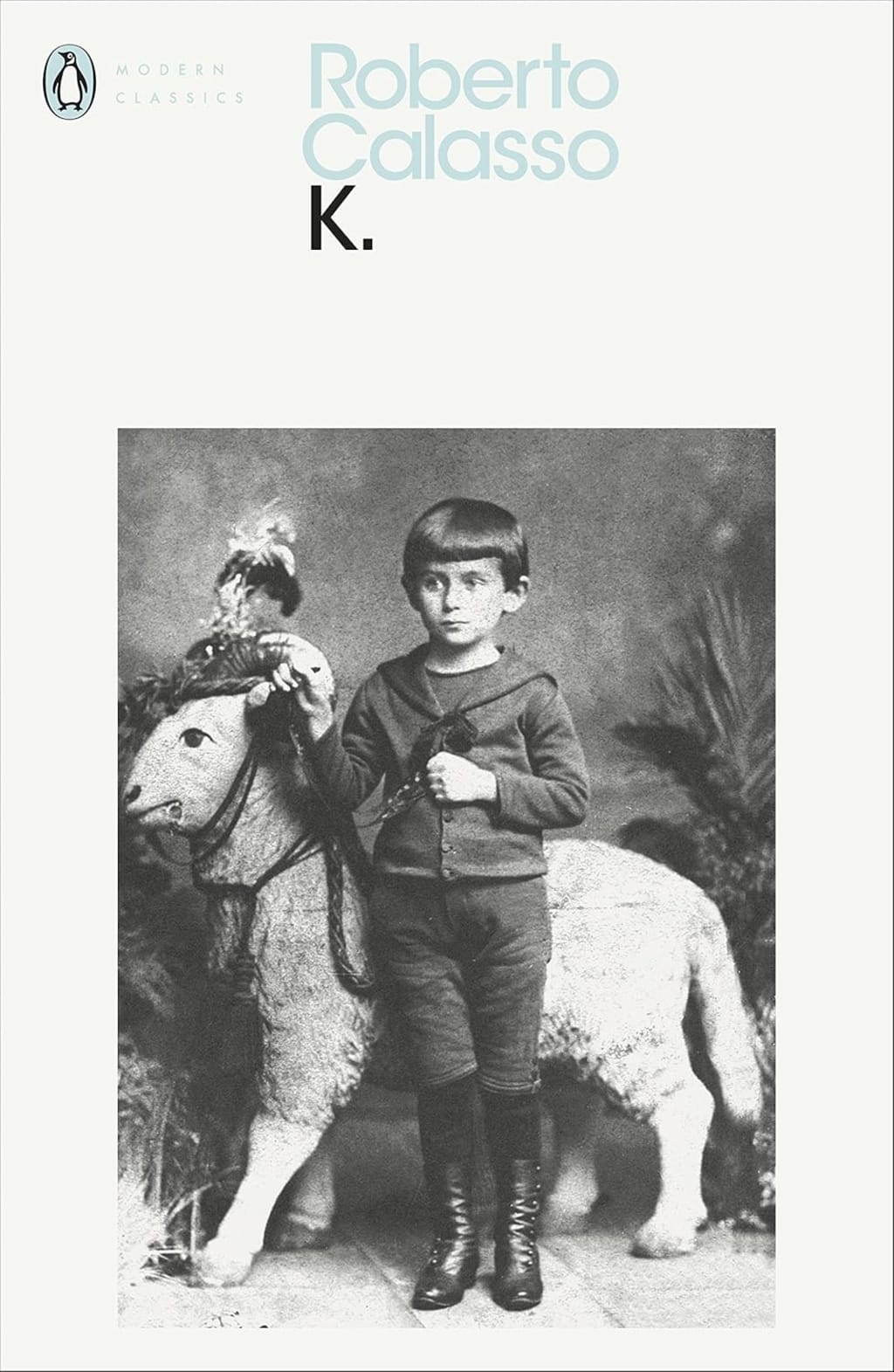
I have been rather busy and so, that is why some of you may have seen my commenting on posts has dropped. I've recently started my new job and I always get home tired. On top of this, I have not really been going out anywhere and so, I've been stuck in my apartment the vast majority of the time I am not at work. It has been an interesting, if rather depressing, time for me. Let's just say I am still trying to find my feet in an entirely new place - a city which is very, very different to Birmingham.
K. was one of those books that happened to be on sale on the Kindle store and I needed a book like this - something where I could just dive straight into some thinking points and expand them in my head. Yes, I needed a distraction of some kind. But, it proved to be a good one. A book about the writings and the meanings behind the works of Franz Kafka is a brilliant way to start the new academic year.
Calasso delves deeply into the psyche of Franz Kafka, portraying him not merely as a literary figure but as someone who captured the existential crisis of modern life. Kafka’s works are explored as more than stories—they are visions of a fractured reality where the individual is lost in an overwhelming, incomprehensible world. He shows how Kafka’s worldview is shaped by feelings of isolation, helplessness, and an eternal search for meaning, a reflection of 20th-century modernity. This is something I think that everyone who reads Kafka realises, so it's not such as revolutionary idea. In fact, it is simply the way the author explains his idea that feels revolutionary. For one, I find this book by Calasso though interesting, somewhat pretentious in its use of language.
One of Kafka's most profound themes is the idea of an authority or law that is beyond reach. In The Trial, Joseph K. is arrested without ever understanding the charges against him, while in The Castle, K. tries in vain to gain access to the castle's mysterious authorities. Calasso analyses these as representations of modern systems—whether political, legal, or divine—that seem impenetrable to the individual. The law is not just a set of rules, but a distant, unknowable force that determines fate without explanation or justice. This idea, I feel, was better written into the text but yet again, is something that any university student reading Kafka would realise eventually. I do like the way, however, the author links the texts together to create a wider and more overarching message concerning the works of Franz Kafka.
Kafka’s characters are often on a journey, but their quests are never fulfilled. Whether it's K. trying to enter the castle or Joseph K. trying to understand his trial, their efforts are fruitless. Calasso interprets these quests as symbolic of humanity’s search for meaning in life—a journey that, in Kafka’s world, is doomed to fail. The structure of Kafka’s narratives reflects a modern condition where clarity or resolution is always just out of reach, and the journey itself becomes the point, even if it’s absurd or futile. I think I should stop going through the ideas we all already know about after reading a few Kafka novels.
But, I think that Calasso might be on to something bigger here. I do not agree that he should have stopped at the idea that the quest is always unfulfilled or that it is representative of real life. I think he should have gone even further into the fact that they are purposefully unfulfilled and they are almost not allowed to be fulfilled. Why? Being fulfilled means the journey has ended and as we all know, Kafka's novels don't exactly 'end' and thus, fulfilment must be impossible.
Kafka’s protagonists, like K. in The Castle or Gregor Samsa in The Metamorphosis, are outsiders—characters who are isolated or alienated from the world around them. Calasso explores how Kafka uses the figure of the outsider to express deeper anxieties about identity, belonging, and power. Kafka himself, as a German-speaking Jew in Prague, often felt like an outsider, and Calasso interprets this sense of alienation as central to understanding Kafka’s themes of marginalisation and existential solitude. Now, I don't think that Kafka's protagonists were always based within an idea he had of himself but I could be wrong. It is an interesting idea to think about especially after you have read Kafka's Letters. It does make you think about the fact that he didn't have a very good image of himself as belonging to a certain country or people - it was almost as though he knew he was partly stateless, like his main characters.
All in all, I enjoyed this book even though I think the writing is more pretentious than the ideas are complex. I think the writer succeeds at giving us his personal analyses of Kafka but also at times it can feel like wading through things that the average Kafka reader would have already realised as a pattern in his texts. There is a lot of stuff about mythologies and how reading Kafka can feel like reading myth from time to time, but then there is the contradictory idea that Kafka's novels represent some sort of reality that we all live in. To conclude: it is a good book, but I think it is jus tad bit everywhere.
About the Creator
Annie Kapur
I am:
🙋🏽♀️ Annie
📚 Avid Reader
📝 Reviewer and Commentator
🎓 Post-Grad Millennial (M.A)
***
I have:
📖 280K+ reads on Vocal
🫶🏼 Love for reading & research
🦋/X @AnnieWithBooks
***
🏡 UK
Keep reading
More stories from Annie Kapur and writers in Geeks and other communities.
Book Review: "The Rebel" by Albert Camus
Albert Camus is one of those strange writers where I think I do like what he writes, but at times he can feel like more of a celebrity than a writer. He seems like he has good ideas and then ruins them with this near-narcissism which underpins his works. If I can feel it then I pretty sure there are a few other people who can feel it too. Sometimes, his voice can feel like he is the speaker of the people and is speaking on behalf of others. Sometimes, his writing resonates with the struggle of the common man. He treads the fine line between, at times he falls on one side and then, on the other. Let's have a look at some of the ideas he explores in the text.
By Annie Kapurabout a year ago in Geeks
Marvel Zombie
The last entry into our 2025 superhero projects catalogue is Marvel Zombies. This was a show that was anticipated by absolutely no one and it disappeared from the public consciousness as quickly as it was released. There was nothing special about the project that made it a must see, or a must remember. In fact if anything it's a must forget.
By Alexandrea Callaghan28 days ago in Geeks
🅼🅸🅳🅽🅸🅶🅷🆃 🆂🅽🅰🅲🅺🆂
"It's 10 in Tuscon! We all know what that means... It's Time for Midnight Snacks with your man, Gerald Gee! Ready to spend the night together? Me too! I'm full of snacks and can't wait to regurgitate them all back into your hungry ears. Crack a brew! Pop some corn! Anything to get ready for one hell of a show where the talk maybe cheap but the words cut deep...
By Lamar Wigginsabout 19 hours ago in Fiction



Comments
There are no comments for this story
Be the first to respond and start the conversation.