
Speed vs. Safety
The Controversial Legacy of the Fastest Aircraft

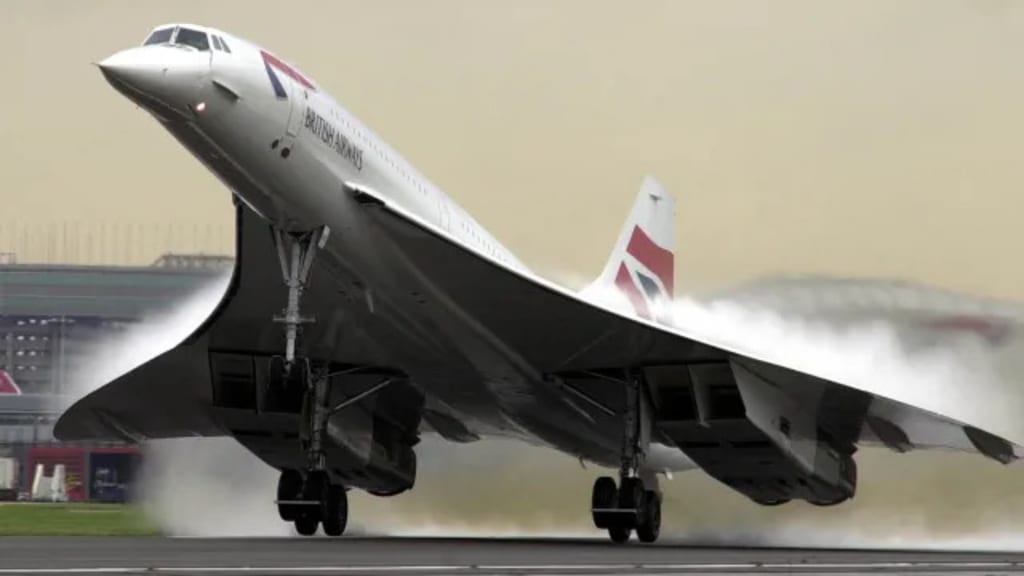
The Technological Marvel
Benjamin Franklin once famously said, “In this world, nothing can be said to be certain, except death and taxes.” If Franklin had lived to see the era of supersonic flight, he might have added “the relentless advance of technology” to his list. Our modern gadgets evolve rapidly: phones gain pixels, laptops get faster, and cars become more efficient. Yet, when we look back at aviation history, one aircraft stands out as a technological marvel with a controversial legacy. Enter Concorde—the supersonic jet that, despite its revolutionary technology, faced numerous challenges that ultimately led to its retirement.

Revolutionary Engineering
Concorde, introduced in 1976 and retired in 2003, was a groundbreaking feat of engineering. It could fly at twice the speed of sound, reaching Mach 2, and cruised at an altitude of 60,000 feet. To put this in perspective, today’s commercial jets, like the Airbus A330neo, take about eight hours to fly from London to New York. Concorde could complete the journey in under three hours. Its sleek, delta-winged design and sharply pointed nose were not just for aesthetics—they were crucial for handling the extreme speeds and temperatures Concorde experienced. During flight, friction with the air caused the aircraft’s surface to heat up significantly, making it warm to the touch upon landing, even though it cruised at -55 degrees Celsius.
Technical and Financial Challenges
However, the journey of Concorde was far from smooth. The development of this supersonic wonder was fraught with challenges. Initially projected to cost £70 million, the final price tag soared to over £2 billion. Technical hurdles included developing the droop nose for better visibility during landing, inventing carbon-based brakes to manage high landing speeds, and dealing with the extreme heat generated by supersonic flight. The aircraft’s four Rolls-Royce engines were among the loudest ever produced for commercial jets, causing significant noise pollution. The sonic booms created by Concorde were also a major issue. These continuous noises, generated by shockwaves as the aircraft broke the sound barrier, were disruptive enough to lead to protests and airspace restrictions. While Concorde could fly at supersonic speeds over oceans, overland routes were limited, impacting its commercial viability.
The Glamour and the Crisis
In its early years, Concorde struggled financially. It operated at a loss, and at one point, there were fears it might be scrapped. However, British Airways implemented a dramatic pricing strategy, significantly increasing ticket prices. By the late 1990s, a round-trip ticket from London to New York on Concorde was about 30 times more expensive than the cheapest alternatives and twice as costly as first-class tickets on subsonic aircraft. This pricing model turned Concorde into a symbol of luxury and exclusivity. For those who could afford it, flying Concorde was the epitome of glamour, attracting celebrities, politicians, and the wealthy.
The Crash and the Aftermath

The crash of Air France Flight 4590 in 2000 was a turning point for Concorde. The aircraft, on its way from Paris to New York, crashed shortly after takeoff, killing all 109 people on board and five on the ground. The crash was caused by a strip of metal on the runway that punctured a tire, leading to a fuel leak and a catastrophic fire. Although safety improvements were made and Concorde returned to service, the incident had a lasting impact on its reputation.
The Final Curtain
Then came September 11, 2001, with its devastating impact on global travel. The terrorist attacks led to a sharp decline in international travel demand, further straining Concorde’s commercial viability. Compounding these issues, by the early 2000s, Concorde was an aging aircraft reliant on outdated technology, requiring expensive maintenance. In 2003, Airbus, which had acquired the French company that originally manufactured Concorde, announced it would no longer produce replacement parts. The decision to retire Concorde was inevitable.
The Future of Supersonic Travel
Despite its retirement, the dream of supersonic travel persists. Companies like Boom Technology are working on new supersonic jets, though they face many of the same challenges as Concorde, including sonic booms, high fuel consumption, and environmental concerns. The return of supersonic flight may depend on overcoming these hurdles and finding a balance between speed, cost, and environmental impact.
Closing
In conclusion, Concorde was a marvel of its time—a testament to human ingenuity and ambition. Its legacy highlights both the incredible achievements and the formidable challenges of pushing technological boundaries. While Concorde’s story ended in retirement, its impact on aviation and its role as a symbol of the quest for speed continue to inspire and captivate. Whether supersonic flight will make a comeback remains to be seen, but Concorde’s remarkable journey remains a compelling chapter in the history of aviation.
About the Creator
Horace Wasland
Research analyst, writer & mystical healer. Exploring the edge where science meets mystery. From mystery/the mystical, to facts, news & psychology. Follow for weekly insights on all four and please leave a tip if you like what you read :)
Reader insights
Nice work
Very well written. Keep up the good work!
Top insights
Easy to read and follow
Well-structured & engaging content
Excellent storytelling
Original narrative & well developed characters
Eye opening
Niche topic & fresh perspectives
Keep reading
More stories from Horace Wasland and writers in Geeks and other communities.
The Genius of Einstein
Albert Einstein is regarded as one of the greatest minds in history, pioneering many groundbreaking scientific revelations during the Golden Age of scientific enlightenment. His discoveries have revolutionized our understanding of the universe and continue to be proven true in modern times. Here are five of his most incredible discoveries:
By Horace Waslandabout a year ago in Geeks
The Rachels - 2025
Much to my surprise, I have kept a list of the films I‘ve seen this year. I daresay it isn’t complete. There will be films that snuck in on a late night in front of the TV that I would’ve forgotten to note. Or others, that I went to watch at the cinema, but then had a red wine and promptly forgotten about. But it’s not a bad approximation of the films I’ve seen this year. In total, there are 53 films listed, so an average of one a week and one for good luck.
By Rachel Robbins19 days ago in Geeks
"Hear Me Out"
"Hear me out, what if we ran away together?" "Where do you want to go?" "Anywhere but here. We could move to a new city or to Canada, or we could disappear from society to live in the middle of the woods. Maybe a combination of two of those things would be good. What do you say?"
By Kay Husnick6 days ago in Fiction




Comments
There are no comments for this story
Be the first to respond and start the conversation.