
Social Media ‘Killed Our Children’: With Prince Harry’s Support, Grieving Parents Take Tech Giants to Court
Bereaved families say social media algorithms fueled a youth mental health crisis. Now, with the backing of Prince Harry, they are demanding accountability from powerful tech companies.

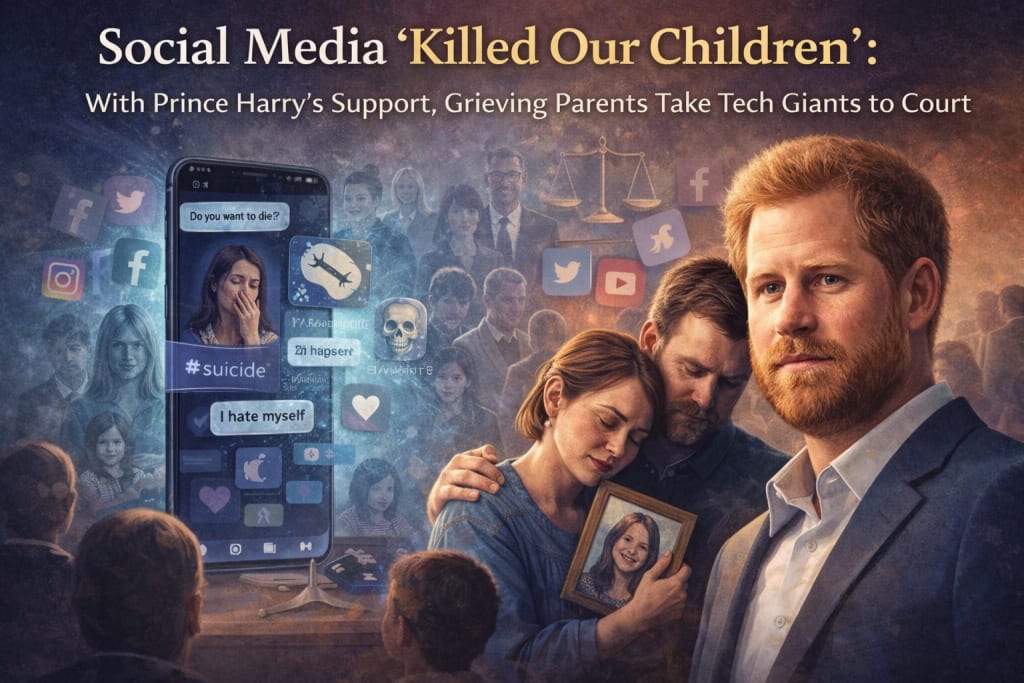
For a growing number of parents, grief has transformed into action.
Mothers and fathers who lost their children to suicide and self-harm are no longer mourning in silence. They are organizing, speaking out, and preparing to confront some of the world’s most powerful technology companies in court. Their claim is as heartbreaking as it is bold: social media platforms contributed directly to their children’s deaths — and must be held accountable.
At the center of this movement is Prince Harry, whose public advocacy for mental health has amplified the voices of these grieving families. With his support, what began as individual tragedies is now becoming a global legal and moral challenge to Big Tech.
________________________________________
The Core Accusation: Algorithms Over Children’s Safety
The parents involved in the lawsuit argue that social media platforms knowingly designed systems that exploit psychological vulnerabilities — particularly in teenagers.
Their case centers on algorithm-driven content. According to families, their children were repeatedly exposed to:
• Self-harm imagery
• Suicide-related content
• Eating disorder communities
• Depressive and isolating messaging
• Echo chambers that normalized despair
In many instances, parents only discovered the extent of this exposure after their child’s death. Phone histories revealed hours spent scrolling through harmful content late at night — content that appeared not by accident, but because algorithms continuously recommended similar material once engagement began.
The families argue that this wasn’t random. It was systemic.
They claim engagement-based algorithms prioritized time spent on platforms over emotional wellbeing — pushing increasingly extreme content to keep young users hooked.
________________________________________
Prince Harry’s Role in the Fight for Digital Accountability
Prince Harry’s involvement has brought international attention to the campaign. Through his longstanding mental health advocacy and charitable initiatives, he has repeatedly warned about the dangers of unregulated digital spaces.
He has described social media as an environment that can “prey on vulnerability,” especially among young people whose identities and emotional resilience are still developing.
By standing beside these families, Prince Harry has helped transform personal grief into a collective demand for reform. His support has also intensified public debate about social media regulation, youth mental health, and corporate responsibility.
For the parents, this is not about celebrity backing — it’s about visibility. They believe powerful allies are necessary when challenging trillion-dollar corporations.
________________________________________
What the Lawsuits Aim to Prove
Legal experts supporting the families say these cases could redefine how courts view social media companies.
Rather than treating each suicide as an isolated personal tragedy, the lawsuits aim to establish that:
• Platforms had prior knowledge of psychological harm
• Internal research indicated risks to young users
• Engagement-driven design amplified harmful content
• Safeguards were insufficient or reactive
• Corporate profit motives overrode safety concerns
Some legal analysts compare the strategy to past lawsuits against tobacco companies. For decades, cigarette manufacturers denied responsibility, even as evidence mounted that they understood the addictive nature of their products. Eventually, litigation forced accountability.
Parents believe social media may be facing a similar reckoning.
________________________________________
Big Tech’s Defense
Technology companies strongly deny direct responsibility for individual outcomes.
Their position includes several key arguments:
• Billions of users engage safely with their platforms
• Content moderation systems are in place
• Reporting tools and warning labels exist
• Crisis hotlines are promoted
• Parents share responsibility for monitoring use
Companies argue that mental health outcomes are complex and influenced by multiple factors — including family environment, school pressures, and pre-existing conditions. They maintain that platforms cannot be held liable for every tragic decision made by users.
But grieving families counter that complexity does not excuse negligence.
________________________________________
The Youth Mental Health Crisis and Social Media
The lawsuits come amid growing global concern over adolescent mental health.
Research increasingly links heavy social media use with:
• Rising anxiety levels
• Depression among teens
• Body image disorders
• Sleep disruption
• Increased self-harm behaviors
Psychologists warn that teenagers are particularly susceptible to algorithmic feedback loops. When a young person interacts with one piece of harmful content, recommendation systems often amplify similar posts — reinforcing negative emotions rather than interrupting them.
Parents argue that these feedback loops are not neutral. They are design choices.
And design choices have consequences.
________________________________________
A Regulatory Gap
Another central issue raised by the families is the lack of consistent global regulation.
Although some countries have introduced online safety laws, enforcement remains uneven. Social media platforms operate across borders, often beyond the full reach of national authorities.
This legal gray area, critics argue, allows companies to move faster than regulators.
Parents believe stronger reforms are urgently needed, including:
• Transparent algorithms
• Independent oversight
• Stronger age verification systems
• Mandatory removal of harmful content
• Legal duty of care toward minors
For many families, financial compensation is not the ultimate goal. Public acknowledgment and systemic reform matter far more.
________________________________________
The Legal Challenge Ahead
Proving direct causation between social media use and suicide will be difficult.
Courts traditionally require clear links between product and harm. Mental health, however, involves complex emotional and environmental factors. Defense teams are expected to argue that platforms are tools — not causes.
But families insist that when algorithms repeatedly direct vulnerable users toward destructive material, responsibility must be shared.
Their case asks a larger question:
If a product is engineered to maximize engagement — even when engagement leads to psychological harm — can the company behind it truly claim neutrality?
________________________________________
A Turning Point for the Digital Age?
As these lawsuits move forward, they may reshape how society views technology companies.
Are social media platforms simply communication tools?
Or are they powerful behavioral systems with ethical and legal obligations toward children?
Prince Harry has framed the issue as a defining moral challenge of the digital era. He argues that society cannot allow corporations to shape the emotional lives of millions of children without accountability.
For the families involved, this fight is deeply personal.
One grieving mother put it simply:
“Our children are gone. But if this forces change — if it protects even one child — then their deaths will not have been in vain.”
________________________________________
Why This Case Matters
This legal battle goes beyond compensation. It is about redefining corporate responsibility in the age of algorithms.
It is about whether tech companies can continue prioritizing growth metrics over safety safeguards.
It is about whether children’s mental health is treated as collateral damage — or as a line that cannot be crossed.
And most of all, it is about parents who refuse to let silence be the final chapter of their children’s stories.
The outcome remains uncertain. But one thing is clear: the era of unquestioned digital dominance may be coming to an end.
If these families succeed, the future of social media — and the protection of young users — could change forever.
About the Creator
Adil Ali Khan
I’m a passionate writer who loves exploring trending news topics, sharing insights, and keeping readers updated on what’s happening around the world.
Keep reading
More stories from Adil Ali Khan and writers in Geeks and other communities.
No Other Choice (2025)
It is only February, so other films may well surpass “No Other Choice”, but I think this is the best film I’ve seen so far this year. And that surprises me, because, it is a subtitled film and while I am pretentious enough to choose to watch foreign-language films, I was also very tired and that was an extra commitment from me. But more importantly, let me warn you, this film is gruesome and violent. There were times I had to turn away from the screen to avoid the worst of it (including some self-inflicted dentistry).
By Rachel Robbins2 days ago in Geeks
Steven Spielberg, Dawson Leery’s Idol, Donates $25,000 to James Van Der Beek Fundraiser
When Steven Spielberg quietly donated $25,000 to a charity fundraiser organized by James Van Der Beek, it became more than just a generous financial gesture. For fans of the television series Dawson’s Creek, the moment carried symbolic weight: Spielberg was the lifelong hero of Dawson Leery, the aspiring filmmaker Van Der Beek portrayed so memorably for six seasons. The fundraiser was launched to support a children’s mental health and cancer research initiative, causes that Van Der Beek has actively promoted following personal family struggles and his broader advocacy for health awareness. Spielberg’s donation was revealed by organizers as one of the largest individual contributions, instantly drawing attention from both Hollywood insiders and longtime fans of the actor’s work. For Van Der Beek, the donation felt deeply personal. During Dawson’s Creek, his character frequently referenced Spielberg as the ultimate inspiration, modeling his dreams of filmmaking on the legendary director’s career. Dawson Leery’s bedroom walls were famously lined with movie posters, and his dialogue often echoed Spielberg’s influence on American cinema. Seeing that influence come full circle in real life added an emotional dimension to what might otherwise have been a routine charity contribution. In a brief statement shared by the fundraiser’s organizers, Van Der Beek expressed gratitude for the unexpected support. He described Spielberg’s contribution as “an incredible honor” and said it represented “a moment where fiction and real life beautifully intersect.” While Spielberg has not made extensive public comments about the donation, sources close to the campaign noted that he was aware of the cultural connection and appreciated the symbolic resonance. The fundraiser itself was created to raise money for pediatric care programs and research into childhood illnesses. Van Der Beek has used his public platform to draw attention to the emotional toll families face when navigating serious health challenges. By inviting fans and colleagues to contribute, he hoped to turn personal hardship into collective action. Spielberg’s donation also highlights a long tradition of philanthropy in his career. Beyond filmmaking, he has supported education, historical preservation, and medical research for decades. His involvement in this campaign reflects a broader Hollywood trend in which established figures lend their influence and resources to initiatives championed by younger or mid-career actors. The story resonated strongly online, with fans of Dawson’s Creek sharing clips and quotes from the show that referenced Spielberg. Many noted how Dawson Leery once dreamed of meeting his idol, and now, years later, that idol had stepped forward to support the actor who brought him to life. Social media reactions described the moment as “full circle” and “unexpectedly moving,” blending pop culture nostalgia with real-world generosity. Media analysts say such moments demonstrate the enduring cultural impact of television storytelling. A fictional character’s admiration for a real director created a narrative thread that continued long after the show ended. Spielberg’s donation did not just support a cause—it revived a shared memory for an entire generation that grew up watching Dawson chase his filmmaking dreams. The donation has also boosted the fundraiser’s visibility. Within hours of the announcement, contributions reportedly increased, as fans were encouraged by Spielberg’s endorsement of the campaign. Organizers noted that celebrity involvement often acts as a catalyst, transforming modest fundraising efforts into national conversations. For Van Der Beek, the gesture reaffirmed the idea that entertainment can inspire meaningful connections beyond the screen. He has spoken in interviews about how portraying Dawson Leery shaped his own understanding of ambition and vulnerability. Receiving support from the very person his character idolized seemed to blur the boundary between role and reality. While $25,000 is only a fraction of Spielberg’s vast wealth, its impact lies in symbolism as much as in funding. It underscores how figures from different eras of Hollywood can unite around shared values of compassion and responsibility. In an industry often criticized for excess, moments of genuine generosity can reshape public perception. Ultimately, the donation stands as a reminder that stories do not end when the credits roll. The fictional admiration of Dawson Leery for Steven Spielberg has evolved into a real-world act of kindness—one that benefits children in need and connects two generations of entertainment history. What began as a character’s dream has become a tangible expression of solidarity, proving that inspiration, when carried forward, can result in meaningful action.
By Fiaz Ahmed about 19 hours ago in Geeks
from death into life
Young Aldin of Wiloh had never contemplated death. It was almost strange — so many around him had the tendency to obsess over it, to clamor and claw almost desperately at their own perceptions of the end to know death as much as they could: when it would come, why it would come, where it would take them when it did.
By angela hepworth5 days ago in Fiction



Comments
There are no comments for this story
Be the first to respond and start the conversation.