
Shakespeare's Fallen Women
The Tragic Decline of Shakespeare's Most Famed Female Characters


Background and Context:
I'm just going to explain this in the simplest terms for those just arriving here. Many years' ago I wrote a bunch of notes on my notes application, my notebooks at the time and all over textbooks - and these were all about various essays I wanted to write for assignments. Of course, only a couple would get chosen to be actually written. Therefore, there's tons just sitting around and that's what this series is. I'm now getting around to write about them and yes, it's a happy time.
Shakespeare's Fallen Women
The Tragic Decline of Shakespeare's Most Famed Female Characters
"Frailty, thy name is woman!" (Hamlet, I.II) is one of the most famous lines from Shakespeare, encapsulating the prevailing view of women during Elizabethan times. Shakespeare’s portrayal of women often reflects the social and moral expectations of the era, where women were predominantly seen as symbols of virtue, purity, and subordination. However, when these ideals are disrupted, they often result in what was perceived as the "fall" of women. In many of his plays, Shakespeare explores this concept through the lives of female characters who experience a decline from grace; either through moral lapses, betrayal, or tragic circumstances. These "fallen women" become a powerful reflection of the restrictive gender norms of the time.
In Shakespeare’s works, the term "fallen woman" often refers to women whose reputations have been compromised due to defiance of social norms, including sexual transgressions, disobedience, or the disruption of family roles. The concept of a "fallen" woman was deeply linked to societal expectations of chastity, virtue, and silence, all of which were considered essential for a woman's moral and social standing (Shepherd, 2014). However, Shakespeare’s treatment of these women is far from simplistic. His fallen women, characters like: Lady Macbeth, Ophelia, and Desdemona, are not merely victims of their circumstances, but are often active participants in their own downfalls. Their tragic fates can be seen as a critique of the rigid societal structures that limit women’s autonomy and condemn them for failing to conform.
Through these complex female characters, Shakespeare critiques the limitations imposed on women, demonstrating how their falls from grace are as much a result of societal pressures as they are of personal flaws or external manipulations. These fallen women invite audiences to reflect on the intersection of gender, power, and fate, revealing the consequences of a world where women are constrained by expectations that leave little room for agency or redemption.
Elizabethan England and the Fallen Woman

During the Elizabethan era, women were expected to adhere to strict codes of behaviour, particularly in terms of chastity, obedience, and passivity. The ideal woman was a submissive figure, bound by the duties of wife and mother, and her reputation was a crucial part of her social standing. Women were often defined by their relationships with men: fathers, husbands, and brothers, who held authority over them in both public and private spheres (Shapiro, 2005). A woman’s moral standing was directly tied to her virginity and sexual purity, and any perceived deviation from these norms could result in her being labelled a "fallen woman" (Shepherd, 2014).
In Shakespeare’s time, "fallen" women were typically those who transgressed these moral boundaries, especially in relation to issues of sexual conduct. This might include: adultery, promiscuity, or perceived immodesty, and the consequences for such actions were often harsh, particularly for women of higher social standing. Women were expected to be chaste and virtuous; their reputation was their most valuable possession, and any blemish on it could lead to their social ostracism (Carson, 2010).
As such, Shakespeare’s portrayal of fallen women often reveals the tension between the rigid social expectations of women and their desires for autonomy or power. While these women are frequently depicted as flawed, they are also victims of a system that marginalises them for their very humanity, forcing them into situations where they must choose between societal conformity or personal fulfilment.
The Purpose
Shakespeare's treatment of fallen women often serves as a means to critique the social structures and gender roles that limit women’s freedom and agency. In his tragedies, comedies, and histories, these characters’ falls from grace are not just personal tragedies, but also commentaries on the broader societal constraints that led to their downfall. The women Shakespeare depicts are often caught in webs of manipulation, passion, or ambition, their fates shaped by both internal desires and external pressures. Their moral decline or tragic demise becomes a reflection of the oppressive conditions they face.
In Macbeth, Lady Macbeth’s moral descent is triggered by her ambitious desire for power and her manipulation of Macbeth. Yet, her ultimate breakdown, marked by sleepwalking and guilt-ridden visions, reveals the psychological cost of defying her traditional role as a passive wife. She cannot reconcile her desire for power with the societal expectations placed on women to be nurturing and supportive (Bradley, 2015). Lady Macbeth’s fall is not just a personal moral failure but a critique of a system that denies women the power to act freely without facing psychological and social ruin.
Similarly, Ophelia in Hamlet is portrayed as a woman whose emotional and moral breakdown is triggered by the manipulations and betrayals of the men around her. Her fall from grace, symbolised by her descent into madness and death, underscores the devastating effects of a patriarchal society that forces women into submissive roles, making them vulnerable to the whims of the men who control their lives (Brown, 2007). Ophelia’s tragic end speaks to the dangers of limiting a woman’s autonomy and agency.
Shakespeare’s fallen women also appear in his comedies, where their moral lapses often serve as a vehicle for social commentary. For example, in Measure for Measure, Isabella’s struggle with her brother’s moral failings and her own sexual integrity exposes the double standards of Elizabethan society. She is pressured to sacrifice her virtue to save her brother, forcing her to navigate the boundaries of virtue and vice in a male-dominated world (Gowland, 2013). While Isabella is not a "fallen" woman in the traditional sense, her moral dilemma places her in a precarious position, demonstrating how women in Shakespeare’s time had to balance personal virtue with societal expectations.
In all these examples, Shakespeare uses the concept of the fallen woman to explore the tension between individual desires and societal pressures. Through his complex portrayal of these characters, he critiques the rigid gender roles that led to their falls, providing a nuanced perspective on women’s lives in Elizabethan society.
Notable Fallen Women
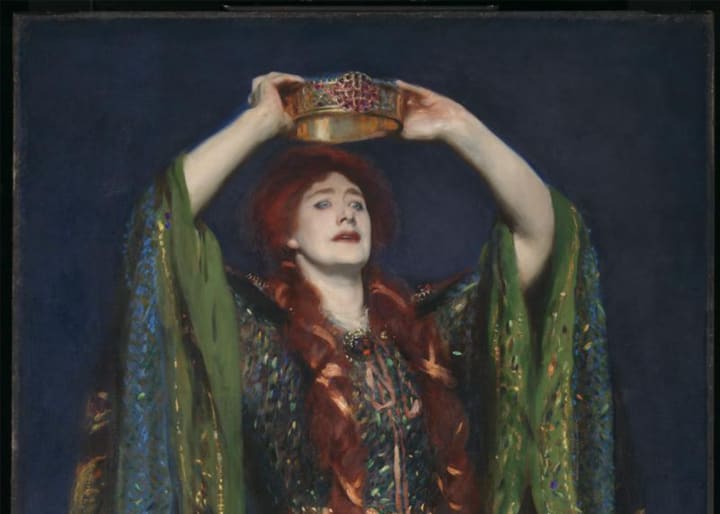
Lady Macbeth
Lady Macbeth is one of Shakespeare's most complex and controversial female characters. At the start of Macbeth, she is a power-hungry and ambitious woman, determined to see her husband crowned king, even if it means committing murder. She is fiercely manipulative, pushing Macbeth to act on his own latent desires for power. Her strength and control seem to break away from the traditional passive roles assigned to women in Elizabethan society, as she calls on dark spirits to "unsex" her and rid her of any feminine compassion. Initially, she appears as a woman with an iron will, confident in her ability to manipulate the events that will lead to her and her husband's rise to power.
Lady Macbeth's fall is marked by her increasing guilt and psychological disintegration following the murder of King Duncan. As Macbeth ascends to the throne, Lady Macbeth's initial strength falters. Her nightmares and hallucinations, notably the scene where she is seen sleepwalking and attempting to wash imagined bloodstains from her hands, highlight her deep sense of guilt and the toll that the crime takes on her psyche. This descent into madness ultimately leads to her suicide, underscoring the psychological cost of her actions.
Lady Macbeth’s desire to "unsex" herself and her manipulation of her husband reflect the era's fear of women defying their traditional roles. In Elizabethan society, women were expected to be nurturing, submissive, and morally upright. Lady Macbeth's ambition and willingness to partake in murder challenge these norms, and her eventual mental collapse serves as a cautionary tale about the consequences of transgressing gender expectations (Bradley, 2015). She falls not only due to her own actions but because she challenges the accepted boundaries of femininity and power.
Ophelia
Ophelia in Hamlet is a tragic figure who represents innocence and obedience, yet her fate is marked by madness and death. Throughout the play, she is manipulated by the men in her life: her father Polonius, her brother Laertes, and her lover Hamlet. Her obedience to the instructions of these men, particularly her father's command to distance herself from Hamlet, prevents her from developing any autonomy or agency of her own. She embodies the ideal Elizabethan woman, defined by her submission to male authority.
Ophelia's downfall begins with the death of her father at Hamlet’s hands. Stricken with grief and betrayed by Hamlet’s cruel behaviour, she spirals into madness. The famous scene in which she distributes flowers symbolising grief, loss, and madness marks her complete psychological disintegration. Her subsequent death, whether it is a suicide or an accidental drowning, marks the tragic culmination of her inability to navigate the pressures of her patriarchal world.
Ophelia's fall is rooted in her dependence on and obedience to the male figures in her life. Her inability to resist the expectations placed on her by her father and Hamlet, along with her emotional vulnerability, makes her a symbol of the tragic effects of patriarchal pressure. Her demise reveals the emotional and psychological toll on women who have no agency in a world dominated by male authority (Brown, 2007). Ophelia, unlike Lady Macbeth, does not actively seek power but is crushed under the weight of male expectations and manipulation.
Desdemona
Desdemona is presented as a virtuous and noble woman in Othello. She defies her father to marry Othello, an act that already marks her as a figure who transgresses social norms. Throughout the play, she remains steadfastly loyal to her husband, despite his growing jealousy and suspicion. Desdemona is the embodiment of purity, and her love for Othello seems to be beyond reproach. However, her marriage is soon overshadowed by Othello’s insecurities, manipulated by the villainous Iago, which leads to her tragic end.
Desdemona's fall occurs when she is falsely accused of infidelity by Othello, who has been misled by Iago’s manipulations. Despite her innocence, Othello’s jealousy consumes him, leading to her murder. Desdemona's ultimate death represents the destructive power of jealousy and the societal pressures that dictate a woman’s worth based on her perceived fidelity.
Despite her purity and loyalty, Desdemona's fall can be understood in the context of the societal emphasis on female chastity and fidelity. In a world where a woman's honour was her most important attribute, Desdemona’s loyalty to her husband is ultimately not enough to protect her from the destructive forces of jealousy and insecurity. Her fall is a tragic reflection of the dangers women faced in a society that held them accountable for men’s emotions and actions (Shapiro, 2005).
Juliet
Juliet, one of Shakespeare's youngest heroines, begins Romeo and Juliet as an innocent, obedient daughter. Her relationship with Romeo, which begins as a forbidden romance, ultimately transforms her into a "fallen" woman in the eyes of her family and society. Juliet’s defiance of her family in choosing to marry Romeo, a member of the enemy house, challenges the traditional expectations of female obedience to parental authority.
Juliet’s fall occurs when she secretly marries Romeo, defying her family’s wishes, and later becomes embroiled in the tragic events that unfold due to her forbidden love. Her refusal to marry Paris, a suitor chosen by her father, further isolates her from her family. In the end, Juliet’s desperate decision to take her own life rather than live without Romeo marks the ultimate expression of her fall.
Juliet’s fall reflects the consequences of love pursued outside the prescribed boundaries of family loyalty and social expectations. Her tragic end underscores how a woman’s personal desires can conflict with societal values, and in Juliet’s case, lead to her ultimate ruin. She is a symbol of youthful passion and rebellion, but her tragic fate highlights the harsh realities of a world where love and family loyalty are often at odds (Carson, 2010).
Tamora
Tamora, the Queen of the Goths, is a character who contrasts sharply with many of Shakespeare’s other female protagonists. Initially a captive of the Roman general Titus Andronicus, she seeks revenge for the brutal death of her son by Titus. Throughout the play, Tamora becomes a symbol of vengeance and cruelty, using her position and sexuality to manipulate others.
Tamora’s rise to power is marked by her ruthless and bloody schemes. She manipulates her husband, the Emperor Saturninus, and uses her position to orchestrate horrific acts of violence, including the rape and mutilation of Titus's daughter, Lavinia. However, her ambition and desire for revenge ultimately lead to her downfall. Her bloody deeds catch up with her, and she meets a violent death, symbolising the destructive nature of unchecked ambition and vengefulness.
Tamora’s fall is significant because she actively defies the passive role expected of women. She uses her sexuality and political acumen to manipulate the men around her, which leads to her demise. Her fall highlights Shakespeare’s commentary on the dangers of female ambition when it breaks away from the traditional submissive role prescribed by society (Shepherd, 2014). While she embodies power and vengeance, her eventual defeat shows the limits of women’s power in a patriarchal world, where even the most assertive and ambitious women ultimately meet tragic ends.
Themes of Fallen Women

Vice vs. Virtue
In Shakespeare’s plays, the concepts of virtue and vice are central to the portrayal of women, often reflecting the Elizabethan society's strict moral and social codes. Virtue in women is traditionally associated with purity, innocence, and obedience, while vice often emerges in their disobedience, sexuality, or ambition. These women are typically judged by their adherence to or deviation from these societal expectations.
Virtue is often symbolised by female characters who embody chastity, modesty, and loyalty. Desdemona in Othello, for example, is depicted as a paragon of virtue, embodying loyalty and unwavering love for her husband, despite the growing jealousy and suspicion surrounding her marriage. However, her unwavering commitment to Othello, her virtue, ironically becomes the cause of her tragic end. In contrast, Lady Macbeth in Macbeth transgresses these virtuous ideals through her manipulation and ambition. Her desire to unsex herself and embrace a more masculine form of power marks her as the embodiment of vice in the play, in stark contrast to the ideals of purity and motherhood associated with traditional femininity (Bradley, 2015).
The association of virtue with purity and vice with ambition or sexuality can also be seen in characters like Ophelia and Juliet. Ophelia’s tragic downfall results from her extreme obedience to the men in her life, a characteristic traditionally valued as virtuous. Her collapse into madness can be interpreted as a consequence of the social and emotional pressures placed on her to conform to these ideals. Juliet’s defiance of her family to pursue her love for Romeo, while considered virtuous in the realm of romantic passion, is ultimately marked as a vice because it contradicts her family’s social and moral expectations (Shapiro, 2005).
Male Influence
The downfalls of Shakespeare’s fallen women are often shaped by the male characters in their lives: fathers, lovers, or husbands. These male figures exert considerable influence over the female characters, either through direct manipulation, emotional abuse, or societal expectations. In Hamlet, Ophelia’s submission to her father Polonius and her romantic relationship with Hamlet lead to her tragic end. Polonius instructs her to reject Hamlet’s advances, and Hamlet’s rejection of her further destabilises her already fragile sense of self. Ophelia’s eventual death can be seen as the result of the oppressive male figures who dictate her choices and dictate her fate.
Similarly, in Othello, Desdemona’s tragic fall is precipitated by Othello’s jealousy and Iago’s manipulation. Although Desdemona is innocent, her loyalty to her husband is ultimately manipulated into an accusation of infidelity, leading to her murder. The male-driven power dynamics in these relationships shape the women's fates, often placing them in positions where they must submit to male authority or face devastating consequences. This reflects the hierarchical, patriarchal structures of Elizabethan society, where women were largely powerless against the influence of men (Carson, 2010).
Moral Ambiguity
Shakespeare’s fallen women are rarely depicted as purely evil; rather, they are often complex figures caught in a web of moral ambiguity. These characters are not simple villains, but rather victims of circumstances, social pressures, and their own internal conflicts. Lady Macbeth, for example, is not portrayed as an inherently evil character, but rather as a woman consumed by ambition and her desire for power. Her fall is as much a result of her internal conflict and guilt as it is of her initial desire to manipulate Macbeth into committing murder. Shakespeare shows that her eventual madness and suicide are consequences of both her external actions and the internal moral turmoil she faces (Brown, 2007).
Similarly, Juliet is a tragic figure not because of her love for Romeo but because of the social constraints that force her to make desperate choices. Her secret marriage and ultimate suicide stem from her desire to reconcile personal love with familial duty. Her decision is not purely an act of rebellion but is driven by her love for Romeo and the desperate circumstances she faces. This moral ambiguity suggests that Shakespeare’s fallen women are not simply cautionary figures but also victims of a society that imposes conflicting expectations upon them.
These complex portrayals highlight Shakespeare’s recognition of the limitations women faced in their world, reflecting both societal pressures and the emotional turmoil these women experienced. The tragic consequences of their actions (driven by ambition, love, and loyalty) demonstrate the ways in which they are shaped by the male-dominated world around them, while also reflecting Shakespeare’s exploration of human nature and the complexities of moral decision-making (Shepherd, 2014).
Conclusion

Shakespeare's fallen women are undeniably complex figures, defying simple categorisation as mere victims of their circumstances. While their downfalls are often precipitated by external forces: patriarchal expectations, male influence, or societal norms, they are also active participants in shaping their fates. Lady Macbeth’s ambition, Ophelia’s obedience, Desdemona’s loyalty, and Juliet’s defiance are all choices that contribute to their tragic ends. These women, in their pursuit of power, love, or independence, engage with and ultimately challenge the rigid gender roles of their time. Through these characters, Shakespeare reveals that the line between virtue and vice is often blurred, making their stories not just tragedies but explorations of the human condition (Bradley, 2015).
In many ways, these characters reinforce societal norms of Elizabethan England, where women were expected to be chaste, obedient, and passive. However, their actions also challenge these norms, particularly in the case of Lady Macbeth and Tamora, who deviate from the traditional roles of women. By presenting these women as both victims and perpetrators, Shakespeare critiques the constraints placed on women, questioning the morality of a society that forces women into such limited roles (Shapiro, 2005).
All in all, Shakespeare’s portrayal of fallen women provides a rich commentary on the intersection of gender, power, and fate. These characters reflect the complexities of gendered expectations and the dangers of defying societal norms. While their stories are set in the context of Elizabethan England, the themes of power, morality, and fate resonate strongly today, reminding us of the enduring relevance of Shakespeare's insights into the human condition (Shepherd, 2014).
Works Cited:
- Bradley, A.C. (2015) Shakespearean Tragedy: Lectures on Hamlet, Othello, King Lear, and Macbeth. London: Macmillan.
- Brown, P. (2007) The Tragedy of Ophelia: Gender and Power in Hamlet. London: Routledge.
- Carson, S. (2010) Women in Elizabethan Drama. Cambridge: Cambridge University Press.
- Gowland, M. (2013) Shakespeare’s Comedies: A Feminist Reading. London: Palgrave Macmillan.
- Shapiro, J. (2005) Shakespeare and the Jews. New York: Columbia University Press.
- Shepherd, S. (2014) Shakespeare’s Women: A Feminist Perspective. London: Routledge.
About the Creator
Annie Kapur
I am:
🙋🏽♀️ Annie
📚 Avid Reader
📝 Reviewer and Commentator
🎓 Post-Grad Millennial (M.A)
***
I have:
📖 300K+ reads on Vocal
🫶🏼 Love for reading & research
🦋/X @AnnieWithBooks
***
🏡 UK
Keep reading
More stories from Annie Kapur and writers in Geeks and other communities.
Book Review: "Pure Evil" by Geoffrey Wansell
Now, I'm not going on a true crime binge (I don't think) so don't worry. I merely needed another book from the library to fill the week until I went back. It's the 11th of February 2025 at the time of writing this review and honestly, I can't say that I didn't enjoy the book. Even though I've never heard of the author and the book was on the same shelf as Killing for Company - which is that really famous book about the infamous Dennis Nilsen. As you know, I've already read Killing for Company and so, I didn't pick it up - but scanned the shelf until I found Pure Evil. And off we went...
By Annie Kapur11 months ago in Geeks
30 Years of 'Pokemon': A Look Back At The Most Memorable/Iconic Pokemon Of The Kanto Region
2026 marks the 30th anniversary of the original Pokemon games, Pokemon Red, Pokemon Blue, and Pokemon Green (a Japanese exclusive) in Japan. An unexpected success arriving late in the lifespan of the original Game Boy, the first batch of Pokemon games, now referred to as Generation 1 or Gen 1, are RPGs taking place in the Kanto region, following a young boy embarking on the journey to become a Pokemon Trainer (later games, and Gen 1 remakes FireRed and LeafGreen, give the option of a female Player Character). This journey involves collecting eight Gym Badges to earn the right to battle Kanto's Elite Four, and being drawn into a battle against the evil Team Rocket.
By Kristy Anderson5 days ago in Geeks




Comments (1)
Another brilliant article!! This was so fascinating to read. I never realized how prevalent Shakespeare’s critique of the societal limitations of women in England was throughout his body of work—nor, honestly, did I spare to think his frequent killings of tragic female characters was even self aware. This was super compelling and well researched. You also reminded me that I’ve never read Othello, which should change!