
Book Review: "Pure Evil" by Geoffrey Wansell
5/5 - a compelling deep-dive into the psychology of Britain's worst criminals...

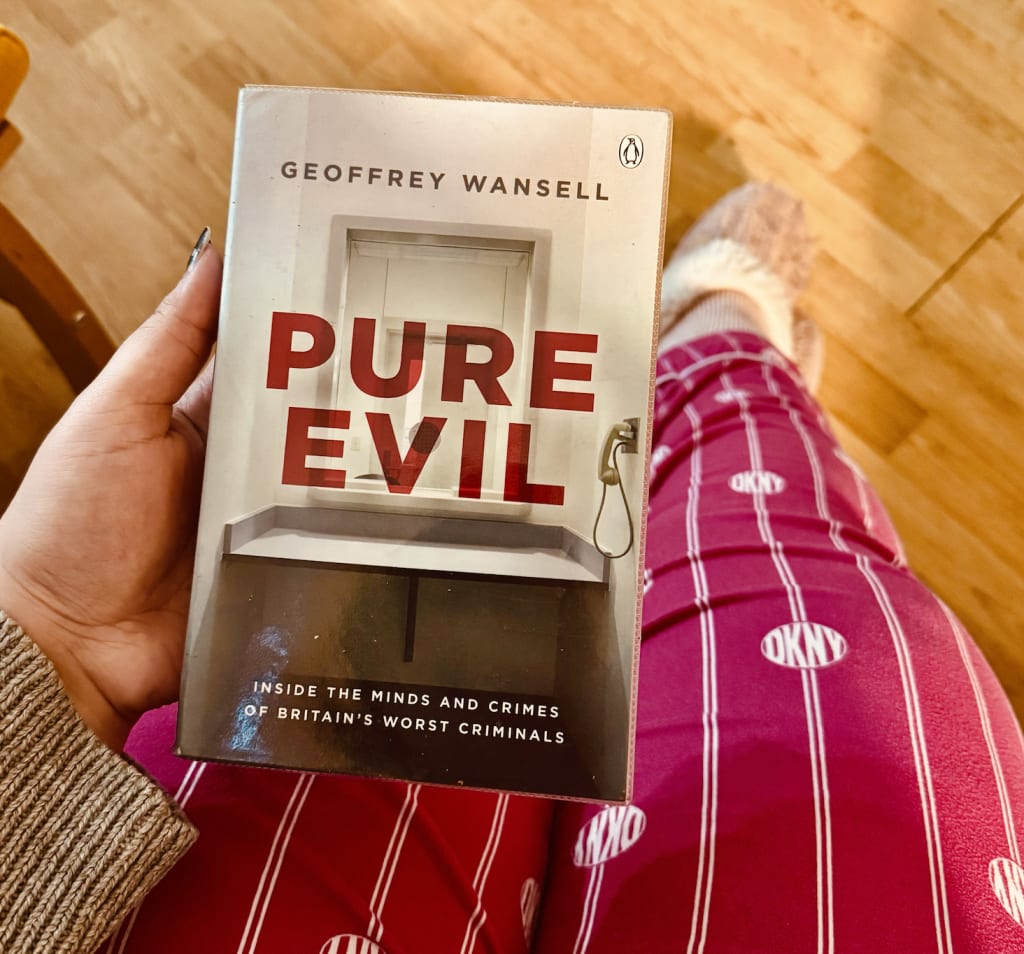
Now, I'm not going on a true crime binge (I don't think) so don't worry. I merely needed another book from the library to fill the week until I went back. It's the 11th of February 2025 at the time of writing this review and honestly, I can't say that I didn't enjoy the book. Even though I've never heard of the author and the book was on the same shelf as Killing for Company - which is that really famous book about the infamous Dennis Nilsen. As you know, I've already read Killing for Company and so, I didn't pick it up - but scanned the shelf until I found Pure Evil. And off we went...
Geoffrey Wansell meticulously examines some of the most infamous criminals in modern British history, offering detailed case studies of individuals whose crimes shocked the nation. The book includes profiles of serial killers, mass murderers, and those deemed so dangerous that they have been sentenced to whole life imprisonment, meaning they will never be eligible for parole.
Among the cases explored are those of Jeremy Bamber, convicted of the ruthless killing of his adoptive parents, sister, and her twin sons in what was initially staged to appear as a murder-suicide; Joanna Dennehy, one of the UK’s rare female serial killers, who embarked on a brutal stabbing spree; and Ian Huntley, the man behind the harrowing Soham murders of two young girls. Each case is presented with an in-depth look at the individuals involved, their backgrounds, and the investigations that led to their convictions. I'm always interested in how the people doing the investigations find out it is that particular person who did it. I remember watching a documentary about The Night Stalker and it said something about a baseball cap and a shoe print. I have to say, these detectives are really Sherlock Holmes in real life.
Rather than simply recounting the crimes, Wansell seeks to explore the deeper question of why these individuals commit such horrifying acts. Are they born with an innate tendency toward violence, or do their life circumstances shape them into killers? The book delves into the psychological, environmental, and social factors that may contribute to extreme criminal behaviour.

For instance, the author examines Joanna Dennehy’s background, which included a troubled childhood and evidence of early psychopathic tendencies. He considers whether her crimes were inevitable given her psychological profile or whether intervention at an earlier stage might have prevented them. Throughout the book, Wansell provides expert insights into the complex mix of nature and nurture in the making of violent criminals. I found this compelling because honestly, most of these crimes I've heard about a billion times and so, if I had to read a lengthy description of them again it was going to be boring. But how the psychological profile is built was really quite fascinating.
One of the book’s core themes is the idea of ‘pure evil’ and whether such a concept truly exists. Are the most dangerous criminals inherently evil, or can their actions be understood as the result of a complex interplay of psychological disorders, upbringing, and personal circumstances?
Wansell challenges readers to question their own beliefs about morality, justice, and the nature of human depravity. While some of the criminals profiled in the book display clear signs of psychopathy and an apparent lack of remorse, others have backgrounds marked by extreme trauma or abuse. By presenting these case studies, Wansell encourages readers to engage with the moral and philosophical implications of labelling someone as ‘pure evil.’ At times this book does make you question the nature of evil and you really want to assume that people like this are born this way, until you start to see various components - thus, you are taught that this could really be anyone. A real American Psycho psychological trip.
A recurring ethical dilemma in Pure Evil is the debate over whole life sentences. While some argue that individuals who commit the worst crimes should never be allowed to re-enter society, others believe that the justice system should always offer the possibility of rehabilitation.
Wansell presents both perspectives, drawing on interviews with legal experts, criminologists, and even former offenders. He considers cases where convicted criminals have demonstrated remorse and efforts toward rehabilitation, prompting readers to question whether true change is ever possible for those who have committed acts of extreme violence. I am not going to lie, I am one of those people who believes that if you have deliberately committed an act of violence towards another human being, you should never be allowed to re-enter society. I'm sorry about it, but that's it.
All in all, this nonfiction book is a fascinating observation on some of Britain's worst criminals. With an exploration of how the British Justice System handled the cases, we complete a portrait of crime which truly gets us to stop and think about how are own times are changing and how new criminals are forming from them.
About the Creator
Annie Kapur
I am:
🙋🏽♀️ Annie
📚 Avid Reader
📝 Reviewer and Commentator
🎓 Post-Grad Millennial (M.A)
***
I have:
📖 300K+ reads on Vocal
🫶🏼 Love for reading & research
🦋/X @AnnieWithBooks
***
🏡 UK
Keep reading
More stories from Annie Kapur and writers in Geeks and other communities.
Book Review: "Evil Eye" by Joyce Carol Oates
Joyce Carol Oates is perhaps a paradox for me. One side of this paradox is that she is a brilliant author and yet, the other side of it is that she is a strange and maybe slightly bigoted human being when it comes to literature especially. I think that there is perhaps a reason for that concerning the fact that she has sold so many books across the world and yet, I cannot understand it. However, she has still written some of my personal favourite fiction regarding the strange - including but not limited to books such as ‘The Corn Maiden’ and ‘The American Book of Martyrs’ (which was phenomenal by the way). Here, we look at four very weird novellas in which she shows us her stock character of a somewhat amicable man who turns out to be someone else entirely.
By Annie Kapur12 months ago in Geeks
A Knight of the Seven Kingdoms Series Review (Season 1)
As one of the biggest properties in fantasy, A Song of Ice and Fire remains immensely popular with audiences. After reaching far into the past with House of the Dragon, a second spin-off was on the cards. A Knight of the Seven Kingdoms serves up a bite-sized slice of action and drama, but it still claims a spot among the best small-screen titles.
By Robert Cain15 days ago in Geeks
REVIEW - The Redemption of Faust (Directed by Genel Mejia)
The Redemption of Faust, written by Justin Suran (Muse, Visitors, The Screenplay) and Genel Mejia (Visitors, The Screenplay, The Experiment, Normal, Splash Damage, La Mejia, Muse), and also produced and directed by Mejia, is a short film which takes its name from the famous 19th century work 'Faust' by Johann Wolfgang von Goethe.
By MegaFlix Movie Awards5 days ago in Geeks
Writing To Succeed
If you want to find something that will help readers find your writing, possibly expand your audience, and maybe even get you noticed for other things, then you’re not alone. But how can you get it done in a world full of want-to-be writers? Look less at what you’re writing now, and more at what other writers have used to boost their views and reads.
By Jason Ray Morton 6 days ago in Writers



Comments
There are no comments for this story
Be the first to respond and start the conversation.