
Review: "Don't Worry Darling"
Drama behind the scenes of a film is never great, but Florence Pugh lifts up an otherwise average film.

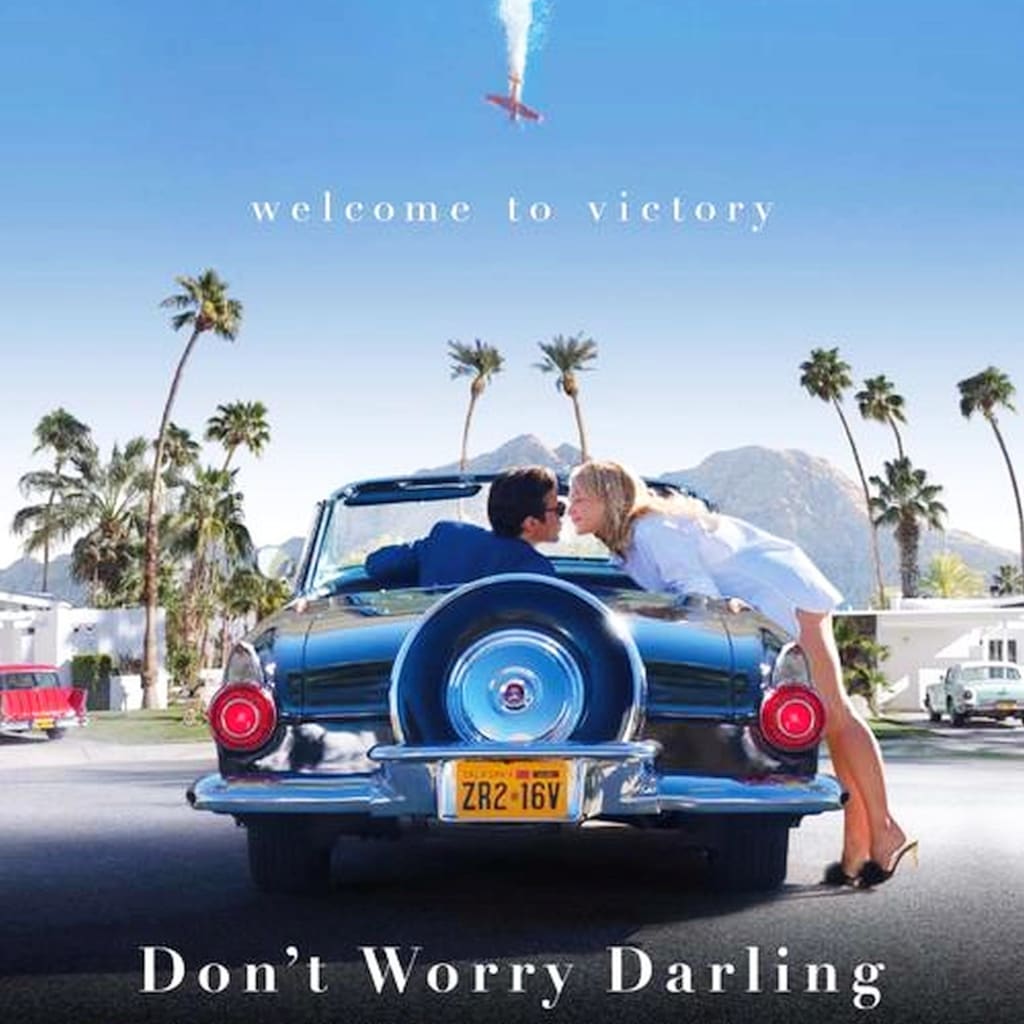
Don’t Worry Darling has been on the wrong side of the internet for a long time leading up to its release in theaters for all the drama it has brought to Hollywood and its stars. Movies are supposed to bring drama, but the behind-the-scenes issues behind this film are almost laughable. Between the relationship between star and director Olivia Wilde and Harry Styles is a sore point, as well as the tension between Wilde and Florence Pugh. To go into all the rumors and drama behind the scenes would be more than enough to go into an entirely different article, but still worth mentioning as it will indeed affect how some view the film. At its core, Don’t Worry Darling is a psychological thriller that features some terrific work from its main star in Pugh as well as some incredible cinematography.
The plot follows Alice (Pugh) who is living in a dystopian mid-century cul-de-sac with her husband Jack (Styles). The pair are madly in love with one another and living the life they have always wanted. That status quo comes into question once Alice begins to notice the white picket fence ideal has cracks in it forcing her to question everything, including her own sanity. Everything within the community known as Victory is cleanly coordinated and carefully regimented, where the men are men that get to go off and do their top-secret work while the women keep the house clean, cook dinner and reward the men with sex when they arrive. All the wives wave in unison to their doting husbands as they leave for their mysterious work and when Alice begins to question things about Victory and its enigmatic leader Frank (Chris Pine), the entire community begins to turn her into a leper.

Don’t Worry Darling has a lot going for it between the star-studded cast and the ideas behind it. It is very very ambitious but it doesn’t stick the landing that you wish it had. The script leaves a bit to be desired as does Wilde’s direction. The film lingers too much on the mental state of Pugh’s Alice and her questioning of the life she is living to the point that it repeats itself for twenty to thirty minutes too long. If that was cut from the film to focus more on letting the ending really set in, the movie would feel more complete and the answers audiences desire would make more sense. The film also has a tendency to rehash conversations that Alice has with her husband that never really move the plot forward.
Florence Pugh to no surprise to anyone proves that she is a superstar. Her ability to carry such an uneven film on her shoulders is a testament to her talent. Without her, the film would completely fall apart and lose audiences but she manages to keep people engaged. She has incredible range and she's very natural throughout. Her character and her name also help drive home the point that something is wrong in Victory. Watching her sanity plummet is deeply engaging and filled with anxiety as the walls literally begin to close in on her. Chris Pine is also great in a smaller role for himself as the enigmatic Frank who leads the Victory community and the mystery Victory Project that all of the men work on. It is more of a villainous role, which is nice to see him in, but it would have been nice to know more about him. Still, his ideas with the Victory Project evoke a bit of the Manhattan Project which fits the time that the film is trying to live in. Olivia Wilde as the neighbor that lives next to Pugh’s Alice provides a bit of comic relief from time to time, but aside from that, she doesn’t have much to offer in terms of the plot.

Harry Styles, who has been a part of plenty of drama behind the scenes, seems out of place in front of the camera. Granted, it can’t be easy being outshined by the great talent in Pugh and Pine, he just seems out of his element entirely. In his bigger moments where he can showcase his range and talent, it is more laughable than anything else. He seems to think getting louder equals being a better actor making it even more difficult for the audience to care for his character or relate to him on any level. A case can also be made that his character is written horribly, but in this case, I think it is a mix of both.

Don’t Worry Darling is obvious in where it is going from the start, and even from trailers, something is off in Victory. It also seems unsure of itself as to whether or not to stay in the paranoia and anxiety-filled state that Alice finds herself in, or to divulge all of its secrets. Other films have tackled this kind of film before, so the writers probably didn’t want this to echo too much of Stepford Wives or other stories that touch on similar themes of gender inequality and female subjugation but the delivery of Don’t Worry Darling is jarring and again it leaves a lot to be desired. The faults of the film are briefly covered thanks to the wonderful talent that is Pugh and cinematographer Matthew Libatique does a phenomenal job capturing all of the claustrophobic moments and beautiful landscapes. Some of the symbolism that is shown throughout of what is truly going on is also beautiful. Composer John Powell also does a great job with the music as it also adds to the paranoia and intensity of the proceedings. Frequently throughout the film when we see Alice investigating Victory or simply freaking out, the music slows down becoming almost a chant and you can clearly hear Pugh’s panicked breathing as a part of the slow rhythmic chant. Looking back, there is plenty to look into that track alone in terms of how it relates to Alice. Overall, Don’t Worry Darling is a fine movie that surely will do better in theaters in large part due to the controversy behind the scenes it could have been a lot better, but it also could have been much worse.

About the Creator
Nick Cavuoti
An avid movie watcher, and I have been writing short stories and novels on the side for years now. Hoping to hone my craft here on Vocal!
Reader insights
Outstanding
Excellent work. Looking forward to reading more!
Top insight
On-point and relevant
Writing reflected the title & theme
Keep reading
More stories from Nick Cavuoti and writers in Geeks and other communities.
Review: "Top Gun Maverick"
Top Gun Maverick by all logic is a film that should not work, but just as the action at times defies logic, the film is just a blast to watch. At times it feels as if Tom Cruise’s Ethan Hunt had been displaced from his Mission Impossible films and planted here in aviation school amongst the best of the best of their kind. Especially when watching the opening scene of Pete Mitchell “Maverick” taking a plane and making it exceed the fastest velocity a human has ever taken a plane. The way that his co-workers look up in awe at computer screens and declare Maverick to be the fastest man alive feels a bit absurd and self-congratulatory of the action maniac that is Cruise, despite these moments of absurdity, the film is likable, full of heart and just fun.
By Nick Cavuoti3 years ago in Geeks
No Word Comes Near Enough
The English language has its limits. I learned this when I became a student of the Bible and looked up the Greek and Hebrew definitions behind the Scriptures I loved. Some languages have so much more depth and power than the one I use to convey my thoughts. But, even so, I don't think any word could ever come close to describing this void and pain I am journeying through. I don't know how to swim through its murky waters.
By Shirley Belk5 days ago in Poets


Comments
There are no comments for this story
Be the first to respond and start the conversation.