
REBOOTING THE GRID: A DEEP DIVE INTO TRON: LEGACY'S LIGHT CYCLES AND LEGACY
In 2010, audiences were plugged back into a digital frontier unlike any they'd seen before. TRON: Legacy, the long-awaited sequel to the cult classic TRON (1982), burst onto screens, promising a visually stunning and aurally captivating experience.

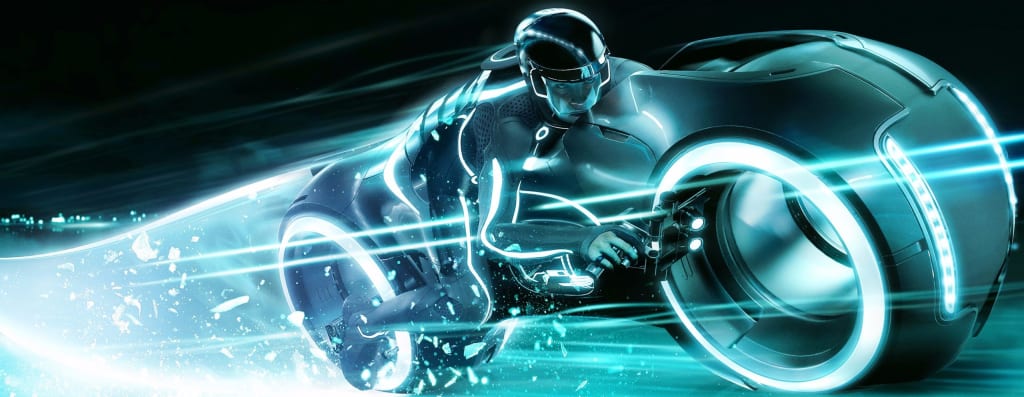
Introduction:
In 2010, audiences were plugged back into a digital frontier unlike any they'd seen before. TRON: Legacy, the long-awaited sequel to the cult classic TRON (1982), burst onto screens, promising a visually stunning and aurally captivating experience. More than just a continuation of its predecessor, TRON: Legacy aimed to bridge the gap between the nostalgic charm of the original and the cutting-edge spectacle of modern filmmaking. Directed by Joseph Kosinski, the film sought to expand the TRON universe, delving deeper into its mythology, themes of identity, and the fraught relationship between creator and creation. This article will explore the film’s intricate plot, compelling cast, groundbreaking production, and lasting impact, examining why TRON: Legacy remains a visually and sonically impressive, yet narratively divisive, entry in the science fiction canon.
Plot:

The narrative picks up decades after the events of TRON. Sam Flynn, the rebellious and disillusioned son of Kevin Flynn, the creator of the ENCOM corporation and protagonist of the original film, is still haunted by his father's mysterious disappearance. Following a cryptic message from his father’s old arcade, Sam is drawn into the digital world known as “The Grid,” a virtual reality realm Kevin Flynn designed years ago.
Inside The Grid, Sam encounters CLU 2.0, a digitally recreated version of Kevin Flynn programmed to create a perfect system. CLU 2.0 has become corrupted, believing that perfection can only be achieved through ruthless eradication of imperfection, and has imprisoned his creator. He also commands armies of programs, identifiable by their light trails, engaged in brutal games and strategic warfare.
Sam is soon rescued by Quorra, a skilled warrior and trusted confidante of Kevin Flynn. Quorra leads Sam to his father, who has been living in seclusion in a remote part of The Grid. Kevin explains that CLU 2.0's desire for perfection has destabilized the system and that Sam is the key to resetting The Grid and escaping back to the real world.
Together, Sam, Kevin, and Quorra embark on a perilous journey across The Grid to reach the portal, a gateway between the digital and physical worlds. They face numerous challenges, including high-speed light cycle battles, intense disc wars, and confrontations with CLU 2.0's forces. The journey reveals more about Kevin's motivations, CLU 2.0's twisted logic, and the unique nature of Quorra, who is revealed to be an "isomorphic algorithm," a living program capable of evolving and possessing seemingly infinite potential.
The climax sees a dramatic showdown between Kevin, CLU 2.0, and Sam. In a selfless act, Kevin sacrifices himself by re-integrating with CLU 2.0, effectively destroying both of them and restoring balance to The Grid. Sam then returns to the real world with Quorra, bringing the isomorphic algorithm out of The Grid, hinting at a new chapter for humanity and technology.
The narrative structure of TRON: Legacy leans heavily on a hero's journey archetype, with Sam fulfilling the role of the reluctant hero thrust into an extraordinary world. The film's narrative style is deliberate and visually driven, focusing on building atmosphere and spectacle over complex character development.
Cast:
Garrett Hedlund as Sam Flynn: Hedlund embodies the rebellious and emotionally wounded Sam, bringing a mix of cynicism and underlying determination to the role. While his performance was considered adequate by some, others criticized his lack of charisma compared to the film's visual spectacle.
Jeff Bridges as Kevin Flynn/CLU 2.0: Bridges reprises his role as Kevin Flynn and also portrays CLU 2.0. His performance as the weary, philosophical Kevin is a highlight of the film, offering a glimpse into the consequences of playing God. As CLU 2.0, Bridges embodies a chillingly detached and driven antagonist, showcasing the dangers of unchecked ambition. De-aging technology was used to create CLU 2.0, which while impressive for its time, now looks somewhat uncanny.
Olivia Wilde as Quorra: Wilde delivers a captivating performance as Quorra, a skilled warrior and wise companion. She brings a unique blend of naiveté and strength to the role, representing the potential of digital life and the importance of embracing imperfection.
Bruce Boxleitner as Alan Bradley/Tron: Boxleitner reprises his role from the original film, appearing in a cameo as Alan Bradley, Kevin Flynn's friend and colleague. He also provides a voice for the program Tron, though this character's presence is limited.
Michael Sheen as Zuse/Castor: Sheen delivers a flamboyant and memorable performance as Zuse/Castor, the owner of the End of Line Club. His eccentric portrayal adds a touch of theatricality to the digital world.
The casting choices aimed to blend familiarity with fresh talent, with Bridges serving as the link to the original film and Hedlund and Wilde bringing a new generation of actors to the franchise.
Reviews:
TRON: Legacy received mixed reviews from critics. The film was widely praised for its stunning visuals, innovative production design, and Daft Punk's electrifying soundtrack. Critics lauded Kosinski's ability to create a visually immersive and captivating world.
However, the film was criticized for its thin plot, underdeveloped characters, and reliance on visual spectacle over substantive storytelling. Some reviewers felt that the narrative failed to live up to the potential of the TRON universe. The de-aging technology used on Jeff Bridges was also a point of contention, with some finding it distracting and unnatural.
Audience reviews were similarly divided. While many viewers were enthralled by the film's visual and auditory experience, others found the story lacking in depth and emotional resonance. The film's pacing was also a point of criticism, with some finding it slow and meandering.
Production:
The journey to bring TRON: Legacy to the screen was a long and arduous one. Discussions about a sequel began shortly after the release of the original film, but various development hurdles and technological limitations delayed the project for decades.
Disney officially greenlit TRON: Legacy in 2007, with Joseph Kosinski, a visual effects artist with a background in architecture, chosen to direct. Kosinski's vision was to create a film that honored the spirit of the original while pushing the boundaries of visual effects and immersive storytelling.
The film's production was a massive undertaking, involving hundreds of artists, technicians, and engineers. The budget was estimated at $170 million, making it one of Disney's most expensive productions at the time.
Writing and Casting:
The screenplay for TRON: Legacy went through several iterations, with writers Edward Kitsis and Adam Horowitz ultimately credited for the final script. The writing process involved balancing the need to create a compelling standalone story while also honoring the legacy of the original film.
The casting process was equally meticulous. Garrett Hedlund was chosen for the role of Sam Flynn after an extensive search, with the filmmakers impressed by his physicality and ability to convey the character's rebellious spirit. Olivia Wilde was cast as Quorra after demonstrating her ability to embody the character's strength and vulnerability. Jeff Bridges was an obvious choice to reprise his role as Kevin Flynn, and his involvement was crucial to the film's credibility.
Principal Photography:
Principal photography for TRON: Legacy began in Vancouver, British Columbia, in April 2009 and lasted for several months. The film was shot primarily on 35mm film, with some scenes filmed in IMAX format to enhance the visual experience.
The production was known for its innovative use of practical effects and cutting-edge visual effects technology. The filmmakers employed motion capture, performance capture, and advanced computer graphics to bring the digital world of The Grid to life. The light cycles, a signature element of the TRON universe, were redesigned and rendered with stunning detail, becoming one of the film's most iconic visual elements.
One humorous anecdote from the set involved Jeff Bridges ad-libbing many of his lines as Kevin Flynn, drawing inspiration from his own life experiences and philosophical musings. This added a layer of authenticity and depth to his performance. There were also reports of the actors having difficulty adjusting to the tight-fitting light suits, leading to some awkward moments on set.
Production Design:
TRON: Legacy's production design was a critical element of its success. The filmmakers created a visually striking and immersive world that blended futuristic technology with a sleek, minimalist aesthetic. The set design was inspired by architecture, video games, and science fiction films, creating a unique and memorable environment.
The costumes, designed by Christine Bieselin Clark, were equally impressive. The light suits, adorned with electroluminescent lighting, became a defining visual element of the film. The costumes were designed to be both functional and visually appealing, allowing the actors to move freely while also showcasing the film's advanced technology.
The visual aesthetics of TRON: Legacy were a significant departure from the original film. While the original TRON had a more primitive, blocky look, TRON: Legacy embraced a sleek, modern design aesthetic, reflecting the advancements in technology over the past three decades.
Sound Design & Music:

The sound design and musical score of TRON: Legacy were equally groundbreaking. The filmmakers worked closely with electronic music duo Daft Punk to create a soundtrack that was both futuristic and emotionally resonant. Daft Punk's score blended electronic music with orchestral elements, creating a unique and immersive soundscape that perfectly complemented the film's visuals.
The sound effects were also meticulously crafted, creating a sense of immersion and realism. The roar of the light cycles, the hum of the identity discs, and the ambient sounds of The Grid all contributed to the film's overall sonic experience.
Visual Effects:
The visual effects in TRON: Legacy were a significant achievement, pushing the boundaries of what was possible with computer graphics. The filmmakers employed a wide range of techniques to create the digital world of The Grid, including motion capture, performance capture, and advanced rendering technologies.
The de-aging technology used on Jeff Bridges to create CLU 2.0 was particularly noteworthy, although it received mixed reactions from critics. While the technology was impressive for its time, it now looks somewhat dated, highlighting the rapid advancements in visual effects technology.
Influences:
TRON: Legacy draws influences from a variety of sources, including classic science fiction films, video games, and mythology. The film's themes of identity, creation, and the dangers of technology echo the concerns of many classic science fiction stories, such as Frankenstein and Blade Runner. The film's visual aesthetic is also influenced by video games, particularly those with a futuristic or cyberpunk theme. The father-son narrative clearly shows influence from Star Wars.
Scientific Knowledge:
TRON: Legacy incorporates several scientific concepts, although they are often presented in a fantastical or metaphorical way. The film explores the idea of digital consciousness and the potential for creating artificial life within a virtual environment. The concept of isomorphic algorithms, living programs capable of evolving and possessing unique abilities, is a fictional extrapolation of current research in artificial intelligence and machine learning. While the film does not present a scientifically accurate depiction of these concepts, it does raise interesting questions about the nature of consciousness and the potential for future technologies.
Marketing, Release & Box Office:
Disney launched a massive marketing campaign for TRON: Legacy, targeting both fans of the original film and a new generation of viewers. The campaign included trailers, TV spots, viral marketing, and partnerships with various brands. Daft Punk's involvement in the soundtrack was also heavily promoted, attracting a wider audience to the film.

TRON: Legacy was released in theaters on December 17, 2010, in both 2D and 3D formats. The film grossed over $400 million worldwide, making it a commercial success, although its box office performance fell short of expectations given its high production budget and marketing costs.
Critical Responses:
Despite its commercial success, TRON: Legacy remains a divisive film among critics and audiences. While the film is widely praised for its visuals, sound design, and Daft Punk's soundtrack, it is often criticized for its thin plot, underdeveloped characters, and reliance on spectacle over substance.
Ultimately, TRON: Legacy is a film that is best appreciated for its visual and auditory experience. While the narrative may not be as compelling as some had hoped, the film's stunning visuals, innovative production design, and electrifying soundtrack make it a memorable and unique entry in the science fiction genre. Its legacy lies not just in continuing the TRON saga, but also in its pioneering use of visual effects and its influence on subsequent science fiction films.
About the Creator
Xavier
Global news reporter covering science, tech, environment, Entertainment & sports. Delivering balanced insights to inform and inspire readers worldwide. Sometimes a poet.
The Politics of Playing Dress-Up
Well, to start off I'd like to say a happy world book day to all who celebrate. I know I haven't really posted anything on my socials about it but I'm not a jubilant kind of person. I lay low most of the time. Let's start off with a popular anecdote from the vaults...
By Annie Kapur7 days ago in Geeks
Book Review: "The Palace"by Gareth Russell (Pt. 2)
This review covers chapter 4 through to the end of chapter 6 *** We've covered people such as Elizabeth of York, Thomas Woolsley, Martin Luther and even Anne Boleyn but now it is time to move on from these figures. It is proven that Gareth Russell has done such an incredible amount of research here and the book itself is a fantastic achievement of nonfiction literature regardless of your personal feelings towards the royal family. Gareth Russell's writing and insight makes the book even more intriguing to read as he offers us arguments to consider, thoughts to ponder on and stories of whispering gossip that lurk inside the walls of this great palace.
By Annie Kapura day ago in Geeks
TUS NUA - ch 53
TUS NUA – ch 53 New Beginnings – Mia and Midnight (*)(*)(*) Finola knew Ali’s brother-in-law needed to put his mind at rest. She fed her arm through his and led him outside. “We’ll sit here. If you like, I can put a block around us so our conversation will be private.”
By Margaret Brennan4 days ago in Fiction



Comments
There are no comments for this story
Be the first to respond and start the conversation.