
POGs: Recess Gambling
And The 90’s Playground Bubble

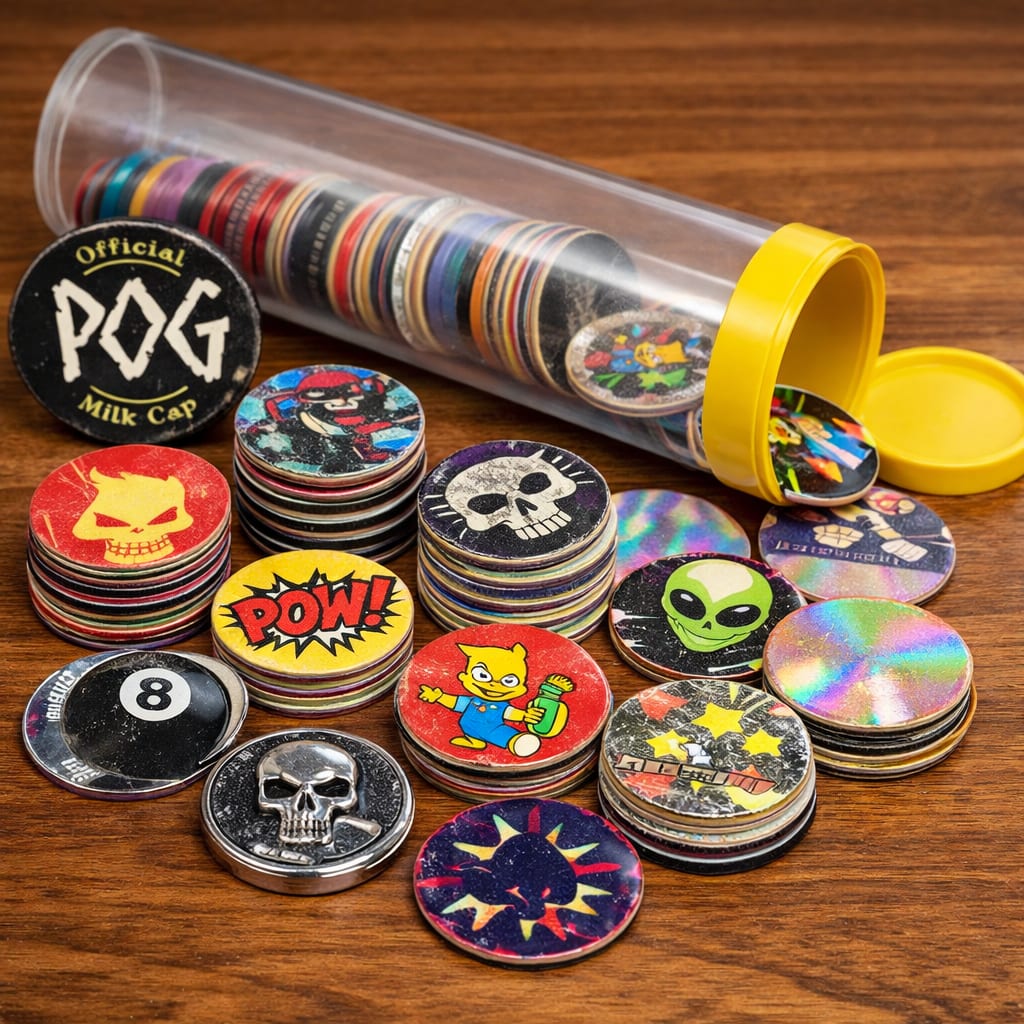
The 90s are making a massive comeback.
Everyone’s wearing JNCO jeans again, chokers are back, and somehow frosted tips are trying to sneak into society like we all forgot what happened the first time.
But nobody talks about the 90s phenomenon that actually ruled our lives in elementary school.
That’s right.
POGs.
A degenerate two-dimensional version of marbles.
The game was simple: stack a pile of small cardboard discs with cartoons printed on them, then slam the stack with a heavier disc called a slammer. Any discs that flipped face-up were yours to keep.
So basically… poker chips for children.
⸻
Where POGs Came From
Despite feeling like a pure 90s invention, the game actually has older roots.
The concept came from a milk-cap game played by children in Hawaii during the early 20th century. Kids used discarded bottle caps and tried to flip them over in stacks.
The modern revival is usually credited to a Hawaiian teacher named Blossom Galbiso, who reintroduced the milk-cap game to her students in the early 1990s.
The irony being that by the late to mid 90’s POGs were being banned from schools for turning a generation of elementary school kids into degenerate gamblers.
The name “POG” itself came from a Hawaiian fruit drink made from Passionfruit, Orange, and Guava.
This may possibly have been the most ingenious marketing strategy for selling more juice in Polynesia.
⸻
How It Took Over the 90s
The modern POG craze exploded when the concept was commercialized and brought to the North American toy market.
True story: it was pushed heavily by a Canadian company that began mass-producing decorated milk caps.
I’m not saying it was psychological warfare.
But if you were designing a plan to destabilize a generation of future American leaders through elementary school cardboard-based gambling, this would be an elegant approach.
It was like eugenic sterilization of the morality of minors.
Very sneaky, neighbors to the north.
⸻
The Schoolyard Economy
Once POGs hit the playground, the market exploded.
Suddenly there were themed sets everywhere:
• Transformers
• Rugrats
• Marvel
• DC Comics
• Nickelodeon
• Disney
• MTV
There were no rules. Everyone made them.
Kids carried stacks in plastic tubes that are identical to modern day marijuana edible packaging.
Officially, the game involved skill and physics. In reality it quickly became schoolyard gambling.
Play “for keeps,” and whatever you flipped belonged to you.
It was recess with a Vegas theme.
⸻
The Bubble
Before Beanie Babies, before Pokémon cards, before Silly Bands, these little cardboard discs had a shocking grip on an entire generation.
We genuinely believed the rare ones would appreciate in value.
Special editions appeared:
• holographic pogs
• tournament releases
• limited runs
Some kids guarded their collections like retirement portfolios.
In hindsight, what we experienced was basically Dutch Tulip Mania in the third grade.
An object with almost no intrinsic value suddenly became a speculative asset because everyone believed someone else would want it later.
⸻
The Collapse
Like all collectible bubbles, the market eventually collapsed.
Manufacturers printed millions upon millions of pogs. The novelty wore off. Schools began banning them because the games were causing fights and encouraging gambling.
The playground economy evaporated almost overnight.
Many former collectors still have tubes of pogs rattling around in old boxes somewhere, quietly reminding them that childhood investment strategies were not exactly foolproof.
⸻
The Original NFTs
Rare holographic pogs functioned almost like physical NFTs for people who prefer “something tactile”.
Their value wasn’t based on materials. It came from:
• perceived scarcity
• community hype
• collectible status
A small group decided certain designs were valuable, and everyone else went along with it.
The only difference is that pogs had the advantage of being tangible objects you could slam into a pile with satisfying force.
Which, frankly, is still a better economic model than most speculative assets.
I had a metal slammer.
Heavy. Chrome. Beautiful.
This thing looked like it had been forged from Dyno bike pegs.
It was such an unfair advantage.
I was like little man Tate counting cards at blackjack.
(That’s right leptons)
I didn’t need the gifted program…
I would be standing there at recess weighing the slammer in my hand and doing physics formulas trying to decide how to best steal Tommy’s green Power Ranger.
(Density = Mass ÷ Volume)
⸻
A Strange Legacy
POGs disappeared as quickly as they appeared, but they left behind an oddly perfect lesson about markets, hype, and human behavior.
Give people something that feels scarce, collectible, and tradeable, and they will build an entire economy around it.
Tulips in the 1630s.
Pogs in the 1990s.
Internet tokens in the 2020s.
Same instincts. Different objects.
Which may also explain why your millennial uncle spent the pandemic on Reddit helping drive up the price GameStop.
I blame Canada.
About the Creator
Jesse Lee
Poems and essays about faith, failure, love, and whatever’s still twitching after the dust settles. Dark humor, emotional shrapnel, occasional clarity, always painfully honest.


Comments
There are no comments for this story
Be the first to respond and start the conversation.