
Neon Genesis Evangelion: Mental Health and Mecha
How 1995's Neon Genesis Evangelion gives you some crucial life lessons while simultaneously making you question your existence.

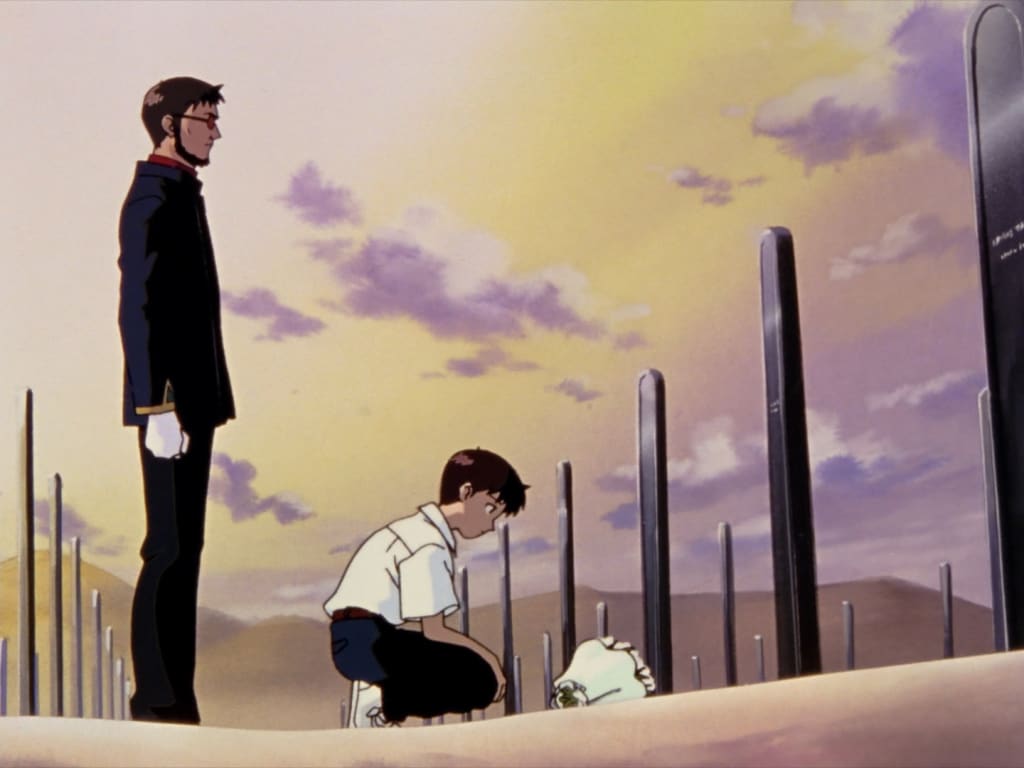
Big robots, alien-like creatures, a pet penguin and a protagonist who looks like your average student in Japan - oh this will be a fun anime.
That's what I thought. Boy was I wrong.
On the surface, Neon Genesis Evangelion looks like your typical mecha anime where big robots fight each other and save humanity or something. It's only when you dive deeper into the series and start living alongside the characters you realize that this is a cognitive study of a young man's identity and a journey into the psyche of individuals that have problems far more toxic than extraterrestrial invasions and humanity's survival.
A Promising Premise
Neon Genesis Evangelion revolves around Shinji Ikari, a 14 year old boy who is summoned under the orders of his father Gendo Ikari to NERV, an agency that fights against Angels, the biggest threat to humanity's existence. Gendo is also the commander of NERV, and instructs Shinji, who has no prior experience in warfare, to pilot an EVA - a "giant humanoid being of near-godlike power" to repel an incoming Angel attack.
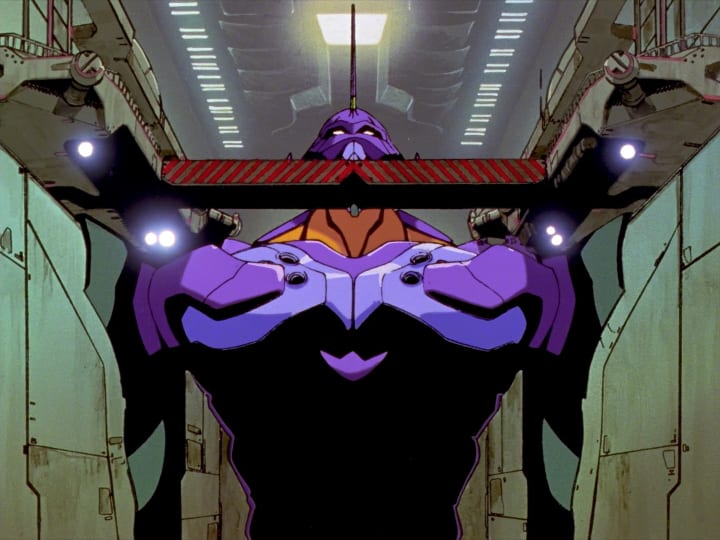
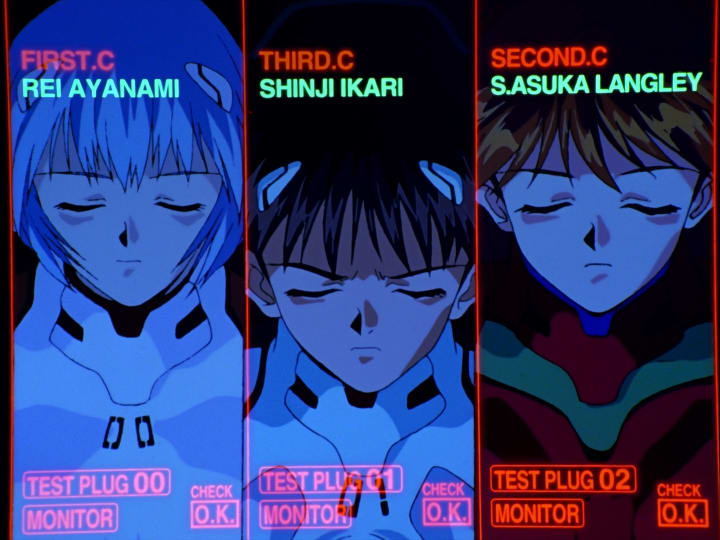
Throughout the series, Shinji teams up with other EVA pilots which include the reserved Rei and the loud and insufferable Asuka, as well as his guardian Misato who is also the operations director at NERV to defeat various Angels in an attempt to prevent an event called the "Third Impact" - which would bring about the downfall of humanity.
While Shinji attempts to adjust to this sudden change in his lifestyle, he simultaneously starts ascending the ladder of self-exploration. This comes with risks that disrupt his functioning, as he continues to be tormented with not only the existence of these Angels and the fate of humanity at stake, but by the lost memories of his departed Mother, the emotionless and cold treatment of him by his father, who only views him as the pilot of an EVA and not his son, as well as his fellow pilots who have their own issues with self-exploration they are trying to make sense of.
This leads to some stellar storytelling and character probing, and after a point, completely goes off the path it's expected to go. Yet, even after taking a detour to get across to you it's intended meaning about existentialism and what it means to fight for yourself, the story is wrapped up rather neatly with a canon film that was released a few years after the original run.
The Bamboozle
Spoilers from this point onward.
Somewhere around the halfway point of the anime, the story starts being told in a darker manner. The continuously action packed episodes are replaced by more grounded, cerebral episodes, showing us an insight into the traumas that many of the characters have endured in the past, as well as the truth and the real motive behind the Evangelions as well as 'The Human Instrumentality Project' - an event that would unite all of humanity's individual souls and fuse them into one in order to attain humanity's evolution. This would cause there to be no more insecurities or flaws in human beings, as everyone will be one and the same. This would also mean that there were no more humans on earth, as we alternatively see in the sequel film 'The End of Evangelion'.
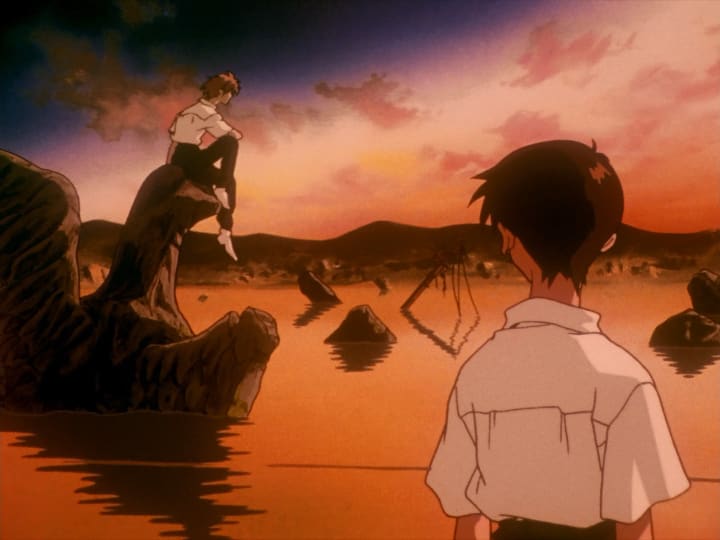
Once the show goes beyond it's halfway point, the fast paced action starts to subside a bit but the narrative is carried forward without a hitch until the 24th episode. The deterioration in Shinji's mental state from being inside EVA Unit-01 and constantly being deployed to fight the Angels begin to take their toll on his personal life. There are battles sprinkled throughout the second half of the series, and they feel much more heavier now because of the mental stakes attached to each character. Shinji has to navigate the ups and downs of teenage life, while at the same time trying to gain approval from his father, develop relationships as well as getting constantly belittled by his roommate Asuka, for whom he has confusing sexual and romantic feelings. He is faced with ethical and moral dilemnas, like being asked to kill his classmate Toji because he gets involved with some messed up Angel takeover. On more than one occasion, he is shown to be restless, afraid or even completely exhausted with what's being asked of him, as he quits NERV twice but comes back eventually.
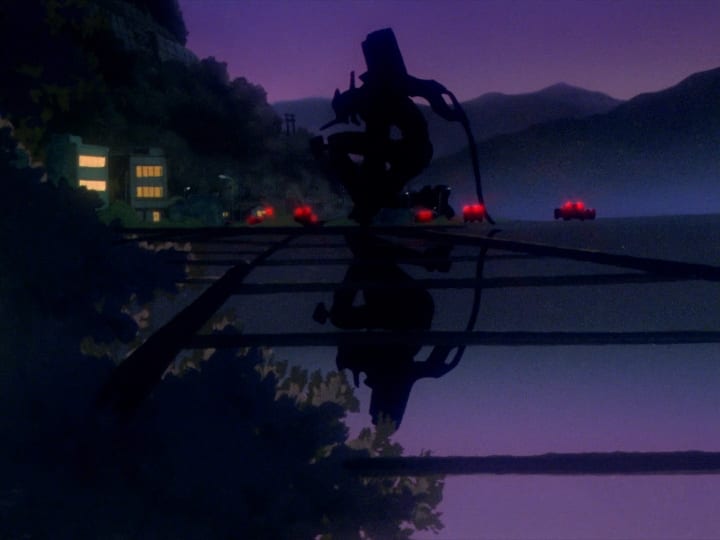
The most fucked up thing this boy has probably seen up close (before the Instrumentality thing happens, at least) is when it comes to the aforementioned butchering of his classmate and fellow pilot Toji, whose EVA Unit was taken over by an Angel and is now battling against Shinji. Shinji, although not knowing who was inside that EVA, decides to disobey command and look for alternate solutions to get the pilot to safety first. Yet, Gendo orders Shinji to destroy that EVA no matter what. After Shinji's refusal to do so, Gendo activates a mechanism called the 'Dummy Plug' within Unit-01, where the EVA develops it's own sentience and doesn't need the pilot to operate it anymore. While Shinji is helplessly trapped inside of the EVA, he watches his own machine ruthlessly dismantle Toji's, to the extent that it's fatal for the pilot itself. Shinji, a helpless boy, trapped inside of a killing machine, is what probably sums up Neon Genesis Evangelion as a whole. All his life he's had no control over his life, being dictated by what to do and what not to do by people who don't care about his wishes.
The End of the World
The ending is a controversial one, because there are two ways that the ending has been told, one through the original series' episodes 25+26, and one via the ending of the film aptly titled 'The End of Evangelion'. Both the endings roughly happen during the same time, it's only the perspectives and presentation of them that's different.
Note: Though contrary opinions exist on the Internet saying they are two different endings, completely different to each other because fans didn't like the original ending. I refuse to believe that, though.
The End of Evangelion takes place during the Third Impact and the activation of the Instrumentality Project. The lore and significance of the various imagery and symbolism of EoE's ending is too much for my pea brain to explain, but basically the ending of EoE wipes off all of humanity, turns them into Fanta like particles, and merges all the souls of humanity into one because Shinji decides that he doesn't want to live in a world which torments him and makes him feel so shit about himself anymore.
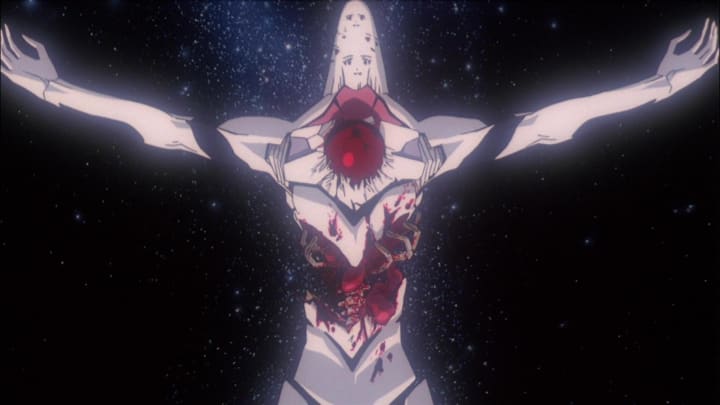
In the original run, we don't get to see any of the action. Parts of the two-episode finale take place inside of the character's heads while the Third Impact goes on outside in real time. It's a well crafted psychological inspection and analysis of what the characters are going through, seeing the world around them burn and collapse. Shinji's decisions in End of Evangelion are explained through a cognitive lens in 25+26 and why he decided to trigger the Third Impact.
"There's no way you can live by linking just the enjoyable moments like a rosary"
However, the beauty in both the endings lie within it's message. Shinji, after causing humanity to merge into one consciousness, realizes that Instrumentality is a very lonely space. Shinji, despite being alone, neglected and comfortable being by himself until this point, realizes that real happiness can only be found among others. The pain of existing alongside others can be quite hurtful, but Shinji realizes that he doesn't want to hide and run away from the sorrows and responsibilities in this world, and that the joy of being alongside others outweighs the pain. Thus, he reverses the Instrumentality and decides to go back to the real world and face his mental demons and continue to live, despite all the hardships.
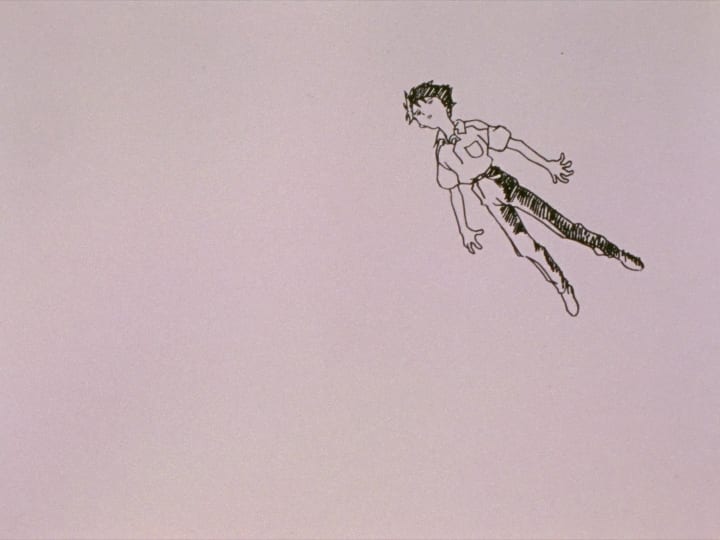
I like to believe this is when the iconic 'Omedetou' (Congratulations) scene occurs inside Shinji's mind, which is also the last scene of the original series. Shinji, once he realizes that he will continue to live on, has a vision in his head where everyone he knows, loves and always wanted to gain approval from, appear around him and congratulate him on winning his mental battles, including people who are dead, like his mother. This is a very powerful and a tear-jerker of a scene, accompanied by a hauntingly beautiful soundtrack that signifies the triumph of Shinji Ikari against not only the monsters in the real world, but also within his head. As one comment on a video of this scene on YouTube puts it:
"This scene is so incredibly powerful if you have ever witnessed depression and anxiety issues. Congratulations to everyone being alive." - Vee.
The Lessons and Mental Lesions
The final two episodes and The End of Evangelion are one of the most important stories told in anime in regards to mental health.
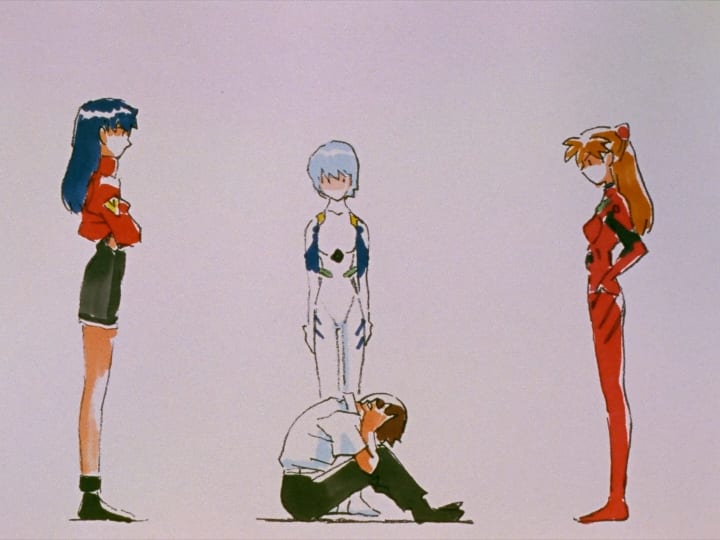
Shinji Ikari was created in a way to tell the story of self-discovery and positive identity, and not about saving the world. For the world he eventually goes on to save is the one inside him, the creatures he defeats are vices like existential dread, loneliness and the need for external validation. The realization that getting rejected and hated on is completely okay, because when the good things come, which they will eventually, experiencing the not so good things first will make them much more worthwhile. Shinji pilots the EVA Unit-01 because he thinks that if he does so, other people will need him. They'll need him to save the world. That they'll give him value. But by the end he realizes that the only person who can give him value is himself. He's willing to come back and live his life, because he feels like maybe, maybe he can start to love himself instead of cowering in an existential space where he has no flaws and no responsibilities. In the brilliant finale of the original series, Shinji overcomes his fear of inadequacy and decides that he has a right to live his life, to exist in this world, to grow and change himself.
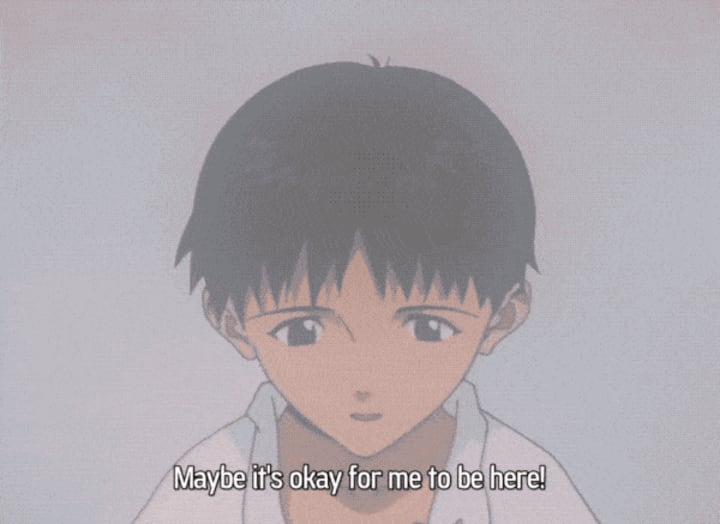
I think everyone who watches and finishes Neon Genesis Evangelion will each have their own interpretation of the ending and the message behind the story based on what they went through or are going through. The negative markers that we set for ourselves aren't real, they are just what we conjure up and romanticize in order to feel like we have something in common with the rest of the people in this world. No one ever told Shinji he's not lovable, no one told him that he is a failure, no one told him that he is shit at making meaningful connections. For Shinji, once he realizes that it was him saying these things to himself all along, breaks free of the chains holding him back and decides to continue living his life and chooses the harsh, cold but human reality over escapism.
_ _ _ _ _ _ _ _ _
My other work: The Slept-On Anime of Spring 2021
*Note: Images are sourced under the Copyright Disclaimer under section 107 of the Copyright Act 1976. Allowance is made for “fair use” for purposes such as criticism, comment, news reporting, teaching, scholarship, education, and research.
I do not own any of the screencaps.
The final GIF taken from - DoctorNerdLove
About the Creator
Abhik Deb
Student journalist based in Bangalore specializing in the sphere of pop culture and football.
A Knight of the Seven Kingdoms Series Review (Season 1)
As one of the biggest properties in fantasy, A Song of Ice and Fire remains immensely popular with audiences. After reaching far into the past with House of the Dragon, a second spin-off was on the cards. A Knight of the Seven Kingdoms serves up a bite-sized slice of action and drama, but it still claims a spot among the best small-screen titles.
By Robert Cain16 days ago in Geeks
Anthony Michael Hall: Did he channel Donald Trump on Psych?
Was Donald Trump the inspiration for Harris Trout? Anthony Michael Hall has had a stellar career that began when he was seven years old. At eleven, he was the little boy known as the Honeycomb Kid in a television commercial. In March 2013, he appeared in three episodes of the final season of the USA drama Psych.
By Cheryl E Prestonabout 20 hours ago in Geeks



Comments
There are no comments for this story
Be the first to respond and start the conversation.