
Movie Review: "Suspicion" (1941)
5/5 - a triumph of tension...


Alfred Hitchcock’s Suspicion (1941) is a fascinating exploration of love, trust, and the darker shadows that lie beneath the surface of human relationships. With its suspenseful narrative, arresting performances, and meticulous craftsmanship, the film stands as a testament to Hitchcock’s genius in the realm of psychological thrillers. Combining moments of levity with an overarching sense of dread, Suspicion keeps viewers riveted from start to finish.
The story centres on Lina McLaidlaw, portrayed with remarkable sensitivity and nuance by Joan Fontaine. Lina is a shy, intelligent woman from a wealthy family who falls for the rakishly charming Johnnie Aysgarth, played by Cary Grant. Their whirlwind romance culminates in marriage, but as the story progresses, cracks begin to form in their seemingly idyllic life. Johnnie’s carelessness with money, his evasive behaviour, and his penchant for telling lies raise Lina’s suspicions. When circumstances lead her to believe he may even be capable of murder, her mental health begins to unravel. Fontaine’s portrayal of Lina’s gradual descent into paranoia is both haunting and compelling, earning her a well-deserved Academy Award.
One of the most captivating aspects of the film is the narrative’s psychological depth. Hitchcock excels in portraying Lina’s growing unease, drawing viewers into her mindset as she struggles to reconcile her love for Johnnie with her growing fear of him. The tension is carefully escalated through subtle cues and cleverly constructed scenes, leaving audiences questioning Johnnie’s true nature. Is he a dangerous murderer, or is Lina’s paranoia clouding her judgement? This ambiguity lies at the heart of the film, and Hitchcock masterfully sustains it throughout.
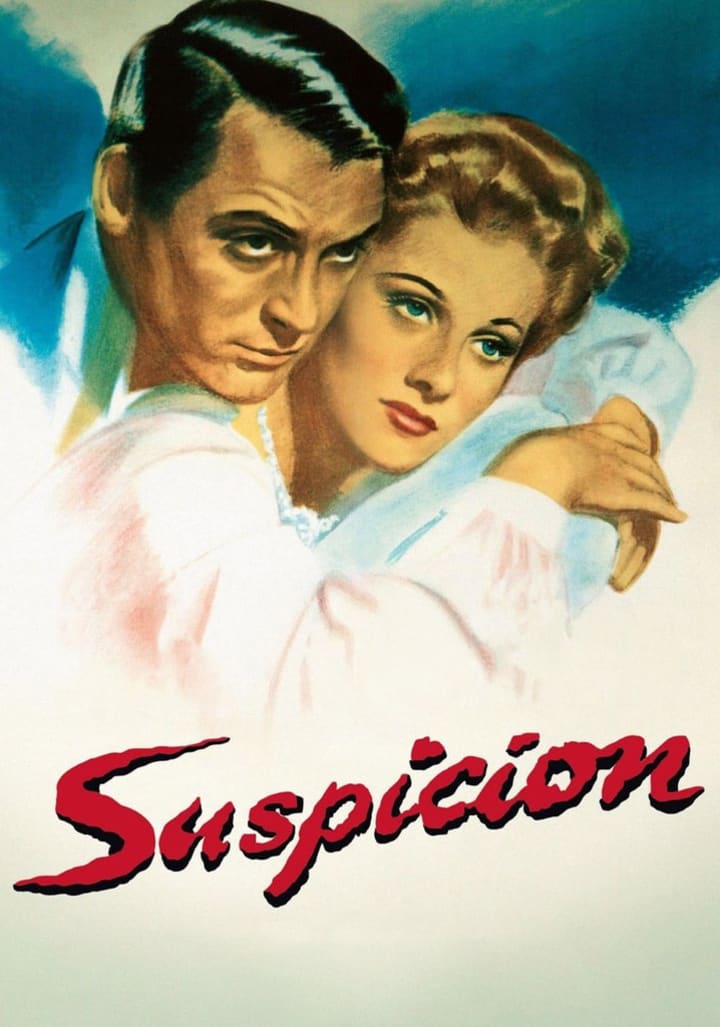
Cary Grant’s performance as Johnnie is equally vital to the film’s success. Known for his effortless charm and debonair persona, Grant brings an intriguing complexity to the role. On the surface, Johnnie is charismatic and playful, which makes it easy to see why Lina is initially drawn to him. However, Grant’s performance also hints at a darker, more manipulative side, keeping the audience as unsure of his intentions as Lina herself. Despite the film’s serious subject matter, Grant also provides moments of casual comic relief that feel natural and well-timed. One particularly memorable instance occurs when Johnnie receives a set of chairs as a wedding gift and cannot comprehend their purpose. His exaggerated confusion and a cheeky glance directly at the camera break the tension and honestly, really do make you realise that he can practically play any kind of character.
Visually, Suspicion is a masterpiece. Hitchcock’s use of light and shadow adds an almost gothic quality to the film, enhancing its atmosphere of foreboding. The interplay of darkness and light often serves as a visual metaphor for Lina’s mental state, with shadows creeping into her world as her doubts about Johnnie grow. One particularly striking motif is the use of shadow patterns that resemble a spider’s web, which appear across the couple’s home. This imagery subtly suggests entrapment and danger, reinforcing the idea that Lina may be ensnared in a perilous situation. The cinematography is meticulously crafted, with each frame contributing to the film’s mood and themes.

The tension in Suspicion is further heightened by its evocative string-based soundtrack, composed by Franz Waxman. The music underscores the rising stakes, with its unsettling melodies mirroring Lina’s growing anxiety. In key moments, the score becomes almost unbearable in its intensity, amplifying the viewer’s sense of dread. Hitchcock’s use of music is never gratuitous; instead, it works in perfect harmony with the visuals and narrative to create an immersive and emotionally resonant experience.
Another strength of the film is Hitchcock’s ability to balance psychological drama with moments of levity. The aforementioned scene with the chairs is a prime example, but there are other moments where Johnnie’s charm and wit provide a welcome contrast to the underlying tension. This balance prevents the film from becoming overly grim and makes the darker moments all the more impactful. It also serves to make the characters feel more human and relatable, as their interactions are not solely defined by the looming spectre of mistrust.
All in all, Suspicion is a film that thrives on ambiguity, and this is perhaps its greatest strength. Hitchcock deliberately withholds definitive answers, forcing viewers to engage with the story on a deeper level. The film invites multiple interpretations, and its open-ended nature ensures that it lingers in the mind long after the credits roll. This is classic Hitchcock: a director who trusts his audience to grapple with uncertainty and draw their own conclusions.
About the Creator
Annie Kapur
I am:
🙋🏽♀️ Annie
📚 Avid Reader
📝 Reviewer and Commentator
🎓 Post-Grad Millennial (M.A)
***
I have:
📖 280K+ reads on Vocal
🫶🏼 Love for reading & research
🦋/X @AnnieWithBooks
***
🏡 UK
Keep reading
More stories from Annie Kapur and writers in Geeks and other communities.
Book Review: "Harriet Said..." by Beryl Bainbridge
I started my Beryl Bainbridge journey this year with a book entitled A Quiet Life and yet, I did begin unsure. After a while, I saw Bainbridge could be witty, write beautifully and grow a story of one character so much that the reader is immersed in learning about them. But when I read Harriet Said... it wasn't like that at all. This book is scary, creepy and reads almost dangerously - as if the reader is reading something they're not really supposed to know. It's a completely different novel and yet, it is just as good - if not better. It reminds me of The Book of Goose by Yiyun Lee, but it goes much, much further into the darkness of power dynamics.
By Annie Kapurabout a year ago in Geeks
Marvel Zombie
The last entry into our 2025 superhero projects catalogue is Marvel Zombies. This was a show that was anticipated by absolutely no one and it disappeared from the public consciousness as quickly as it was released. There was nothing special about the project that made it a must see, or a must remember. In fact if anything it's a must forget.
By Alexandrea Callaghan27 days ago in Geeks
Emma Watson, Sir Lenny Henry and Sir Elton John lead British Diversity Awards
The prizes will be handed out at a glittering ceremony in London on March 25 2026 and Harry Potter actress/activist Watson will compete with Henry and John for the top gong of Media Personality of the Year with the musician competing alongside his husband David Furnish.
By Dena Falken Esq7 days ago in Geeks




Comments
There are no comments for this story
Be the first to respond and start the conversation.