
Marlon Brando’s The Formula (1980): Why Brando Did It, Why Avildsen Disowned It, and What really happened
An in-depth look at Marlon Brando’s role in The Formula (1980): what he said afterwards, on-set friction, director John G. Avildsen’s attempt to remove his name, and how the film became a cautionary tale in Hollywood late-career projects.

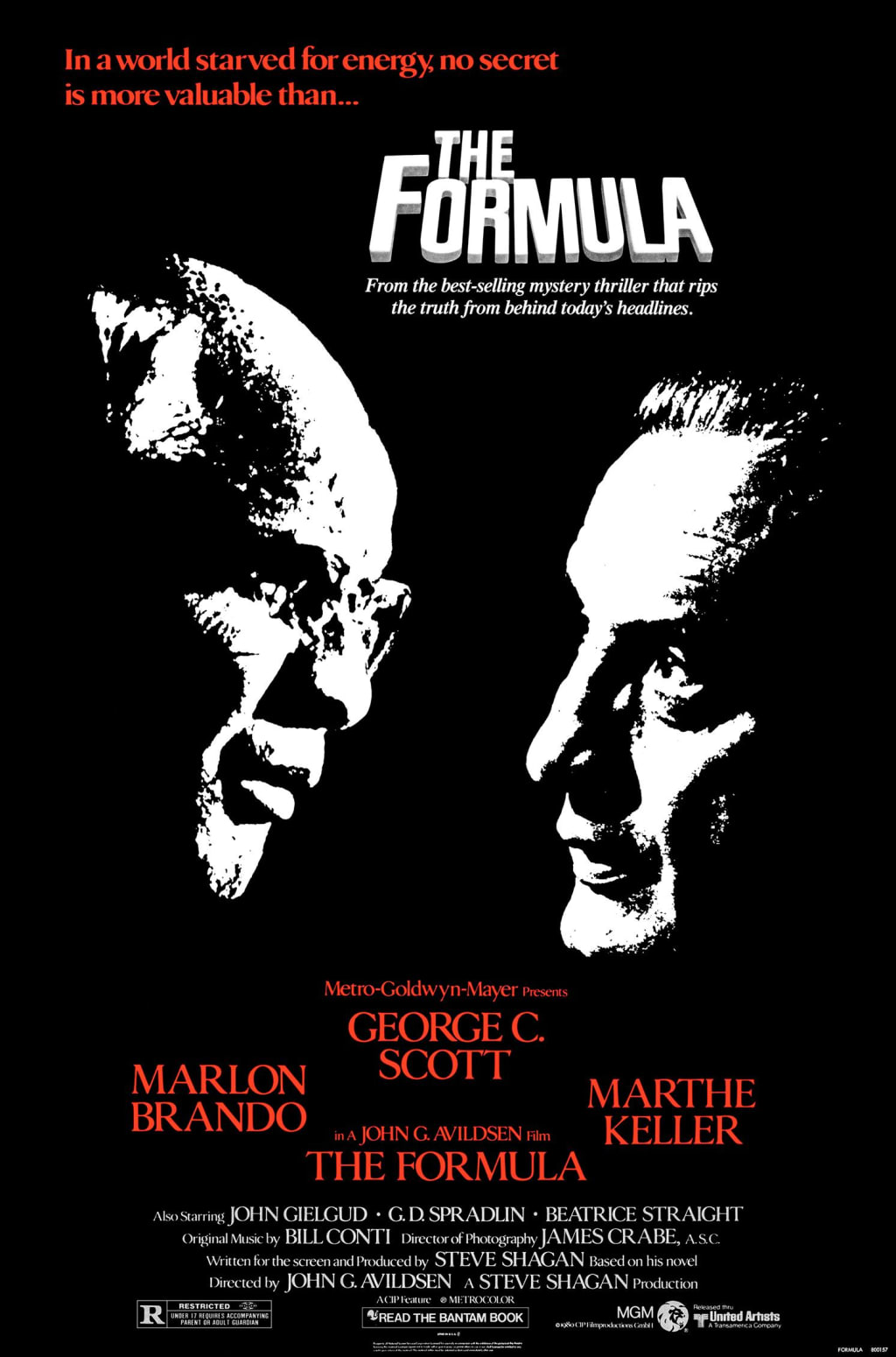
In the pantheon of 1980s cinema, The Formula stands out as one of Marlon Brando’s more controversial late-career films—not for its box-office glory so much as what happened behind the camera. Between tension over editing, ideological clashes, and Brando’s later dismissal of the film, it’s become a case study in how even big names can’t always save a troubled production.
⸻
Why Brando Signed On
Marlon Brando took the role of Adam Steiffel, a powerful oil baron involved in suppressing a Nazi-era synthetic fuel formula, in The Formula (1980). The film was based on Steve Shagan’s bestselling novel, which Shagan also adapted for screen. Brando was a major draw, and his presence gave the story gravitas. The premise—secret fuel formula, global conspiracies, moral corruption of big industry—had appeal in an era increasingly sensitive to energy politics. Brando himself was concerned about the use of fossil fuels and electricity. He first met with Steve Shager and John G. Avildsen at his home in near complete darkness, lit only by candles.
⸻
Editing, Messages, and Who Wanted What
From what critics reported at the time, The Formula suffered from a tug-of-war between two visions. On one side was Shagan, the writer-producer, who cared deeply about the political/ideological dimension: the suppression of fuel formulas, the power of oil corporations, etc. On the other was John G. Avildsen, the director, who apparently wanted more clarity and coherence as a conventional thriller—less message, more tension.
In Ebert’s view, Brando appears in only a few scenes (“three fascinating scenes”) but leaves a strong impression despite the film’s muddled plot. 
⸻
Avildsen vs. Shagan: Letters, Frustration, and Disowning
The most dramatic behind-the-scenes development was that Avildsen reportedly asked for his name to be removed from The Formula. Critics (notably Ebert) reported that Avildsen felt the final product no longer represented his vision. But that request was not granted.
Sources also note that Avildsen and Shagan exchanged letters in the Los Angeles Times after the film’s release. These were public spats about editorial control, plot coherence, and the degree to which ideology vs. entertainment should dominate.
While Avildsen is remembered for his underdog stories (Rocky, The Karate Kid), The Formula is regularly cited in retrospectives (including his obituaries) as one of his more frustrating experiences: a film where he felt overridden by producer/writer decisions, and where the story ended up compromised.
⸻
Brando’s Own Take: Money, Disappointment, and Later Reflections
Brando was not shy afterward about his dissatisfaction. Though there is less documentation of him saying publicly in interviews exactly “the editing ruined it” for The Formula, there is consistent testimony from people who interviewed him (e.g. Lawrence Grobel) that in his later assessments he grouped The Formula with films he accepted primarily for the money, or with projects he felt were not up to his own standard.
Brando also later announced his “retirement” from acting after The Formula, though he did return in A Dry White Season (1989) and The Freshman (1990). He was particularly critical of editing choices in some of those later films, which suggests that his frustrations with The Formula were part of a pattern: taking roles, then being disappointed by the finished product.
⸻
Legacy: What The Formula Teaches About Star Power & Creative Control
For Brando, The Formula remains one of the films he later distanced himself from. It’s not forgotten, nor is it the worst of his later work, but it exemplifies a few key Hollywood dynamics:
1. Power of Editing & Post-Production: Even the most celebrated actor or well-intentioned script can be reshaped in ways that dilute or distort the original vision.
2. Producer vs Director Conflict: In this case, Steve Shagan’s control of both source material and production gave him leverage, while Avildsen, though director, found himself overruled in tone and structure. When that happens, directors may try to disown the result—as Avildsen sought to do. Columnist Marilyn Beck later reported
3. Actor Self-Assessment: Brando’s later public statements show that he was not unaware of how his output in later years might be perceived; he acknowledged choosing money, turning down expectations, and being disappointed by post-production. The Formula fits into that narrative of late-career choices.
4. Critical vs Box Office Reality: The film underperformed financially (budget vs gross was unfavorable) and received mixed to negative critical reactions. Yet Brando’s performance is often singled out as one of the film’s rare bright spots.

Subscribe to Movies of the 80s on YouTube for more of the best of the Movies of the 80s in video form.
About the Creator
Movies of the 80s
We love the 1980s. Everything on this page is all about movies of the 1980s. Starting in 1980 and working our way the decade, we are preserving the stories and movies of the greatest decade, the 80s. https://www.youtube.com/@Moviesofthe80s
Keep reading
More stories from Movies of the 80s and writers in Geeks and other communities.
Jaclyn Smith’s Fight for Control: The Making of Nightkill (1980)
In 1980’s Nightkill, Jaclyn Smith went from TV stardom to psychological thriller — fighting off nudity demands, navigating on-set tension, and finding romance with cinematographer Anthony Richmond. Here’s the story behind the cult desert noir.
By Movies of the 80s4 months ago in Geeks
Marvel Zombie
The last entry into our 2025 superhero projects catalogue is Marvel Zombies. This was a show that was anticipated by absolutely no one and it disappeared from the public consciousness as quickly as it was released. There was nothing special about the project that made it a must see, or a must remember. In fact if anything it's a must forget.
By Alexandrea Callaghan16 days ago in Geeks
Tom Hiddleston Credits Tim Burton’s ‘Batman’ for His Marvel Run: ‘Don’t Think I Would’ve Played Loki Without That Film’ | Video
“When I came to play Loki for the first time, I consciously carried Jack Nicholson in my mind,” the actor says Without Tim Burton’s “Batman,” Marvel fans would not have the Loki they know and love today. At least, that’s what Tom Hiddleston himself thinks.
By Dena Falken Esq4 days ago in Geeks


Comments
There are no comments for this story
Be the first to respond and start the conversation.