
Late Review: 'Samurai Champloo'
A continuous series about movies, music, books and other arts

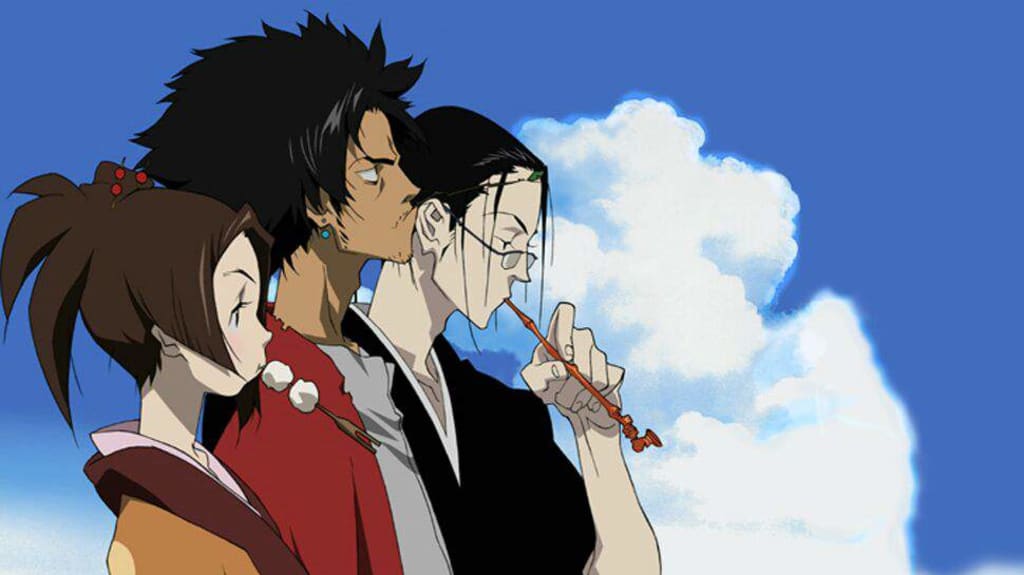
Anime, anime, anime.
Some people can't get enough of it. Some people don't understand it. Whatever your stance on anime is, any fan of film and television can tell you that anime has some way found its way into their television screens at some point.
Take, for example, Saturday morning programming: Pokemon, Dragon Ball Z, Digimon, Yugi-Oh. A lot of the 90s and 80s kids (including myself) grew up watching these television shows. Some other series, such as Cowboy Bebop, Trigun, etc. found their way onto television networks that had dedicated blocks of their airtime to anime. Toonami on Cartoon Network is a prominent one, while other countries like United Kingdom, Japan, and Canada had their own.
Some of these early anime series found much success. Much of their premises are very similar and the structure of its overall story are pretty much the same. Each series follows a group of ragtag protagonists, as they journey to reach their ultimate goal (to be the "best" or to defeat an overarching "evil" usually). There are even some examples of present day shows following the same structure. Shows like Avatar: The Last Airbender, Steven Universe, etc. follow these same principles.
Samurai Champloo is very much the same. Directed by Shinichiro Watanabe (the man behind Cowboy Bebop and Space Dandy), the show follows three characters, Fuu (an orphaned tea girl), Jin (a wandering ronin) and Mugen (a trouble making vagabond) during the Edo Period in Japan. All three characters are 15, 20, and 19 respectively. It's important to note their ages because their maturity and naivety is often critiqued in episodes. Fuu rescues Jin and Mugen after a scuffle, so in order to pay her back, they agree to help her find "the samurai who smells of sunflowers."
Simple set-up, right?
The audience follows our three protagonists as they journey through feudal Japan and that is when the tropes or lack of tropes come into play. Each episode follows a different minor story in the overarching journey. They are episodic in nature. This means there are very few reoccurring characters other than our three protagonists. This is essential, as in each episode, it displays a different aspect of feudal life.
In season one, episode 11, titled "Gamblers and Gallantry" the episode starts as the trio enters a town and must stay, due to heavy rain and bad weather. This is where Jin falls in love with a prostitute and wishes to rescue her so they can run away together. With this quick description, readers might guess that our hero will rescue her from slavery and maybe a connection will be established. This is where the wrench is thrown into the cog. The prostitute, although in love with Jin, denies to be rescued. Feudal Japan society requires her to stay a prostitute unless released or bought off from her owner. She recognizes this and knows they will be hunted down if it does happen. It is the tender moments in which Jin realizes he cannot truly help her and be with her at the same time, that hits home. These subversion of hero tropes in this episode is executed really well.
In another example, episode six titled "Stranger Searching," our three characters meet a new character. He is a tall white Dutchman that speaks in broken Japanese. He wins Jin's and Mugen's weapons in an eating contest, and attempts to leave with them. Fuu convinces him to give back their weapons, but the Dutchman only agrees to this if they take him sightseeing. Throughout the episode, viewers discover the reasoning for the Dutchman to be in Japan. The backstory of the Dutchman is explored in more detail. The audience discovers that the Dutchman is gay. He had journeyed to Japan to escape persecution and possibly find true love abroad. During the Edo Period in Japan, homosexuality was not criminalized like it was in other countries. It takes an interesting stab at this notion. Foreigners were not welcome in Japan unless sanctioned by the federal government. At the same time, it follows an unique path as homosexuality is often not addressed in main stream shows.
At first glance, Samurai Champloo falls into the same category as these anime series. Just some misfits traveling on a whirlwind adventure, but throughout its 26 episode run, viewers will find something odd about the series. Like it was aforementioned, Samurai Champloo looks like any other anime and in some parts of the episodes. Frantic sword fights, our main female character and other side characters always needing to be rescued and crazy amounts of blood. But what many fail to see is that under the surface, this story is relatable. It is just three friends journeying and discovering an unknown world.
Piggy backing off this notion, the ending of this series has this idea seeps into the conclusion of the show.
The Ending Though (Top Tier)
*SPOILERS AHEAD
Near the end of the series, we find Fuu identifying and meeting the samurai who smells of sunflowers. Jin and Mugan are fighting to survive, as they are being hunted down by mercenaries. In the end, our heroes survive and Fuu finally meets her samurai. Then the protagonists meet up one last time and go their separate ways.
That's it. That's the ending of the show.
The end credits roll, as we get a montage of each main character walking through the country side of Japan on their own separate path.
What makes this ending so powerful?
I could write a whole essay about this, however, it can be boiled down to one word: cliche.
In our time on planet Earth, we are lucky to meet certain people in our lives. People that are not there for very long, but somehow make an impact long after they are gone. In this case, the time we spent watching the misadventures of Mugen, Jin, and Fuu is just that. They are lucky to have met each other and they will forever remember the times they had. Yet all good things must come to an end. It sounds so cliche when describing it but it holds true. Some things can be boiled down to simple meanings and so does this. It holds an ambiguity that maybe their paths might cross again but who knows? It's the beautiful simple things that prove to be the most moving sometimes.
Back to the Review
There are very few things that someone could find unappealing about Samurai Champloo.
For example, we hardly find moments of Fuu being a driving force during the series. She is often under attack under the men of the series, which is interesting. Since Samurai Champloo takes place during a slightly altered historic Edo Period, there could have been a possibility for Wantanbe and his writers to dissect the roles of women even deeper.
In conclusion, Samurai Champloo is an excellent anime series, for both casuals and die-hard fans. It is a fun anime filled, both action and comedic moments. The soundtrack throughout the whole series in phenomenal (the closing track fits the ending of the series perfectly). It is an anime I'd recommend to anyone who loves a good quality show.
Rating: 9/10
*Also one of my own personal favorite series.*
About the Creator
George Gomez
A screenwriter writing about reviews and other nonsense.
Keep reading
More stories from George Gomez and writers in Geeks and other communities.
Late Reviews: 'Drive'
What drives a story? Puns asides, people find different stories compelling. Some prefer the drama that unfolds in lavish period pieces, while others prefer the anxiety of a horror story. The viewers ask questions left and right: will the hero/heroine escape with their lives? Will they end up with the love of their life? Who's on their side? Who or what stands in their way?
By George Gomez7 years ago in Geeks
A Knight of the Seven Kingdoms Series Review (Season 1)
As one of the biggest properties in fantasy, A Song of Ice and Fire remains immensely popular with audiences. After reaching far into the past with House of the Dragon, a second spin-off was on the cards. A Knight of the Seven Kingdoms serves up a bite-sized slice of action and drama, but it still claims a spot among the best small-screen titles.
By Robert Cain5 days ago in Geeks
Book Review: "The Great Shadow" by Susan Wise Bauer
There was no reason why I would choose this book to read apart from the fact it had an interesting subtitle and the cover looked quite telling. I like it when the cover to a book looks like it has been worked on to hide things within. I also ended up reading the blurb to the book only to realise it was not only nonfiction, but the topic was about to be expanded upon in a whole host of ways. From how survival instincts move us from cold to hot and back to cold environments all the way through to why children were dying at a similar rate as adults in some cases. We are taken through a look at how sickness, once treated as an individual thing, moved to a group thing and thus, came to change the way we buy things and spend our lives. The COVID pandemic may have taught us somewhat about that, but who knew our everyday consumerism is coated with a deep fear of getting sick?
By Annie Kapura day ago in Geeks



Comments
There are no comments for this story
Be the first to respond and start the conversation.