
Lady Jane Grey
Why It's Shifty (Week 26)


Welcome back to Why It's Shifty and today we're looking at the weird tale of Lady Jane Grey. Known as the 'Nine Days Queen' Lady Jane Grey was a pawn used by King Edward VI of England when he was dying to stop his half-sister, the then Princess Mary, from succeeding to the throne as she was a Catholic. Upon hearing the news she was going to be queen, the teenaged Lady Jane fainted.
But what if she wasn't just some woman who was a passive pawn in English politics? Today we look at the theory that Lady Jane Grey was very much an active player in the fight for the English throne. Maybe, just maybe, she knew exactly what she was in for. Maybe she was an active orchestrator of Queen Mary's retaliation.
Even though she didn't have a coronation, you could say she was in fact, Queen Jane....Approximately.
Plot

Said to be a key figure in the turbulence of the Tudor succession crisis, Lady Jane was one of the great-granddaughters of Henry VII, giving her a small but nevertheless legal, right to the throne. Edward VI was on his deathbed at the age of 15 years' old and required to make sure his Catholic half-sister did not acquire the throne because of his father's reformation constitution years' earlier. Edward VI was raised a Catholic and commissioned the English Book of Common Prayer. There was no way he'd let his 'traitorous' half-sister Mary, who still observed mass in private, ascend to the throne. To prevent her taking the crown, Edward drew up the "Devise for the Succession," naming Lady Jane Grey as his heir.
Lady Jane, only 16 or 17 at the time, was married to Lord Guildford Dudley, the son of John Dudley (Duke of Northumberland), Edward’s chief advisor. On July 6, 1553, Edward died. Four days later, Jane was proclaimed queen. Though her own account later presented her as reluctant, she quickly accepted the crown and issued royal proclamations, signing them "Jane the Queen."
However, support for her reign quickly crumbled. Mary Tudor gathered military backing and popular support in East Anglia. By July 19, just nine days after Jane was declared queen, Mary entered London in triumph. Jane and her husband were imprisoned in the Tower of London. Therefore we can see that the term 'Nine Days Queen' does not apply tot he time between her rule and execution, but between her rule and her imprisonment - a common mistake made by many.
Initially, Mary was inclined to spare Jane, seeing her as a victim of circumstances beyond her control. But following her father’s involvement in a rebellion in 1554 (Wyatt’s Rebellion), Mary signed Jane’s death warrant. Lady Jane Grey was executed on February 12, 1554. Her reign therefore became a symbol of political struggles during the English Renaissance.
Into the Theories

Swift Acceptance
One of the theories (and perhaps the most believable) is Jane's quick acceptance of royal authority. Though it is true that in her own words she was a reluctant queen, she did start signing her name 'Jane the Queen' before a coronation that would never happen. Even though for a long time we did in fact, believe her own words that she resisted power of the throne - we now accept the fact that she insisted on being referred to as 'the Queen' pretty quickly. Some of this even suggests she knew about the plan before we think she did - perhaps even whilst Edward VI was drawing up his plans shortly before his death.
The Committed Protestant with a Motive
Jane was a committed Protestant, highly educated in theology and strongly opposed to Catholicism. Some historians suggest she saw Mary Tudor’s accession as a threat to the Protestant Reformation and believed it her moral duty to accept the crown to protect the faith. This theory casts Jane not just as a political figure but as a religiously motivated actor who believed her claim was divinely justified.
A Politically Aware Young Woman
Jane’s letters and posthumous writings show sharp political awareness and moral conviction. Some scholars believe that the language she used in defending her actions, especially her religious justifications and criticism of Mary’s Catholicism, indicates she saw herself as a rightful monarch rather than a passive victim. This theory posits she was not merely manipulated but intellectually and spiritually aligned with the coup’s aims.
Why It's Shifty
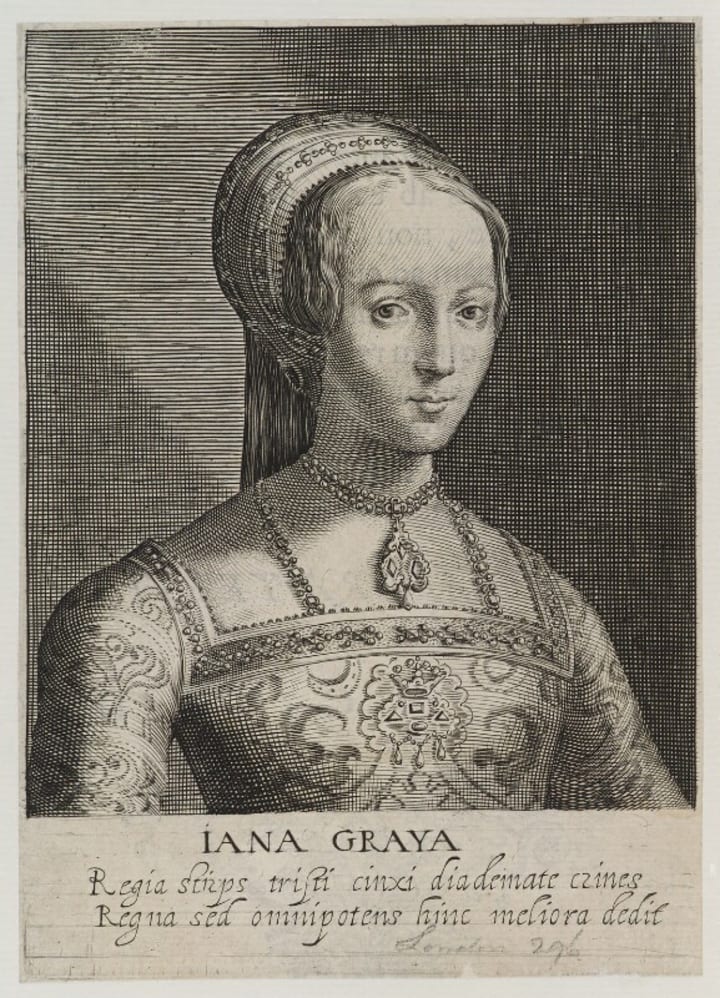
The difference between what Jane has said about herself by accounts, what others have said about her and what she has demonstrated in her short (kind of) reign are three different things. We might accept the notion that Jane wasn't as reluctant queen as previously noted, but how involved she was in the politics of her acceptance of the crown is yet again, a different question. Notes about her personality show that she was very devout as a protestant and yes, quite politically aware. So, how much involvement in the document drawn up by Edward VI did she really have?
Conclusion

Thank you for reading this week's 'Why It's Shifty'. I hope you've enjoyed it being a bit to the side of violence and gore this time. I've been wanting to write about Lady Jane Grey for a while because I've always been interested in British Royal History. I will return to some royal history stuff in the future but for now, on to next week...
Next Week: The Crying Boy
About the Creator
Annie Kapur
I am:
🙋🏽♀️ Annie
📚 Avid Reader
📝 Reviewer and Commentator
🎓 Post-Grad Millennial (M.A)
***
I have:
📖 280K+ reads on Vocal
🫶🏼 Love for reading & research
🦋/X @AnnieWithBooks
***
🏡 UK
Keep reading
More stories from Annie Kapur and writers in Geeks and other communities.
Book Review: "A Girl Walks Into the Forest" by Madeleine Roux
Well, I can't say I've been too active on social media lately. I'm sort of losing it with Twitter and when it comes to BlueSky, I'm basically barely there. Facebook has been alright and I've most been sticking around there especially uploading things to my story. I don't know why but I'm finding Twitter a bit boring and am seriously considering my future there. It's always better to have many different avenues if you are looking to expand your audience for writing but the place has become such a horrid pit of nothing that it almost seems pointless. Well, that's enough of me ranting, time for the review...
By Annie Kapur5 months ago in Geeks
Marty Supreme Review: Timothée Chalamet Is Excellent, The Movie… Not So Much
⭐ Rating: 2 out of 5 stars Marty Supreme Directed by Josh Safdie Written by Josh Safdie, Ronald Bronstein Starring Timothee Chalamet, Gwyneth Paltrow, Tyler The Creator, Odessa A'zion
By Sean Patrickabout a month ago in Geeks
Global Hypermarket Market Size and Forecast 2025–2033
Global Hypermarket Market Outlook The global hypermarket market continues to hold a vital position in the modern retail ecosystem, driven by its ability to combine convenience, affordability, and variety under one expansive roof. According to Renub Research, the Global Hypermarket Market is expected to expand from US$ 776.56 billion in 2024 to US$ 998.28 billion by 2033, registering a compound annual growth rate (CAGR) of 2.83% from 2025 to 2033.
By jaiklin Fanandish6 days ago in Geeks



Comments (2)
Excellent article for us, and I did see the Dylan reference
I hadn’t heard of Lady Jane Grey before this. Really fascinating to learn about her story and the idea that she might have played a more active role than history usually gives her credit for.