
"Jane Austen at Home" by Lucy Worsley (Pt.3)
5/5 - can this book simply never end?

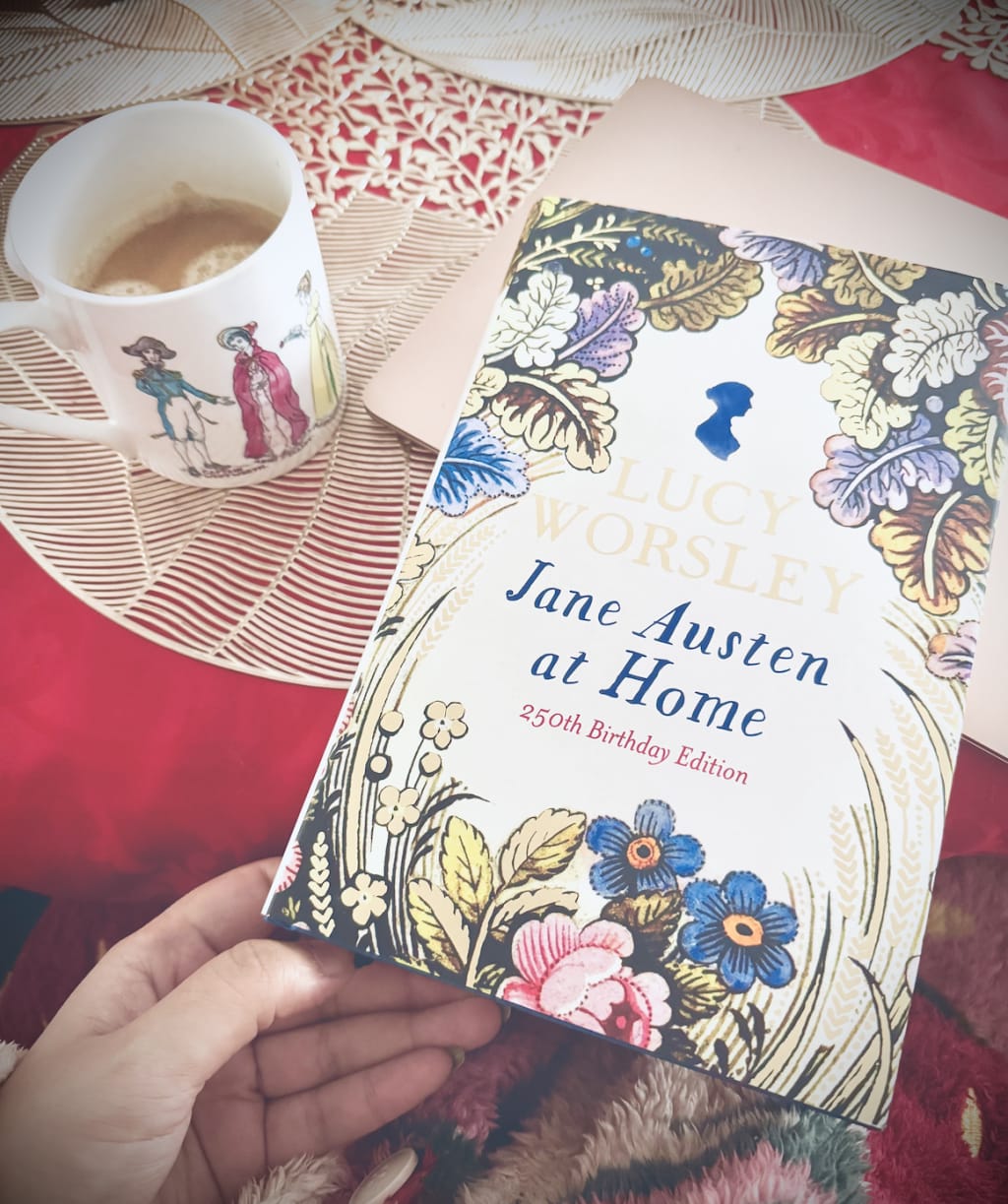
This review covers chapters 19 through to 26.
***
As we continue through the story of Jane, Lucy Worsley gives us something to chew on. We get the story of the first writing of my personal favourite Austen novel, Northanger Abbey - originally entitled Susan. The 'chewing' is to decide exactly when it was being forged. There are known bursts of it in 1798 and 1799, but as the author states, there is certain inspiration from another book that wasn't published until 1801. It is a direct representation that though we may know much about Jane Austen's life from her letters, her everyday mapped out for us, her dislikes and likes seen clearly - we still don't really have the minutae of her writings. It is a bit here and there. Again, maybe this was done on purpose. Jane Austen was clever enough to keep those who didn't need to know in the dark about her actual intentions for the writings and when they were held out.
But I think the bigger story here comes in a chapter entitled Green Park Buildings East in which Jane Austen's father passes away. This is only shortly after the mother of one of Jane's former loves passes away as well. Mr Austen may have been old, but it is clear that his daughters adored him, he was loved by his wife and that everyone who knew him had a good word about him. The narrative presents a bit of a hole in the lives of the Austen family after his death - something that would be reflected in the moving they would do then out. Lucy Worsley shows us how close this family really is through the death of one of their most beloved members and tells us this story with a darkness coated with compassion. It is unusual to see this done for a patriarch of a family in this time period. He was not violent. He was not patriarchal. He was a simple man who loved his family. And that is how he left the world.
One of the sections I really found interesting dealt with the move out of Bath and towards Southampton. We get this writhing history of Southampton in which it is struggling to really know its place in the world - much like the characters of Jane Austen's novels. Southampton, according to Lucy Worsley and her historical research, wanted to present itself as a 'spa', an up-coming city much like Brighton was starting to present itself as. But, Southampton falls short and is, at best, a port. There are interesting things to learn about the history of the city and even though this shifts away from our subject, it does show us what the city would have looked like in the time of Jane Austen and the Georgians.
This book therefore, (if it was not already obvious) doesn't only show us the life of Jane Austen, but depicts what her world would have looked like, where she stepped and what the culture around her really was. This is because that though Jane was definitely a woman of her time, she was also an introvert, a subversive, a political feminist, but also a woman who wanted to tell this story: sometimes the culture is wrong. Sometimes, it gets it all a bit upside-down.
By Chapter 24, we are moving into Chawton Cottage. It's Act 3 of the text and Lucy Worsley wastes no time in explaining this little, often overcrowded, home is to Jane and her writing. Some of her novels would be written and rewritten here, including a rewrite of Northanger Abbey and the final draft of Pride and Prejudice (previously these were titled Susan and First Impressions). I was quite surprised to also learn that the most famed portrait we have of Jane Austen (which is a sketch) apparently doesn't look anything like her at all. Lucy Worsley states that Jane's appearance doesn't matter and I have to agree: Jane Austen became the 'everywoman' that every woman needed (and still needs) in their life. She is a best friend, a sister, a gossipy cousin, a sarcastic aunt and most of all, the most elusive and famed Georgian sensibility writer. It definitely doesn't matter what she looks like.
When Jane finally gets her work published, it is the novel Sense and Sensibility in 1811. She is thrilled. But she is not the first in her family to be published and definitely is said to have resented Edward for publishing his sermons before her works were released. But I can honestly say that nobody has ever heard of Edward's sermons, yet over two centuries later we are still reading the works of Jane Austen - so in the end, she won. When Pride and Prejudice is released, there is a lot to be said about it. It is praised for being a great novel as it is slated for being overly realistic and therefore, is said to be without creativity (I'm sorry, I just vomited at the very thought of someone saying that Pride and Prejudice doesn't have creativity). Something I very much enjoyed reading about was what Charlotte Bronte had to say about Pride and Prejudice because well, you couldn't put a gun to my head and make me choose between them:
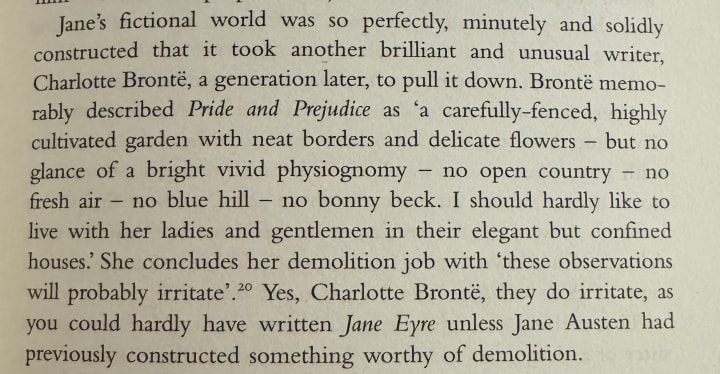
(Note: though Jane Eyre is one of my all-time favourite novels, I have to agree with Lucy Worsley here. Jane Eyre is where Thornfield Hall represents Pemberly and Bronte 'dismantles' it through the domestic gothic. It is a different side to another coin. One cannot exist without the other).
As we press on through the book, I would like to state that I have thoroughly enjoyed myself so far and the very reason for this review being split into parts is because I did not want this book to end. I wish it had never ended at all.
About the Creator
Annie Kapur
I am:
🙋🏽♀️ Annie
📚 Avid Reader
📝 Reviewer and Commentator
🎓 Post-Grad Millennial (M.A)
***
I have:
📖 280K+ reads on Vocal
🫶🏼 Love for reading & research
🦋/X @AnnieWithBooks
***
🏡 UK
Keep reading
More stories from Annie Kapur and writers in Geeks and other communities.
Book Review: "Jane Austen at Home" by Lucy Worsley (Pt.2)
This review covers chapters 10 through to 18. *** Chapter 10, entitled 'Novels' covers Jane's written beginnings. We get to see inside the first formations of the novel that would become Sense and Sensibility and how, in installments, she would read it per evening to her family. These were novels written in letters, which were not in fashion and had not been for decades. I'm quite surprised and filled with joy that such an incredible woman existed in a place where more than often, extra-curricular activities outside that of being a wife and mother were not considered very important. However, her father thought them important enough to buy his daughter a writing desk with many drawers. This single act of encouragement was definitely a play to make sure his daughter continued to show her passions - a man clearly ahead of his time and fond of his daughters.
By Annie Kapura day ago in Geeks
No Other Choice (2025)
It is only February, so other films may well surpass “No Other Choice”, but I think this is the best film I’ve seen so far this year. And that surprises me, because, it is a subtitled film and while I am pretentious enough to choose to watch foreign-language films, I was also very tired and that was an extra commitment from me. But more importantly, let me warn you, this film is gruesome and violent. There were times I had to turn away from the screen to avoid the worst of it (including some self-inflicted dentistry).
By Rachel Robbins2 days ago in Geeks
How to Get Government App Contracts in San Diego?
For many technology companies, government contracts represent both opportunity and mystery. Unlike startup clients or enterprise customers, public sector agencies operate under structured procurement processes that can seem opaque from the outside. Teams often assume that winning a contract depends solely on offering the lowest price or the most advanced technology.
By Samantha Blake2 days ago in Geeks



Comments
There are no comments for this story
Be the first to respond and start the conversation.