
If JoJo Rabbit, then Fleabag
Spoiler Alert: Feelings will be felt (seriously though, spoiler alert).


Feelings: our ultimate TV guide
I believe it is the feeling we seek that steers our movie or television choices. We select a story to feel love, to be thrilled, amused, inspired, optimistic, or comforted. Cinema can be our escape from feeling scared, lonely, sad, sorrowful; or it can be our excuse to feel scared, lonely, sad, or sorrowful. Through story, the screen in front of us allows us to connect to our emotions, and each other. How we felt when we first planted our bums on the couch, has changed, all of forty five minutes later. We travel through an array of feelings, and come back to the screen to feel it again. We watch television and movies to feel human.

I want to preface my argument with a massive spoiler alert of the details on both stories that I will introduce. My intent is to prove that two stories, with largely different storylines, can attract the same audience, through the feelings they provoke. I found it all too easy to connect mockumentary workplace comedies and use talented directors of various films to prove my "if this, then that" point. I will be honest, I could talk about The Shining for days, and connect it to various films. I cannot bear to however, waste your time by explaining to you that if you like a film with Chris Pratt in it, you will probably love Parks and Recreation. So, if you choose to read further, please note that my goal is to show that in choosing a film or television serious, we are choosing how we want to feel.
If Jojo Rabbit, then Fleabag
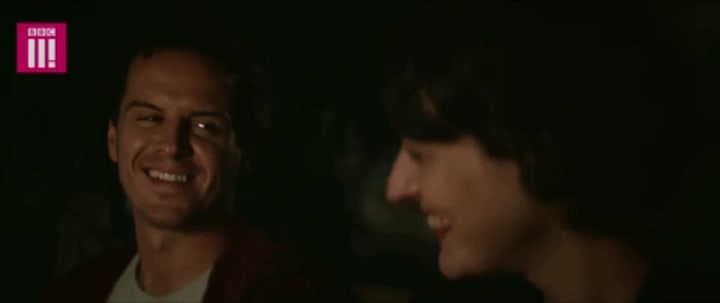
If you enjoyed Jojo Rabbit, then you will love the series Fleabag. Jojo Rabbit is satire, comedy-drama that follows a young, dedicated member of the Hitler Youth, as he discovers that his mother is hiding a Jewish girl in their home. Johannes discusses his innermost turmoil and fears to his imaginary friend, Adolf Hitler. Fleabag is a black-comedy television series following a hot mess female protagonist. Fleabag constantly shares her honest musings by breaking the fourth wall, and communicating directly to the audience. Navigating casual trysts and the modern world, Fleabag is desperately trying to escape the pain of the accidental suicide of her best friend, Boo. What could these two stories possibly have in common? The feelings and emotions they evoke.
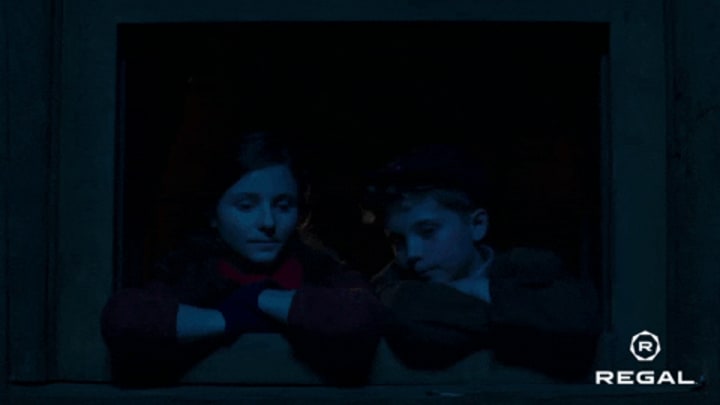
While each story takes place in vastly different timelines, and feature wildly contrasting protagonists, they give the audience a similar experience, through emotions. By using a brutal, transparent honesty, both stories elicit amusement through tragedy. These stories summon sadness and loneliness in the loss and devastation of death. The two tales both tackle the emotion of unrequited love, and acceptance by presenting the protagonists with forbidden love. Finally, both narratives evoke fear, by illustrating the ultimate risks life presents.
Amusement
Johannes first earns his nickname of "Jojo Rabbit" when he cowers away from killing a bunny rabbit while at Hitler Youth Camp. Jojo is called a "scared rabbit" by his peers after being unable to kill the little bunny. Devastated and humiliated, Johannes confides in his imaginary friend. Adolf explains that he too, has been ridiculed by his peers, "this guy's a lunatic. Oh, look at that psycho, he's going to get us all killed." Adolf inspires the ten year old to outwit his enemies, and "be the rabbit". This comedic moment of Adolf encouraging Johannes leaves the viewers in stiches. The audience watches, as Hitler motivates Johannes to charge ahead, without caring about judgement. This transparent honesty that Adolf shares about his own insecurities and doubts, somehow allows an amusement for the man who lead the tragedy, destruction and genocide of World War II.
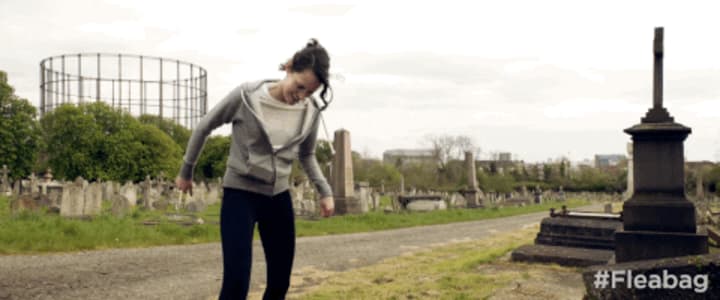
Fleabag is no stranger to tragedy. Having lost her mom after double mastectomy's and never recovering, she joins her sister to mourn at their mothers grave. Sitting across from the grave, she admits to "having a fart the other day that was exactly like mom's". On the same, dry-humored note, her sister deadpans back, asking, "a door opening, or a suspicious duck?". This bluntly honest conversation about flatulence brings humor and amusement to the solemn tragedy of death. The same dark humor is used again, when Fleabag's sister, Claire, stares directly at the grave of their mom, and says she cannot wait to be old. Joke after joke, there is amusement amongst death of their mother.
Sadness and Loneliness
Johannes is questioned by the Gestapo, who seem to be suspicious of his mother hiding Elsa, the Jewish girl, in their attic. He then returns to posting Nazi propaganda posters about town. While doing so, Johannes discovers his mom, Rosie, hung at the gallows in the public square. Gutted, he hugs her shoes, and ties her shoelaces, as she used to do for him. Johannes has now lost his mother, and sister Inge, and feels incredibly sad and alone. He returns to his home, distressed and crushed. Johannes tries to hurt Elsa, and instead realizes she is all he has left.
Fleabag is desperate to keep her Guinea-Pig-themed-Cafe afloat. It is all she has left of her best friend Boo, who died by accidental suicide. Fleabag feels responsible for Boo's death, and punishes herself by isolating herself, and denying all offers of true connection and companionship. She also perpetuates her sadness and loneliness by continually seeking casual sex. Furthermore, when offered support, she turns it down, and says she is okay. Claire, offers Fleabag a hug, and a drink out, and in response Fleabag rejects both offers. Moments following, Fleabag attempts to ask a complete stranger out for a drink. The loss of her best friend Boo leaves Fleabag feeling sad and lonely; in an endless state of self induced isolation.
Unrequited Love
While slowly warming to his hidden-in-the-wall enemy, Johannes soon enlists Elsa's help in writing an exposé on Jews. At first, he drafts "Yoohoo Jude", depicting Jewish people as beastly monsters, attracted to ugly things. Johannes finally starts to understand that in demonizing Elsa's race, he is hurting her. Jojo is conflicted by his increasing enjoyment of Elsa's company, and is at war with himself in understanding his feelings for her. He consults Adolf on the matter, and comes around to the idea that he is falling for the enemy. "She doesn't seem like a bad person", he tells Adolf. Adolf makes abundantly clear the relationship is forbidden, and would only result in Johannes ultimate betrayal of Germany. Later, when Jojo realizes that he may lose Elsa, due to Germany losing the war, he lies to Elsa so that she will not leave him. He soon confesses his love for her, though she sees him as a brother. Johannes has finally accepted his love for the Jewish girl, although the love is unrequited.
Fleabag meets a Priest at a family dinner, and is intrigued by his untraditional approach to religion, and attractive appearance. While attempting to change her life by dropping all destructive habits, including casual sex, she initially resists the attraction. Eventually, she engages in a few church events with him, and finds she cannot withstand the temptation of the forbiddingness of being romantically involved with a priest. Fleabag opens up to the priest about her loss of her best friend, and finds the attraction only grows. She starts to build feelings for the priest, and he pushes her away, as he is committed to God. When the two finally consummate the relationship, they are each overwhelmed with feelings. The priest soon tells Fleabag, their relationship has only strengthened his connection to God. Fleabag tells him, "I love you", and he responds, "it'll pass." Her love for him is unrequited, and Fleabag is crushed.
Fear
Jojo idolizes his imaginary friend, Adolf, and vows his commitment to Germany. His undying allegiance to Hitler eventually is faced with the reality of his mothers' death from being a part of the Anti-Nazi movement. Petrified from the death of his mother, he fears losing Elsa, and also fears loving Elsa, as she is the enemy. He is faced with the ultimate risk of loving the enemy, as well as losing the only person he loves. Jojo must encounter each fear, and relinquish of his loyalty to Hitler. As Hitler is a direct reflection of Jojo's ego, insecurities and doubts, it is scary for him to confront, and reject Adolf. Johannes bravely confronts the fear, boot-on, and kicks Adolf out the window. He rids himself of his fear, and is free.
Fleabag is fearful of connection and vulnerability, from losing her mother and Boo. The connection and love she had with both her mother and Boo was so dear to her heart, that she never wanted to lose someone again. She avoided all forms of true connection and emotional investment, by participating in surface level relationships, and fleeing any relations that veered on the side of meaningful. When she developed feelings for a priest, she is forced to risk the loss, and be vulnerable, revealing her love for him. She does so, already knowing the relationship will never work, yet jeopardizes the perceived loss, to finally allow a true connection into her life. Her fear is sadly reinforced, as she loses another meaningful relationship.
From Scared Bunnies to Cringe-Worthy Funnies
Jojo Rabbit and Fleabag each use a unique, honest perspective to connect the audience to the feelings and emotions true to each story. Whether a fan of historical satires, or dark, witty modern comedies, you will be emotionally involved in the rollercoaster of events within these distinctive stories. From amusement, to sadness and loneliness, to unrequited love, and finally fear, there is such transparency of the human experience in both stories, that you are demanded to feel it all.
While genres, themes, directors and cast can help us unearth stories that we enjoy, we can equally be lead astray by them. I, for one, have most definitely began watching a cartoon movie about dinosaurs, excited to be taken on a Jurassic World like adventure, and instead ended the movie in hysterical tears. This scenario demonstrates why feelings and emotions are so important to our viewing experience. As much I feel resistant to allowing the internet access to how I feel, it could be massively helpful in selecting what I want to watch. As Decider already features "moods" as a menu item, there is certainly an opportunity choose how you want to feel. So, when choosing your next movie or show, ask yourself; how do I want to feel?
About the Creator
Lindsay Neal
Whitehorse, YT, Canada.
Aspiring Celiac Breadwinner
Keep reading
More stories from Lindsay Neal and writers in Geeks and other communities.
The best thirty-five pounds I've ever gained; The Weighted Blanket
In the past year, I have spent more time online shopping than I have working. I guess you could say I spent most of my billable hours online shopping, and then a few hours after "work" online browsing, for extra measure. It's not that I am a bad employee or anything; I am just a product of my environment. The internet is where I make, and spend my money. If the movie Mean Girls was my life, I would play the part of the entire female population of North Shore High School, and my cookies and data would be none other than Regina George. "Raise your hand if you have ever been personally victimized by your cookies and data." *I sheepishly lift my finger off the "checkout now" button and slowly raise my hand.*
By Lindsay Neal5 years ago in Lifehack
The Politics of Playing Dress-Up
Well, to start off I'd like to say a happy world book day to all who celebrate. I know I haven't really posted anything on my socials about it but I'm not a jubilant kind of person. I lay low most of the time. Let's start off with a popular anecdote from the vaults...
By Annie Kapur3 days ago in Geeks
Can You Solve the Hill House Murders Before Watching Clue (1985)?
A Movie Mystery You Can Solve What if you approached a movie like a real unsolved case? That’s the challenge behind Cold Case Cinema — examining fictional crimes as if they were real investigations.
By Movies of the 80sa day ago in Geeks
Becca
"Everything is so... flat." Denille said stupidly as she looked around her new neighborhood. She looked around at the muted desert where even the smallest sign of life seemed to have given up. The plant life was shrubs that were half cooked by the heat and where there should have been a lawn, a mess of white rocks laid glistening in the sun. Even the sky looked stretched thin, like the sun had ironed it smooth. She’d moved from Riverside, where at least there were hills, but here in Barstow, everything felt baked and brittle.
By Sara Wilson2 days ago in Fiction



Comments
There are no comments for this story
Be the first to respond and start the conversation.