
How Much Denver Mobile App Development Costs in 2026 Guide
A detailed, phase-aware cost guide showing Denver businesses how to budget realistically for mobile app development Denver in 2026 — from MVP to enterprise-grade systems.

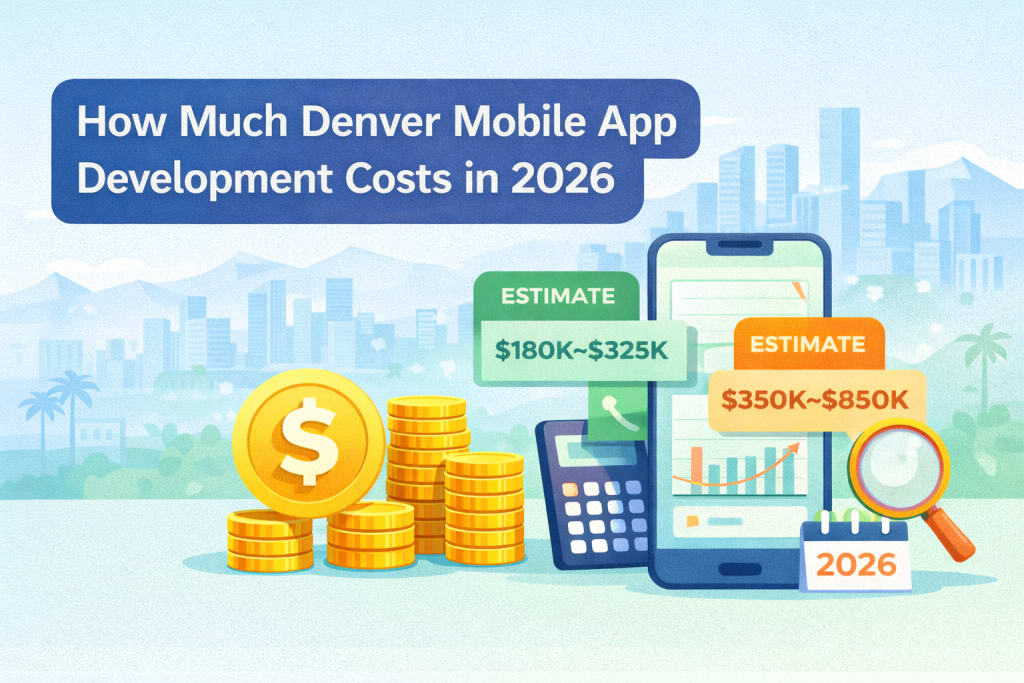
The question most founders, product leaders, and procurement teams whisper to themselves is not “How much could an app cost?” but “How much will it actually cost me?” In Denver in 2026, the answer is nuanced, shaped by local developer rates, national trends, feature expectations, and ongoing ownership realities. There isn’t one number you can paste into a budget; there’s a range tied to decisions you make long before a single line of code is written.
This guide breaks down those choices into cost brackets, explains the drivers behind them, and shows you where risk and opportunity hide — so you can budget for quality rather than surprises.
Denver’s cost context: why regional pricing matters
Denver has evolved into a thriving tech hub. Local developers are in demand, and wages reflect that. In 2024, the median salary for software developers in Denver was around $135,000, up roughly 28% over the past six years, signaling strong local demand and higher pay scales for skilled talent.
Locally based developers in Denver typically charge $70–$100 per hour for mobile app work, depending on skill and complexity, making options here competitive compared with major coastal hubs while still delivering quality U.S.-based engineering.
Rates like these shape the foundational economics of any app project: your team costs, timelines, and even your choice of architecture all flow from them.
Typical cost brackets for app development in Denver (practical 2026 planning)
There’s no one “Denver number,” but most projects tend to fall into practical cost bands influenced by complexity, integration needs, and platform choice.
1) Simple / MVP Mobile Apps — $30,000 to $80,000+
These are apps with limited user roles, basic authentication, simple UI flows, and minimal server logic. Good for prototypes or early stage MVPs that validate ideas before larger commitments.
2) Mid-Complexity Business or Consumer Apps — $80,000 to $180,000+
Apps in this range include user accounts, third-party integrations (e.g., payments or CRM), basic analytics, and scaled UX design. They require fuller testing and typically involve several months of coordinated work between designers, developers, and QA engineers.
3) Enterprise or Feature-Rich Apps — $180,000 to $400,000+
Apps with real-time data sync, advanced features like AI components, geo-tracking, encrypted messaging, or custom backend services live here. Enterprise requirements also often include security hardening, audit trails, compliance layers, and performance governance.
4) High-Assurance / Large Scale Platforms — $400,000+
These are mission-critical apps with complex backend ecosystems, multi-tenant architecture, or heavy regulatory obligations (healthcare, finance, logistics). They often require extended roadmaps, cross-functional teams, and significant post-launch support.
How cost drivers break down across the project lifecycle
Every dollar you budget gets consumed by activities that fall into strategic buckets:
Discovery and Planning (5–10% of budget)
Before any code, solid discovery shapes architecture, risk plans, and user journeys. Skipping this phase often leads to scope creep and overruns.
Design & Prototyping (10–20% of build cost)
Quality UX/UI design improves retention and conversion but adds hours up front — a worthy investment for user-centered apps.
Development & Engineering (40–60% of build cost)
This is the core coding effort. Denver’s hourly rates push this bracket higher when using fully local teams.
Testing & QA (10–20% of build cost)
Robust QA prevents expensive post-launch fixes. Consider automated testing, regression suites, and performance benchmarking as part of this.
Deployment & Go-Live Support (5–10% of build cost)
Launch is more than a date; it’s a coordinated handoff. Planned deployments and rollback strategies reduce risk.
Maintenance & Growth (15–30% per year)
After launch, expect ongoing costs for updates, platform shifts, bug fixes, and scaling. Treat this as a baseline operating expense.
National gradients and Denver’s place in the broader U.S. market
Across the U.S., mobile app development cost profiles reflect complexity rather than location alone:
- Basic apps in the broader U.S. often start around $25,000–$60,000.
- Mid-tier apps with integrations hit $60,000–$120,000.
- Advanced apps — especially involving AI, streaming, or real-time features — can push $120,000–$300,000+.
Denver’s local rates place it comfortably in line with national mid-market costs, while giving access to U.S.-based collaboration without the premium of large coastal tech hubs.
Two experienced voices explaining the 2026 cost reality
- “App development cost ranges will vary significantly based on core architecture decisions and integration complexity,” says Shawn Hart of Appinventiv — a leading mobile development consultancy. “In 2026, budgets between $40,000 and $400,000+ reflect not just build effort but design integrity, backend resilience, and long-term adaptability.”
- Echoing this, industry analysts at TechAhead Corp. note that feature sets and security requirements — not geography alone — are the primary determinants of price bands, especially for apps handling sensitive data or real-time operations.
Together, these perspectives remind us that cost is a function of scope and discipline — not just hourly rates.
Real cost traps Denver teams should avoid
Successful budgeting is not just about the first quote. Common pitfalls:
- Under-estimating integration complexity. APIs, payment gateways, device sensors, and legacy systems — each imposes unique challenges.
- Ignoring production readiness. Without deployment pipelines and monitoring, your “build” turns into a cost center for support.
- Skipping documentation and handover. Poor onboarding for future hires increases maintenance cost dramatically.
- Not budgeting for ongoing changes. New OS versions, privacy policies, and user feedback demand regular updates.
Staffing models and how they influence your total cost
Your choice of team affects both timeline and long-term quality:
- Local Denver teams — highest tags, strongest in-person alignment, best for regulated or enterprise environments.
- Hybrid teams (local leadership + remote specialists) — often most cost-efficient for mid-complexity apps.
- Fully remote/offshore teams — can lower initial spend but require strong internal product ownership to avoid rework costs.
Quick table: Denver cost ranges (2026)
App Tier Typical Build Cost Range Typical Features
Basic MVP $30,000 – $80,000 Simple UI, few screens, limited integrations
Mid Complexity $80,000 – $180,000+ Auth, analytics
Advanced / Enterprise $180,000 – $400,000+ Custom backend, AI/machine insights, compliance
Large Enterprise $400,000+ High availability, security layers, deep integrations
Closing thought
Budgeting for mobile app development Denver in 2026 is more art than arithmetic. It’s about aligning business goals with technical depth, operational readiness, and growth expectations. The numbers above are ranges — not ceilings — and they reflect a market where quality, clarity, and long-term ownership matter.
The smartest teams treat cost not as a line item but as a structured investment in sustained value.
Frequently Asked Questions
Why does mobile app development cost more in Denver in 2026 than a few years ago?
Costs have risen mainly due to higher demand for experienced developers, increased salary levels, and greater app complexity. Denver has matured into a strong tech hub, which means competition for talent is higher and expectations around security, performance, and scalability have increased compared to earlier years.
Is Denver considered a high-cost city for app development?
Denver is not a low-cost market, but it is not at the extreme end either. It typically sits between coastal tech hubs and lower-cost regions. Businesses choose Denver because they can access skilled U.S.-based teams without paying the premium often associated with cities like San Francisco or New York.
What is the biggest factor that drives app development cost in Denver?
Complexity matters more than location. Features like real-time data, integrations, AI components, security requirements, and compliance layers have a much larger impact on cost than hourly rates alone. A simple app can remain affordable, while a complex one can become expensive quickly.
How much should businesses budget beyond the initial build?
A realistic budget includes ongoing maintenance and updates. Many Denver-based teams recommend planning for 15 to 30 percent of the initial build cost per year to cover OS updates, bug fixes, performance improvements, and feature enhancements.
Are MVP apps still affordable in Denver?
Yes, but only if expectations are realistic. MVPs with limited features and integrations can still be built at relatively modest budgets. Problems arise when an MVP is expected to behave like a full production system without funding the necessary architecture and testing.
Why do some app projects exceed their original estimates?
Overruns usually happen because assumptions change. Common reasons include adding integrations, expanding feature scope, underestimating testing needs, or discovering technical constraints late. Clear discovery and written assumptions reduce this risk significantly.
Does choosing a local Denver team increase or reduce long-term cost?
Local teams often cost more upfront but can reduce long-term cost by improving communication, reducing rework, and responding faster to issues. For complex or regulated projects, this trade-off often favors local or hybrid teams.
How do hybrid or remote teams affect the budget?
Hybrid teams can balance cost and quality when local leadership handles architecture and decision-making while distributed developers handle execution. Fully remote teams may lower initial spend but can introduce coordination overhead if ownership is unclear.
What costs are commonly missing from initial proposals?
Commonly omitted costs include post-launch support, monitoring setup, documentation, deployment pipelines, and security hardening. These items often surface later as change requests if not planned upfront.
Is it possible to get a fixed-price app project in Denver?
Fixed pricing is possible for tightly defined scopes, but flexibility is usually required. Apps evolve, and rigid fixed-price contracts often lead to compromises in quality or unexpected renegotiations. Outcome-based planning tends to work better.
How should finance teams evaluate Denver app development budgets?
Finance teams should look at three-year cost projections instead of just build estimates. Separating build cost, maintenance, and contingency provides a more accurate picture of total ownership.
When does spending more upfront actually save money?
Spending more upfront saves money when it funds solid architecture, testing, and documentation. These investments reduce future rework, shorten iteration cycles, and prevent costly emergency fixes later.
What is the safest budgeting mindset for 2026?
Treat app development as an ongoing investment rather than a one-time purchase. Apps become part of daily operations, and budgeting for change, growth, and maintenance from the beginning leads to more predictable outcomes.



Comments
There are no comments for this story
Be the first to respond and start the conversation.