
How Mobile Apps Are Reverse Engineered in Practice?
A first-person reflection on how mobile apps quietly reveal their inner logic through behavior long before tools ever enter the picture.

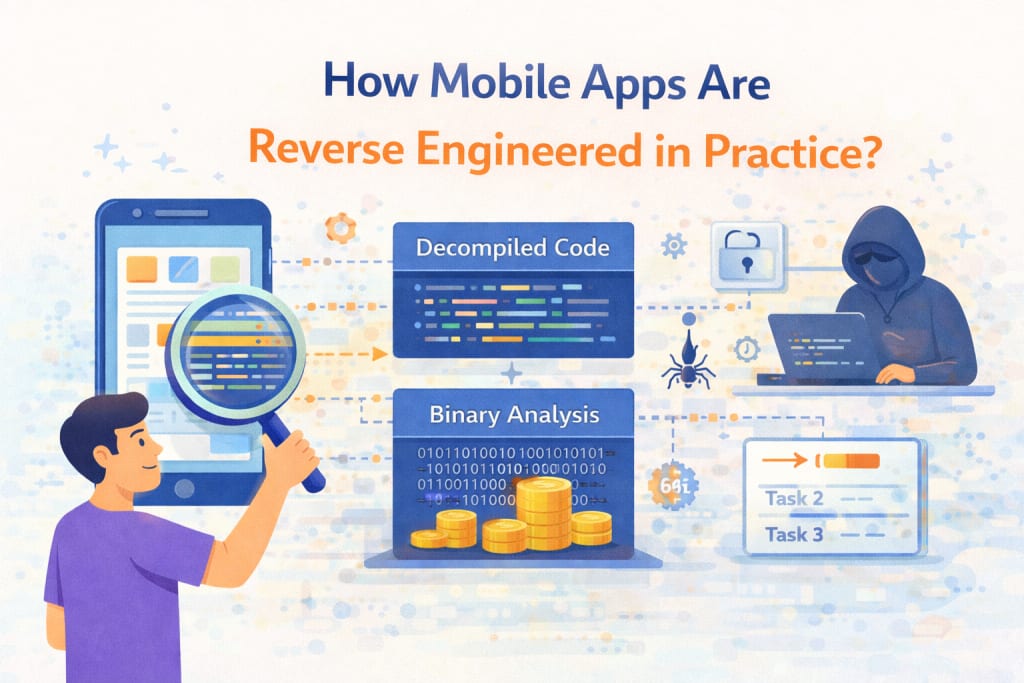
The first time I truly felt it, I wasn’t being attacked. I was being watched. I was sitting alone at my desk late at night, replaying a short screen recording someone had sent me. The app looked normal. Too normal. Buttons tapped. Screens loaded. Still, the sequence of actions didn’t match how the app was supposed to behave.
I replayed it again, slower this time. That’s when I understood something I hadn’t fully accepted before. Reverse engineering doesn’t begin with tools. It begins with patience.
It Starts With Curiosity, Not Code
Most people imagine reverse engineering as something loud and technical. Decompilers. Debuggers. Obscure terminals glowing in the dark.
In practice, it starts much earlier and much quieter. Someone installs the app and simply uses it. They tap things out of order. They repeat actions. They notice what responds and what doesn’t.
I’ve learned that the earliest signals are behavioral. What happens when the network drops. What happens when the app resumes after a pause. What data arrives sooner than it should.
Those moments teach more than source code ever could.
Screens Reveal More Than We Expect
UI flows are honest storytellers. They show what the app believes should happen next.
I’ve watched people map out entire internal flows just by observing transitions. Which screens appear immediately. Which wait. Which fail gracefully and which don’t.
Even loading states say something. A spinner that appears too quickly suggests local work. One that lingers suggests dependency.
When you build an app, you stop seeing these cues. Someone on the outside sees them clearly.
Network Behavior Is the First Window Inside
The moment traffic leaves the device, assumptions begin to crack.
I’ve seen people learn entire backend structures just by watching request patterns. What fires first. What retries. What arrives even when the app claims to be offline.
Encryption protects content, not intent. Even when payloads are unreadable, timing speaks.
Reverse engineering often advances simply by noticing rhythm.
State Is Harder to Hide Than Logic
State leaks in subtle ways. A button disabled too early. A screen remembering something it shouldn’t.
I once watched someone infer session handling purely by force-closing the app at specific moments. They didn’t need access. They just needed repetition.
Every remembered state tells a story about where decisions are made. On device. On server. Somewhere in between.
Those stories add up quickly.
Errors Teach Faster Than Success
Successful flows are boring to someone trying to understand a system. Errors are gold.
What message appears. What doesn’t. How long it takes to fail. Whether the failure is loud or silent.
I’ve learned more about internal structure from error behavior than from normal usage. Reverse engineering thrives on edges, not happy paths.
Apps that fail consistently are easier to understand than apps that fail politely.
Timing Becomes a Language
Once you start paying attention, timing becomes expressive.
Delays before responses. Pauses between requests. Actions that only work after waiting a certain amount of time.
I’ve watched people infer background tasks simply by locking the screen and waiting. Something wakes up. Something checks in.
The app never says what it’s doing. Still, it leaves footprints.
Static Analysis Comes Later Than People Think
Eventually, tools enter the picture. Files get inspected. Binaries get unpacked.
By that point, much of the system is already understood. The tools confirm what observation suggested.
This is the part people talk about most. It’s also the part that benefits most from everything learned earlier.
Without context, static inspection is just noise.
Obfuscation Slows, It Doesn’t Stop
I’ve seen teams take comfort in obfuscation. Renamed classes. Shuffled logic. Reduced readability.
It helps. It buys time. It does not erase behavior.
Reverse engineering in practice leans less on reading code and more on watching results. Obfuscation hides words, not outcomes.
If the app must behave, it must reveal something.
Assumptions Are the Weakest Layer
The most common vulnerability I’ve encountered isn’t technical. It’s assumption.
Assuming no one will try this sequence. Assuming this screen can’t be reached directly. Assuming this response won’t be reused.
Reverse engineering thrives on these assumptions. It questions paths no one thought to walk.
When an app relies on belief instead of verification, it invites understanding from the outside.
Scale Makes Patterns Easier to See
At small scale, odd behavior feels random. At large scale, patterns emerge.
I’ve watched people gather observations over days. Repeating flows. Logging outcomes. Slowly assembling a mental model.
By the time teams notice something is being understood externally, it often already is.
This is especially true in widely distributed environments like mobile app development Milwaukee projects, where apps meet diverse devices, networks, and habits that expose behavior faster than expected.
Why Reverse Engineering Feels Personal
For builders, discovering that someone understands your app from the outside feels unsettling.
Not because something was stolen, but because something you assumed was private turned out to be observable.
I’ve felt that discomfort myself. It forces humility. It reminds you that once software ships, it lives in someone else’s hands.
Reverse engineering isn’t always hostile. Sometimes it’s just curiosity meeting opportunity.
Defensive Design Starts With Empathy
The most effective defenses I’ve seen didn’t come from paranoia. They came from empathy.
Thinking like someone patient. Someone bored. Someone willing to try the same thing ten different ways.
When teams ask what someone could learn just by using the app, design decisions shift. Validation moves earlier. Trust becomes explicit instead of implied.
That shift changes everything quietly.
Nothing Is Invisible Once It Executes
This is the truth I’ve come back to again and again. If code executes, it leaves traces. If it responds, it communicates.
Reverse engineering in practice is about listening to those traces until they form a picture.
The goal isn’t secrecy. It’s clarity about what you’re willing to reveal.
Ending With the Recording That Started It
I watched that screen recording one last time before closing my laptop. Nothing new appeared. Still, I understood it differently now.
The app wasn’t being broken. It was being read. Slowly. Carefully. From the outside in.
That’s the reality mobile apps live in once they leave the build system. Reverse engineering isn’t rare. It’s routine. The question isn’t whether it happens. It’s whether the app was designed with the humility to expect it.
About the Creator
Keep reading
More stories from Samantha Blake and writers in Geeks and other communities.
Preventing Frame Drops When LLM Calls Occur During Navigation
The first time I felt it, I didn’t look at a profiler. I felt it in my thumb. I was navigating quickly between two screens, the way people do without thinking, and the transition hesitated for a split second. No freeze. No crash. Just a tiny hitch, like the app briefly forgot where it was going. That kind of hesitation is hard to explain to someone who hasn’t felt it, but once you do, you can’t unfeel it.
By Samantha Blake2 months ago in Geeks




Comments
There are no comments for this story
Be the first to respond and start the conversation.