
How Alice Walker's novel "The Color Purple" became an Oscar-nominated film to a Tony Award-Winning Musical
Before there was"The Color Purple" the film and Oscar-nominated musical film, it was based on a best-selling novel written by Alice Walker.


Before "The Color Purple" was an Oscar-nominated film to a Broadway musical to a successful musical film, it was based on a best-selling novel written by Alice Walker. The novel was published and became a success.
Alice Malsenior Walker was born in Eatonton, Georgia, a rural farming town, to Willie Lee Walker and Minnie Tallulah Grant. Both of Walker's parents were sharecroppers, though her mother also worked as a seamstress to earn extra money. Walker, the youngest of eight children, was first enrolled in school when she was just four years old at East Putnam Consolidated. At age eight, Walker suffered an injury from her right eye after getting shot from her brother's BB gun causing her to be blind on her right eye.
As the schools in Eatonton were segregated, Walker attended the only high school available to Black students: Butler Baker High School. She went on to become valedictorian, and enrolled in Spelman College in 1961 after being granted a full scholarship by the state of Georgia for having the highest academic achievements of her class. She found two of her professors, Howard Zinn and Staughton Lynd, to be great mentors during her time at Spelman, but both were transferred two years later. Walker was offered another scholarship, this time from Sarah Lawrence College in Yonkers, New York, and after the firing of her Spelman professor, Howard Zinn, Walker accepted the offer. Walker became pregnant at the start of her senior year and had an abortion; this experience, as well as the bout of suicidal thoughts that followed, inspired much of the poetry found in Once, Walker's first collection of poetry.Walker graduated from Sarah Lawrence College in 1965.
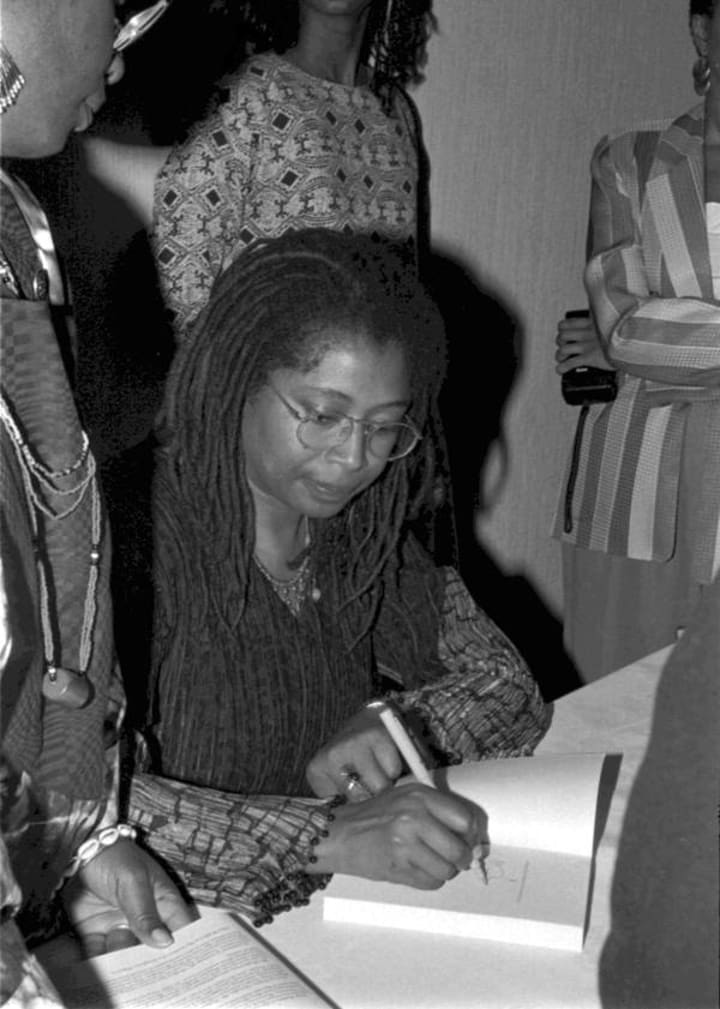
Walker first started writing poetry, and published her first book of poetry, Once, was published in 1968 while she was still a student. By the time Once was published, Walker was living in Mississippi and working on the completion of her first novel, The Third Life of Grange Copeland. In the 1980s, Walker started writing her next novel, The Color Purple inspired by her own family's stories, particularly her grandparents' lives, channeling the voice of her gentle step-grandmother (Celie) and her grandfather's mistress (Shug Avery) to explore themes of abuse, resilience, and Black womanhood in the rural South, a story she felt compelled to tell after leaving NYC and moving to nature to capture the authentic voices of her characters.
The Color Purple tells the story of Celie, a poor Black woman in early 20th-century Georgia, through letters to God and her sister Nettie, detailing abuse, finding empowerment through strong women like Shug Avery, discovering her sister's survival and children's safety in Africa, and ultimately achieving independence and self-love, transforming from victim to resilient individual with a hopeful ending. The Color Purple published in 1982.

The novel received critical acclaim, won the Pulitzer Prize for Fiction in 1983, making Walker the first black woman to win for fiction; in 1950 Gwendolyn Brooks had won the Pulitzer Prize for poetry. Walker also won the National Book Award for Fiction in 1983. Mel Watkins of the New York Times Book Review wrote that it is a "striking and consummately well-written novel", praising its powerful emotional impact and epistolary structure.Though the novel has garnered critical acclaim, it has also been the subject of controversy. The novel was listed by the American Library Association in the banned books list. The novel would be adapted into a film in 1985. Alice Walker was initially reluctant to sell the film rights to her novel The Color Purple, due to Hollywood's portrayal of female and African American characters. She only agreed to executive producers Jon Peters and Peter Guber's offer after consulting with friends, who agreed the only way to improve representation of minorities was to work within the system. Walker's contract stipulated that she would serve as project consultant and that 50% of the production team, aside from the cast, would be African American, female or "people of the Third World". Walker wrote an initial screenplay draft, but was replaced by Dutch-born writer Menno Meyjes, under the provision that she be given final script approval. Walker worked as an uncredited script doctor, and coached actors in their use of a Southern African American Vernacular English dialect. Music mogul Quincy Jones, whose only prior film experience was as a composer, served as producer while Film Director Steven Spielberg directs the film. The cast stars Whoopi Goldberg as Celie, Danny Glover as Mister Albert, Magaret Avery as Shug Avery, Oprah Winfrey as Sofia, and Adolph Caesar as Ol Mister.
The Color Purple was a box office success, grossing $98.4 million against a budget of $15 million. The film received generally positive reviews from critics, with praise going to its acting (especially Goldberg's performance), direction, screenplay, musical score, and production values; criticism was directed by some for being "over-sentimental" and "stereotypical". The film was nominated for 11 Academy Awards, including Best Picture, but did not achieve a single win. It holds the record for most Oscar nominations without one for Best Director. It also received four Golden Globe Award nominations, with Goldberg winning Best Actress in a Drama.
In 2005, years after the book and film adaptation, it would be adapted as a musical adaptation of the novel and film with lyrics and music by Stephen Bray, Brenda Russell and Allee Willis, and book by Marsha Norman opened at The Broadway Theatre in New York City. The show was produced by Scott Sanders, Quincy Jones, Harvey Weinstein, and Oprah Winfrey, who was also an investor. The Color Purple was originally workshopped by the Alliance Theatre in Atlanta, Georgia, in mid-2004 following Scott Sanders' optioning the work from Alice Walker in 1999 and auditioning various creative team members. The September 9, 2004, world premiere of the musical was produced by the Alliance Theatre in Atlanta by special arrangement with Creative Battery and Scott Sanders Productions. For the Atlanta run, LaChanze starred as Celie, Felicia P. Fields as Sofia, Saycon Sengbloh as Nettie, Adriane Lenox as Shug and Kingsley Leggs as Mister. Gary Griffin staged the work, with scenic design by John Lee Beatty, lighting by Brian MacDevitt, costumes by Paul Tazewell and sound by Jon Weston. However, the 2005 musical received mixed reviews praising the actors performance and criticized its heavy adaptation, sluggish running time and the absence of romance between the female characters.
The musical earned 11 Tony Awards in 2006. Singer LaChanze won for Best Actress in a Musical for her performance as Celie.
In 2015, decades later, the musical was revived with a new cast: Jennifer Hudson as Shug, Orange is the New Black Danielle Brooks as Sofia, and Cynthia Ervio (Before she was Elphaba in Wicked) as Celie. Previews began November 10, 2015, with the official opening being December 10 at the Bernard B. Jacobs Theatre. The musical received positive reviews and garnered four Tony nominations. The musical won for Best Revival of a Musical.
Unlike LaChanze, Ervio won a Tony for Best Leading Actress in a Revival Musical.
The production closed on January 8, 2017, after 33 previews and 449 performances. On November 2, 2018, it was announced that a film adaptation of the musical was in development at Warner Bros. Pictures and Amblin Entertainment, the same companies that made the 1985 film adaptation of the novel, with Steven Spielberg, Quincy Jones, Scott Sanders, and Oprah Winfrey all signing on to produce. On August 24, 2020, it was announced that Marcus Gardley will write the screenplay and Black is King's Blitz Bazawule will direct. Winfrey praised the selection of Bazawule as director, after she and the producers saw his work on The Burial of Kojo. Walker (herself), Rebecca Walker, Kristie Macosko Krieger, Carla Gardini, and Mara Jacobs served as executive producers. The cast stars Fantasia Barrino as Celie, who has previously starred in the Color Purple on Broadway, Taraji P. Henson as Shug, Corey Hawkins as Harpo, Danielle Brooks reprising her role as Sofia, Louis Gossett Jr. as Ol' Mister, Colman Domingo as Mister, and Halle Bailey as Nettie.
The Color Purple premiered in London on November 20, 2023, and was released in the United States on December 25, 2023, by Warner Bros. Pictures. Although it received positive reviews from critics, it grossed $68.8 million against a budget of $90–100 million. Danielle Brooks was lauded for her performance, receiving nominations for the Academy Award, BAFTA Award, Golden Globe Award, and Screen Actors Guild Award for Best Supporting Actress. At the 55th NAACP Image Awards, the film won a record-breaking eleven awards out of sixteen nominations, including Outstanding Motion Picture and acting wins for Barrino, Henson, Domingo, and the ensemble cast.
Source
YouTube
Wikipedia
About the Creator
Keep reading
More stories from Gladys W. Muturi and writers in Geeks and other communities.
The Story Behind "A Christmas Story"
A Christmas Story is one of the humorous Christmas flicks compared to Home Alone films and The Grinch. The film tells a young boy who wants a BB gun for Christmas but when he mentions a BB gun he gets the same pointless quote "You'll shoot your eye out". This film was told by humorist writer Jean Shepherd who wrote "In God We Trust: All Others Pay Cash" that. His story became a Christmas cult film and spawned sequels making this film one of the greatest humorous Christmas film.
By Gladys W. Muturi2 months ago in Geeks
Spongebob Review
The episode “Valentine’s Day” opens with a bright, sugar‑spun carnival setting that immediately signals the festive intent of the story, and the animators spare no effort in embedding every booth, ride, and cotton‑candy stall with heart‑shaped motifs that pulse with a playful, romantic optimism. SpongeBob, ever the eager romantic, is armed with a meticulously handcrafted valentine that he intends to deliver to Patrick, hoping to cement their friendship in a tradition that feels both sincere and mischievously earnest. Sandy, whose scientific pragmatism is juxtaposed against the sheer silliness of the holiday, offers a technologically enhanced “gift‑launcher” that can propel the valentine across the midway without the risk of accidental crushing by a rogue clown. The episode’s opening scenes are a masterclass in setting tone: the shimmering lights, the muffled carnival music, and the subtle background chatter of other sea‑creature patrons combine to immerse the viewer in a world that is simultaneously familiar and whimsically exaggerated.
By Forest Greenabout 14 hours ago in Geeks


Comments
There are no comments for this story
Be the first to respond and start the conversation.