
Here's the Thing About 'Centaurwold' (part two)
Body horror in a magical world

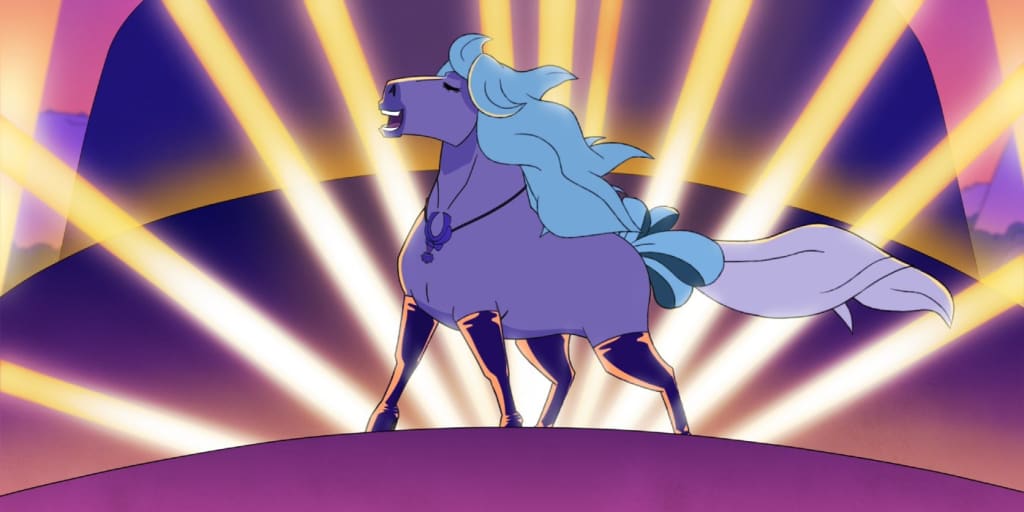
As of the time of this writing, it has been a week since Centaurworld debuted on Netflix, and just as long since I took the time to dive into what I assumed would be a middling show at best. I was wrong, and now we're here. If you would like to read my thoughts surrounding the first four episodes of the series, you can follow the link right here. Otherwise, let's go ahead and get right to it, but do beware of spoilers ahead.

When the fourth episode of the series entitled "What You Need" came to a close, there was a clear tonal shift in its final scene. As Horse and the rest of her adoptive Herd continued their journey down the Rainbow Road, the flowers in fields began singing an unsettlingly high pitched rendition of "The Nowhere King." This song, much like "Rider's Lullaby" and "Fragile Things" soon becomes an integral part of Centaurworld's story telling method. The further along the story goes, the more frequently reprises are relied upon as the focus of the series rather abruptly shifts from its heavy handed undertones to that of the more traditional fantasy epic playing out. This is good for moving the story forward, but not for the pacing of several episodes. The music suffers at times as the majority of songs becoming noticeably shorter on average than they were in the first four episodes, leading several of them to become all but entirely forgettable rather than the character defining moments they were clearly meant to be. On the other hand, this being one of the show's biggest sins while it still manages to remain genuinely enjoyable as a whole speaks to how good it is despite any shortcomings.

Episode five, "It's Hidin' Time," picks up an undisclosed yet not irrelevant amount of time after the previous episode saw Horse acquire the next part of the key from the Tree Shamans. That encounter also left the Herd's leader Wammawink in a much needed slumber, one that has not worn off by the time the Herd have made their way deep into the mountains. This gives the other members of the cast a time to shine on their own, which doesn't serve to make them much more likeable on their own. Wammawink's comatose state sets up an arc wherein the other Centaurs and their general incompetence are put under a spotlight, and that only highlights the fact that none of them could carry their mission or this series on their own. Thankfully, there aren't too many moments that leave one character to flounder by themselves, but the increased prevalence of them from this point forward does make the show less enjoyable than it has already proven itself capable of being. This does afford the cast a greater capacity for development than they may have had otherwise, although that prospect is undercut by fact that the profoundly cartoonish nature of the centaur Herd makes readily apparent the ceiling on how much they can grow as characters. The scene in which Wammawink springs into a superpowered state to save Horse, even though she is still hibernating and at no point comes to, is probably the greatest indicator that no matter how bad things get in Centaurworld, there are still bumpers in play to protect our heroes from any real harm. It could be argued that this signifies how deeply Wammawink feels for Horse, but that still doesn't make up for the stakes never really being all that high for the core cast of characters. At least, not when it comes to any worldly threats.

With the previously mentioned tonal shift, the actual stakes of its overarching conflict quickly come into focus. The Nowhere King and his titular tune are something that everyone but the centaurs of the Herd seem to know more than well enough, and as the lone ominous reprise in the entire series it haunts Centaurworld from the first time it is sung up until the very end. Any horror that was once subtle is now terrifyingly overt. No one is keeping any secrets when it comes to how scared they are of the Nowhere King, but the anticipation of his eventual emergence is still not as unnerving as the body horror that is introduced through Horse's gradual transformation into another one of Centaurworld's wibbly-wobbly denizens. The way that the Herd try to embrace Horse's predicament doesn't make things any better, and no amount of Paul F. Tompkins' portrayal of her newly wisecracking tail can change how deeply unsettling the entire situation is. There are of course plenty of instances where Horse's evolution into a magical being are beneficial to the journey she is on, but nothing about any of them detracts from how devastating all of this is for her mental/emotional state before being one of the primary factors in her decision to (effectively) commit suicide. Because yes, Centaurworld is going there.
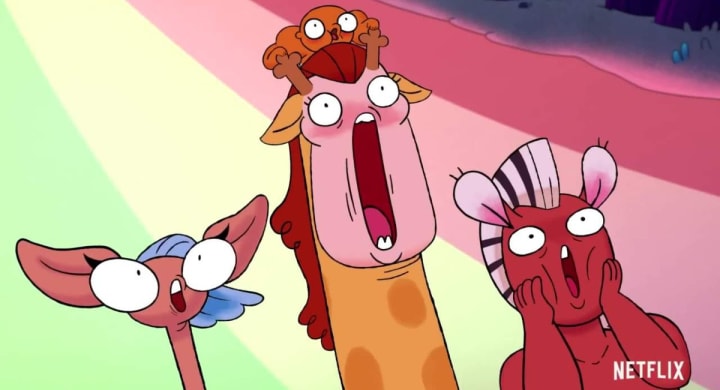
If you thought everything else going on meant that the series was done with confronting difficult or sensitive subjects, you couldn't have been more wrong. Sure, Horse doesn't really kill herself, she just jumps off of a cliff to knowingly be swallowed by the Whaletaur Shaman who has the power to take all of her pain away, but we can all see that for the obvious allegory that it is. Surviving this tragic encounter thanks to the Herd and acquiring the final piece of the Key is a powerful setup for the series' two-part finale, as well as the last real deep dive into any particularly distressing topics outside of those that are directly tied to the Centaurworld's central plotline. And speaking of that finale...
This is going to be the end of this part of my review of Centaurworld. If you're reading this right after it was published, check back in a day or two for my review of the finale and the series as a whole. Otherwise, there should be a link to that right about here. And if you're still on the fence about this show, don't be. It's well worth the watch.
You can find John Dodge writing about all sorts of things right here on Vocal, as well as writing about comic book nonsense over at CBR.com. For potential new meme formats, follow him on Twitter here. If you just want to follow him like a normal person on social media, you can do that here, here, and here. Remember to like this article to let John know you enjoyed it, or send a tip directly through Vocal if you'd like to support him directly.
About the Creator
Keep reading
More stories from John Dodge and writers in Geeks and other communities.
The Shifting Landscape of the United States Luxury Car Industry at CAGR of 1.2%
A sales consultant reviews overnight inquiries. A returning customer compares trim levels on a tablet. Outside, a silent electric luxury sedan glides past traffic. Inside, leather, brushed aluminum, and ambient lighting signal something more than transportation.
By Ashutosh Srivastava3 days ago in Geeks
Veil of Subconscious Awakening
Images slide behind my eyelids like film cadres, bursting with meanings. In one moment, I’m speeding down the highway, making the speedometer swing wildly like a frantic pendulum. The next moment, I’m plunging from a falling plane, slowly crashing earthward. At home, I meet black cat’s green, googly eyes staring at me from the cavernous hollowness of the kitchen. When I turn for a moment, it disappears, and all I can see is a pair of blue suede shoes set up against the wall. I pick them up and put them on. When I glimpse at them again, they’ve become black as night, making me blink and flinch.
By Moon Desert6 days ago in Fiction




Comments
There are no comments for this story
Be the first to respond and start the conversation.