
Heidi Klum Halloween 2025: What brought?
From Sacred Rituals to Celebrity Spectacles; How Heidi Klum’s Medusa Look Redefined Halloween 2025.

The Spirit of Halloween and Its Evolution
Halloween, once a humble Christian-influenced observance, has evolved into one of the most extravagant global spectacles of creativity, trade, and entertainment. What began centuries ago as a religious vigil has transformed into a commercial and cultural phenomenon where art, costume, and celebrity meet in dazzling form. The 2025 celebration, highlighted by Heidi Klum’s astonishing Medusa transformation, proved once again that Halloween is not just a night of costumes but a statement of imagination and reinvention. Yet behind all the glitz, lies a deep story of how an ancient religious and cultural event turned into a billion-dollar global industry.
From Samhain to All Hallows’ Eve
Long before the glitter and flashing cameras, Halloween had roots in ancient Celtic traditions. The Celts celebrated Samhain, marking the end of the harvest and the beginning of winter. They believed that on the night of October 31st, the boundaries between the living and the dead blurred, allowing spirits to roam freely. When Christianity spread across Europe, church leaders sought to Christianize pagan customs rather than abolish them. Thus, All Saints’ Day or All Hallows’ Day was established on November 1st, and the night before it became known as All Hallows’ Eve—which, over time, simply became “Halloween.” The Christian influence was clear in its early observance; people lit candles for departed souls, attended church, and prayed for the faithful departed. However, as centuries passed, the religious side slowly faded and the playful, mysterious aspect took over.
The Rise of the Modern Halloween
The modern Halloween, particularly in Western countries, took shape during the 19th and 20th centuries. Immigrants, especially the Irish and Scottish, brought their customs to North America. Pumpkins replaced turnips as easier-to-carve lanterns, and the practice of dressing up and going door to door for treats became a household tradition. By the mid-20th century, Halloween was already shifting from spiritual remembrance to social celebration. Television, Hollywood, and pop culture turned it into a festival of costumes, candy, and creativity. In today’s world, it is less about faith and more about fun, less about saints and more about style.
The Christian Connection and the Cultural Shift
It’s important to remember that Halloween, even with its ancient pagan roots, was eventually integrated into Christian culture as a night preceding All Saints’ Day. It was meant to honor martyrs, saints, and faithful souls. However, the spiritual significance was gradually replaced by commercial excitement. For many modern Christians, this transition has become a matter of debate. Some see it as harmless entertainment; others see it as a departure from Christian values. Nonetheless, Halloween’s persistence through centuries reveals its adaptability—it reflects each generation’s fears, fascinations, and artistic spirit.
Heidi Klum: The Queen of Halloween
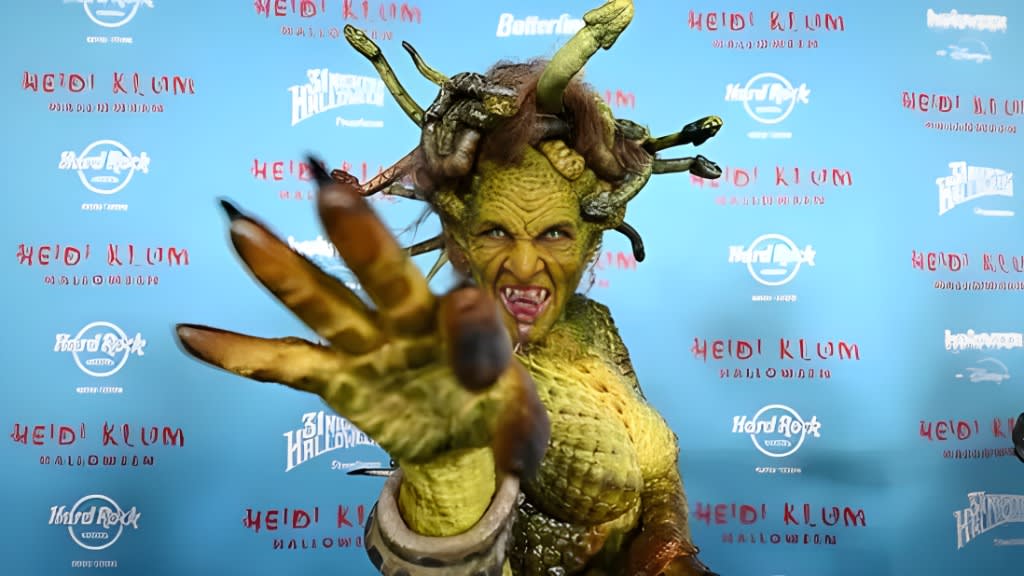
Few embody the modern spirit of Halloween like Heidi Klum. Every year, she reinvents herself into something spectacular, bizarre, and unforgettable. Her Halloween parties are now legendary in the entertainment world. From turning herself into a giant worm, an elderly woman, an alien, and even a human-peacock hybrid, she has redefined what a costume can be. In 2025, Klum brought the mythological Medusa to life, a transformation that stunned fans and fashion critics alike. Her costume was not merely a fancy outfit—it was a moving piece of art.
The Medusa Transformation
Heidi Klum’s 2025 Halloween costume was inspired by the Greek myth of Medusa, a woman cursed with living serpents for hair and the power to turn onlookers into stone. Her design took nearly six months of planning, featuring mechanical snakes that moved independently, shimmering green scales that mimicked reptilian skin, and prosthetics that reshaped her face into a lifelike monster of beauty and horror. The transformation took roughly ten hours of detailed work by a professional team of special effects artists. Every element, her glowing eyes, fanged smile, and metallic armor; captured the essence of a modern Medusa who, instead of turning men to stone, turned the internet into awe.
Symbolism and Message Behind the Costume
Klum’s Medusa wasn’t only about horror. It was also a message about power and transformation. Medusa, in mythology, is both feared and misunderstood—punished for being violated, she became a symbol of both curse and strength. By embodying Medusa, Klum seemed to reclaim that mythic power, presenting a character who is terrifying yet beautiful, fierce yet graceful. It reflected the way Halloween has shifted from religious reverence to artistic expression—a night where even monsters tell human stories.
The Auction of Modern Halloween
In the 21st century, Halloween has become something close to an auction of creativity. Designers, influencers, and companies compete to outshine one another with the most innovative, viral, or extravagant displays. The line between tradition and trade is almost gone. Each October, stores flood with decorations, candies, and costumes worth billions of dollars collectively. In cities like New York and Los Angeles, Halloween feels like a fashion week fused with a carnival. Celebrities like Heidi Klum are not just participants—they are the headline acts in what has become a massive global industry.
The costumes have turned into artistic statements that involve professional makeup teams, engineers, animatronics, and digital design. Social media platforms such as Instagram and TikTok serve as global runways for Halloween creativity. What was once a community night of modest costumes and shared candies has turned into a high-stakes display of design, luxury, and influence. Halloween has, in a way, become a global auction—not of money alone, but of imagination. Whoever can shock, inspire, or impress the most, wins the invisible prize of fame and viral attention.
Heidi Klum’s Halloween Legacy
For over two decades, Heidi Klum has treated Halloween not as a party but as performance art. Her 2025 Medusa was perhaps her most technically ambitious yet. Through her transformations, she has kept the essence of Halloween alive—not through superstition, but through reinvention. She has proven that the holiday, no matter how commercialized it becomes, still thrives on creativity and storytelling. Each costume she unveils reminds the world that Halloween is not merely about fear; it’s about metamorphosis.
From Faith to Fantasy, from Soul to Spectacle
The journey of Halloween—from Celtic rituals to Christian adaptation, from remembrance to entertainment—reflects how traditions evolve with time. Today, it is a global fusion of art, commerce, and culture. Heidi Klum’s 2025 Medusa costume stands as a symbol of that evolution: beautiful, terrifying, and unforgettable. It shows that while the roots of Halloween were once about honoring the souls of the dead, its modern branches have reached into fashion, creativity, and identity. The night of All Hallows’ Eve may no longer belong solely to saints or spirits, but it continues to remind us that transformation—whether spiritual or artistic—is the heart of human celebration.
About the Creator
Keramatullah Wardak
I write practical, science-backed content on health, productivity, and self-improvement. Passionate about helping you eat smarter, think clearer, and live better—one article at a time.
Keep reading
More stories from Keramatullah Wardak and writers in Geeks and other communities.
PUBG in 2030: The New Evolution for Humankind
When PUBG (PlayerUnknown’s Battlegrounds) first stormed into the gaming world in 2017, no one imagined it would become a cultural phenomenon. From professional tournaments to casual mobile matches played in remote villages, the game changed how people interacted, competed, and even thought about entertainment. But as technology evolves rapidly, one question stands out: what will PUBG look like in 2030; and how will it impact the youth of that generation?
By Keramatullah Wardak5 months ago in Geeks
A Knight of the Seven Kingdoms Series Review (Season 1)
As one of the biggest properties in fantasy, A Song of Ice and Fire remains immensely popular with audiences. After reaching far into the past with House of the Dragon, a second spin-off was on the cards. A Knight of the Seven Kingdoms serves up a bite-sized slice of action and drama, but it still claims a spot among the best small-screen titles.
By Robert Cain7 days ago in Geeks



Comments
There are no comments for this story
Be the first to respond and start the conversation.