
Hedda (2025)
Character - not a label



You have no idea how much I’ve agonised over writing a review of Hedda. I know people read film reviews for two main reasons: is this film my kind of film and is it any good?
But as a writer, I want to tell you all about my understanding of Ibsen, how I how I studied him at university and got a first for a paper on The Doll’s House. I want you to know that I have an understanding of the character of Hedda Gabler. I want to write about the historical moment of her creation, which was about a shift in theatre towards naturalism, but also a shift in the science of psychology and the burgeoning art of psychoanalysis.
I’ve tried to put those words down, but I ended up lost amongst them. It was like being in a competition, trying to prove something that only mattered to me. This is fitting for watching Nia DaCosta’s dazzling Hedda. She has made a film about a woman who is also lost without the courage of her convictions.

Hedda is a 2025 film written and directed by Nia DaCosta, based on the stage play Hedda Gabler by Henrik Ibsen in 1891.
The original play is set in turn of the 19th century Norway. It could be classified as a comedy of manners crossed with a tragedy focussed on the unpredictable Hedda. What is Hedda going to do next, having chosen what she sees as a stultifying marriage to George Tessman? Returned from her honeymoon, where he pursued his academic research, she is bored, wound-up, ready for mischief. The play establishes the artifice of the newly-weds seemingly affluent lifestyle, as dependent on borrowed money, requiring George to get promoted to Professor to pay off debts. This seemed assured until his old rival and a possible ex-lover of Hedda’s returns to the scene – Eilert Lovberg. Eilert was written off as a drunk and unreliable, but has since found sobriety and a new love, Thea. What makes the play startling and intriguing is Hedda. She is vivacious, unfocussed and cruel.

There are three major changes that DaCosta has made to Ibsen’s work.
First, she has moved the action to the 1950s. DaCosta’s 1950s is a more exuberant age than the stuffiness of Ibsen’s 1890s. But it maintains some of the same limitations, especially for women of limited resources. The class system still holds onto the reins. (There is a delightful interlude where momentarily the action moves ‘downstairs’ to the servant quarters and the maid (Kathryn Hunter) gets to commentate on the fragility of the luxury in a turn that is reminiscent of Thelma Ritter). It is pre-computer, so a handwritten manuscript is still feasibly a one-off. The setting remains a big house away from a town centre. It has a glamorous recklessness of a continent recovering from war, but also the sense of isolation that comes from a lack of infra-structure and a reliance on gossip.
The second change is that everything is on-screen. Ibsen concentrated on the actions of Hedda as a Victorian wife, whose reputation required a demure demeanour and societal expectations meant she could not attend parties or drink. She could only receive passing visitors. The action was reported through dialogue. However, her 1950s counterpart is the hostess. She throws a party, she gains agency and she gets to show us the full extent of her charms, jealousies, concerns, fears and wiles. More importantly, we get to see the consequences.
And the third change, the one that will get the most coverage, is that there is a change of gender for George’s rival for the professorship. Eilert becomes Eileen.

Making the party the centrepiece allows for a swirl of action, of beautiful dresses, of nighttime intrigue, of music and dancing. The evening builds as guests get drunk, with a tenuous hold on reality and motives. The film is beautiful to watch.
In particular, Tessa Thompson’s rendition of Hedda is intoxicating. The script hints constantly at her past as a voracious party-goer, fiery and passionate with ex-lovers regardless of gender. Her Hedda has a gift at reading and playing people. She has a remarkably agile face that allows us to see the masks she puts on and drops.
The film works well with Ibsen’s themes around the performances required in class and gender. DaCosta extends this to include race and sexuality. But she still struggles to explain the malice of the protagonist.
So is this your kind of film? If you like historical drama, if you like big ideas and luxurious sets, if you like character-driven plots – then yes.
Is it good? Yes. I can make many clever observations about how it is not quite the play that Ibsen wrote, and that some of the subtlety is lost in all the sumptuousness and sexuality. But I loved being drawn into the world that it created.

Hedda will continue to be re-presented and revived for years in both the theatre and the screen, because there is something beguiling about watching a woman make unnerving, unwise choices.
There will always be discussion about whether she was trapped by circumstance or character, by gender or lack of courage.
Hedda would definitely receive some arm-chair psychological diagnosis these days – a sociopath, a narcissist, attention-deficient. And this would miss the point. There is no need to give her a label. Our job as audience or writer is simply to observe and record.
George Bernard Shaw hated the play and said of Hedda’s character:
“with plenty of cleverness, energy and personal fascination she remains mean, envious insolent, cruel in protest against others’ happiness, fiendish in her dislike of inartistic people and things, a bully in reaction from her own cowardice”
But Ibsen in writing her and writing about her, described her as a “poet” who cared about “human freedom”.
My own take is that she is driven by an impulse to create, but has no focus. She chose a stifling marriage and financial security to avoid making more courageous, creative choices. It leaves her envious and empty. She wants validation and attention, like an unloved child, or an over-looked academic…

If you've enjoyed what you have read, consider subscribing to my writing on Vocal. If you'd like to support my writing, you can do so by leaving a one-time tip or a regular pledge. Thank you.
About the Creator
Rachel Robbins
Writer-Performer based in the North of England. A joyous, flawed mess.
Please read my stories and enjoy. And if you can, please leave a tip. Money raised will be used towards funding a one-woman story-telling, comedy show.
Keep reading
More stories from Rachel Robbins and writers in Geeks and other communities.
Plainclothes (2025)
Plainclothes is my kind of film. I take along my 1940s imaginary screenwriter persona, and she complains about not being able to smoke in cinemas. But I reassure her, reviews have been mostly positive, and it won an award at the Sundance Film Festival. I knew I wanted to see it from the trailer. It is a small budget, independent film, with a small cast, telling a story that could easily be overlooked or dismissed. My kind of film.
By Rachel Robbins4 months ago in Geeks
The Politics of Playing Dress-Up
Well, to start off I'd like to say a happy world book day to all who celebrate. I know I haven't really posted anything on my socials about it but I'm not a jubilant kind of person. I lay low most of the time. Let's start off with a popular anecdote from the vaults...
By Annie Kapur5 days ago in Geeks
Marblehead Little Theatre's Riveting Production of "A Few Good Men"
You can’t handle the truth! Marblehead Little Theatre stages a riveting production of “A Few Good Men,” a play written by Aaron Sorkin. Two Marines are accused of killing a fellow soldier at Guantanamo Bay, and LT. J.G Daniel A. Kaffee is assigned to defend the case. As evidence unfolds, Kaffee and his legal team suspect foul play.
By Marielle Sabbagabout 24 hours ago in Geeks
Early March 2026: 4 Goals Accomplished
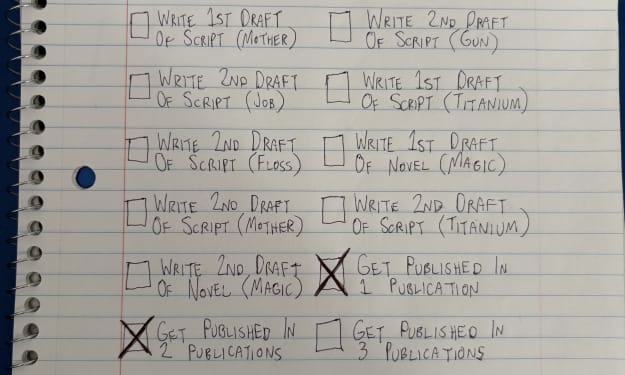
It's early March and I've now accomplished my 4th writing goal for the year of 2026. Before diving into the behind-the-scenes of it... why not tell you up front what that accomplishment was? I was published in a 2nd publication for this year. Published in Helix Literary Magazine out of Central Connecticut State University. You can read it for free right now!
By Stephen Kramer Avitabile4 days ago in Writers



Comments (8)
Your take on Hedda’s complexities is so thought provoking. The idea that she’s driven by the impulse to create but lacks focus resonates deeply. Such a powerful character study.
Thanks again Rachel, I started to watch it at the weekend. Got about 2/3 of the way through and gave up. In many ways a sumptuous set-piece but I found it a bit too much like Downton, but with a bit more sex and snow and swearing servant (only the one). Not quite as much stiff upper-lip and snobbery as Downton of course. I may have another look another time. I might also take a look at some Ibsen who has so far escaped me.
I was led to your fabulous review from the "show some love" posts on FB! I am enthralled now with the whole story and must see the film. I'm a fan of yours yet am like a year behind in reads due to family issues. A gazillion stars to you!
I went into this not knowing anything about the original play or the new film, and now I feel like I’ve been given the perfect introduction to both. Thanks for sharing :-)
This review is so smart and gives us a deep look into the film without ever feeling like an academic paper. Your personal struggle with writing the review actually makes your reading of Hedda stronger. Great job focusing on the character's choices and the film's style! Huge congrats on the Top Story!
Beautiful
Really enjoyed this review! Makes me want to see the movie.
Probably not my kind of movie but, having read your review, how could I resist? From what you say perhaps a better movie than a stage play. And if GBS thinks feminine cruelty is a big part of her character, all the more enticing