
🔹 Grace Hopper – A Mind, A History, A Revolution! 🚀
The Woman Who Debugged the World: How Grace Hopper Shaped the Digital Age
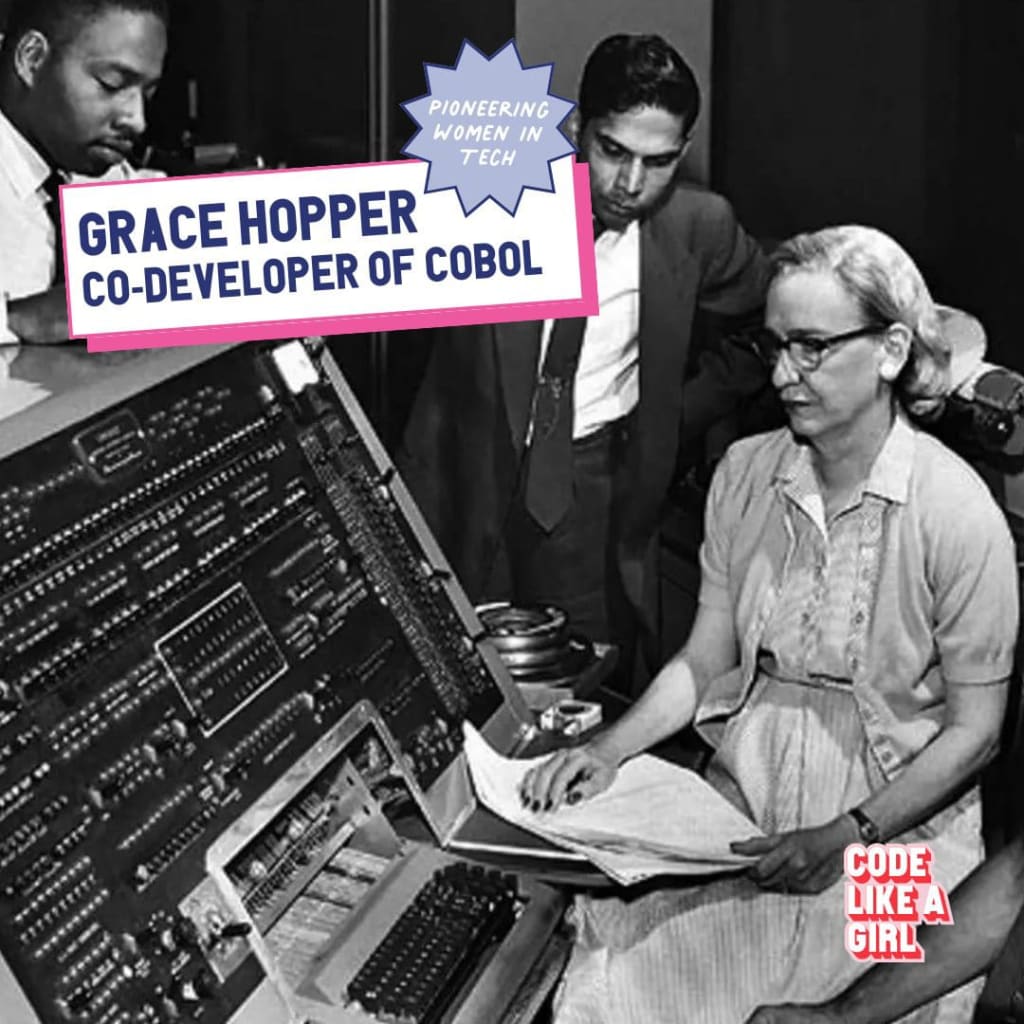
✨ Introduction
Some people in history don't just succeed—they lay the foundation of an era.
Grace Murray Hopper was one of those rare minds who not only revolutionized computer programming but also played a key role in laying the groundwork for the entire digital world.
---
🧠 A Spark of Genius – The Reverse Alarm Clock!
Born in New York City in 1906, Grace had a deep curiosity for how things worked.
At the age of 7, she dismantled seven alarm clocks just to see how they functioned. She successfully got one to run counterclockwise, showcasing her early rebellious and analytical thinking.
This moment reflected her lifelong habit of "asking questions," "thinking differently," and challenging norms.
---
👩🎓 Academic Journey – From Rejection to PhD
Her academic path was not without setbacks.
Vassar College initially rejected her due to low Latin scores, but Grace didn’t give up.
She later earned:
B.A. in Mathematics and Physics – Vassar College (1928)
M.A. in Mathematics – Yale University (1930)
Ph.D. in Mathematics – Yale University (1934)
She became one of the first women in the U.S. to earn a Ph.D. in Mathematics.
---
🏫 Teaching Career Before the War
Before joining the military, Hopper worked as a professor of mathematics at Vassar College, where she taught for almost a decade.
Despite her success in academia, she felt a strong urge to contribute during World War II, which led her to a new mission in life.
---
⚓ World War II & Joining the U.S. Navy
In 1943, during World War II, Hopper joined the U.S. Navy Reserve (WAVES).
She faced rejection at first due to her age (37) and petite frame, but she persisted and eventually earned a commission as a Lieutenant.
She was then assigned to work at Harvard University’s Computation Project.
---
🖥️ Harvard Mark I and the First "Bug"
While working on the Harvard Mark I, one of the first electromechanical computers, Hopper encountered a moth trapped inside the machine.
She taped it in her logbook and coined the term "computer bug" to describe glitches—thus giving rise to the now-common phrase “debugging.”
---
👨🔬 Collaboration with John Von Neumann
Hopper collaborated with the legendary John Von Neumann, a pioneer in computer science. Together, they worked on programming techniques used in the Manhattan Project, which led to the development of the atomic bomb.
---
🖥️ UNIVAC I – America’s First Electronic Computer
In 1949, Grace Hopper joined the Eckert-Mauchly Computer Corporation, where she contributed to the development of UNIVAC I (Universal Automatic Computer I)—the first commercial electronic computer in the U.S.
UNIVAC I revolutionized business, census, and scientific calculations.
---
🔤 Compiler Revolution – A-0 System
Hopper’s most revolutionary contribution came when she developed the first compiler—the A-0 System.
A compiler is a tool that converts human-readable language into machine code.
This invention laid the foundation for all modern programming languages and made programming accessible to non-mathematicians.
---
💼 COBOL – Programming Language for Business
In the 1950s, Hopper led the development of COBOL (Common Business-Oriented Language)—a language designed to be readable by humans and suitable for business applications.
Even today, COBOL is used in banking systems, government software, and large-scale enterprise systems.
---
⚓ Grace Hopper's Naval Legacy
Despite retiring in 1966, the Navy recalled her in 1967 due to her unparalleled expertise.
She finally retired in 1986 at the age of 79, holding the rank of Rear Admiral (Lower Half).
She was the oldest active-duty officer in the U.S. Navy at the time of retirement.
---
🎓 Teacher, Speaker, and Advocate
After her military career, Hopper continued to speak globally, especially advocating for young people and women in STEM.
She became known for using short, sharp quotes and engaging stories in her lectures—always encouraging innovation and risk-taking.
---
🏅 Awards and Legacy
Grace Hopper received numerous prestigious awards:
40+ honorary degrees
National Medal of Technology – Awarded by President George H.W. Bush in 1991
Presidential Medal of Freedom (posthumously in 2016) – By President Barack Obama
USS Hopper (DDG-70) – A U.S. Navy destroyer named in her honor
Grace Hopper Celebration of Women in Computing – The world's largest gathering of women in tech is named after her
She passed away in 1992 at the age of 85, but her influence continues to shape computer science today.
---
🧠 Quotes and Philosophy
Grace Hopper was famous for her wit and insight. Some of her most iconic quotes include:
> ❝The most dangerous phrase in the language is: ‘We’ve always done it this way.’❞
❝It’s easier to ask forgiveness than it is to get permission.❞
❝You manage things; you lead people.❞
Her words continue to inspire innovation, creativity, and leadership.
---
💬 Legacy and Motivation
Grace Hopper teaches us:
✅ Age, gender, or obstacles can't stop a determined mind.
✅ Rules can be redefined; systems can be reimagined.
✅ Programming is not just about writing code—it’s about solving problems and shaping the future.
About the Creator
Keep reading
More stories from Ikram Ullah and writers in Geeks and other communities.
🌍 World Hepatitis Day 📅 28 July 2025
What is Hepatitis? Hepatitis is a silent killer—an inflammation of the liver caused by viral infections. If left undiagnosed and untreated, it can lead to serious outcomes like liver cirrhosis, liver cancer, liver failure, and even death. Types B, C, and D, in particular, may result in chronic infection, while A and E typically lead to acute but self‑resolving illness .
By Ikram Ullah7 months ago in FYI
Invincible Power Rankings
The world of Invincible isn’t built on clean heroics or simple good-versus-evil lines. It’s a universe where cities fall in minutes, loyalties shatter without warning, and strength isn’t just about who can throw the hardest punch — it’s about who survives when entire civilizations go to war. Some fighters look unstoppable until they face someone faster. Others seem secondary until the body count starts rising. And then there are the beings so overwhelmingly powerful that every battle feels less like a fight and more like a reckoning.
By Top Ranked5 days ago in Geeks


Comments
There are no comments for this story
Be the first to respond and start the conversation.