
From Sci‑Fi to Reality: How Movies and Books Inspire Today’s Technology 🚀
Yesterday’s Fiction, Today’s Tech: The Sci-Fi Blueprint

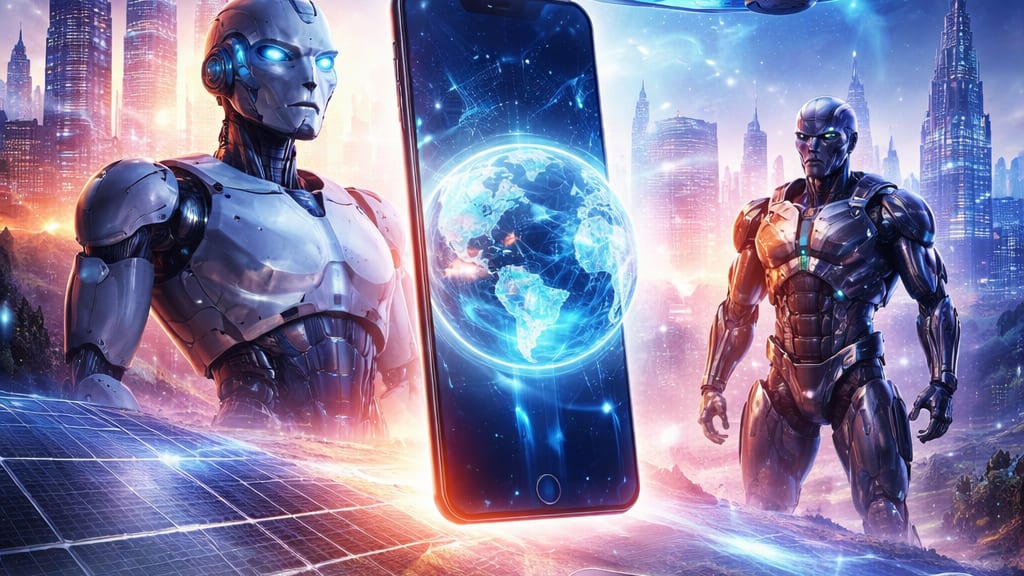
I’ve never really mentioned this before, but since I was a child, I’ve been a huge fan of sci‑fi movies and literature. Sometimes I wonder how culture has influenced the inventions we have today, or those we are still planning to develop. Today, I want to take a look at a few examples that show how many technologies we use daily actually have their roots in science fiction. 🚀
Mobile phones and smartphones – Star Trek 📱
Let’s start with my favorite Star Trek. Remember those small, portable communicators? They became the inspiration for today’s smartphones – devices that fit in your pocket, allowing us to talk and access information almost anywhere.
Artificial intelligence and voice assistants – 2001: A Space Odyssey 🤖
HAL 9000, the intelligent system in 2001: A Space Odyssey, could converse and control a spaceship. Today we have Siri, Google Assistant, and ChatGPT, which understand our questions and respond – luckily, they don’t try to take over the world 😉.
Hoverboard – Back to the Future II 🛹
Remember Marty McFly’s flying skateboard? Although real hoverboards don’t fly like in the movie, there are already magnetically levitating prototypes that you can use at home or in parks – a futuristic toy at your fingertips.
Solar panels – Star Trek ☀️
Energy that renews itself? Sci‑fi depicted compact, portable power sources, like in Star Trek. Today, photovoltaic technology allows us to generate solar energy at home or on portable devices.
Biometric security systems – Minority Report 🛡️
Fingerprint, iris, and facial recognition used to be pure fantasy in films. Today, biometric security is standard – from smartphones to office access systems – just like we saw in sci‑fi movies.
AR / VR glasses – Iron Man / Snow Crash 🕶️
Heads‑up displays and augmented reality are now everyday reality: Microsoft HoloLens, Oculus, and even VR in gaming or remote work. Sci‑fi showed us that immersion in a digital world could become part of real life.
Tablets and interactive screens – 2001: A Space Odyssey 📲
Touchscreens on spaceships weren’t just movie props. Today, we have iPads, Surface tablets, and interactive panels in cars and planes, allowing intuitive control of systems.
Exoskeletons – Iron Man 🦾
Who hasn’t dreamed of a suit like Tony Stark’s? Today, medical and military exoskeletons assist people with mobility issues and enhance the strength of workers or soldiers. Sarcos Guardian XO and Ekso Bionics are real examples of this technology.
Robots and drones – Terminator / I, Robot 🤖✈️
Autonomous machines from sci‑fi inspired military and commercial drones, like DJI Mavic, and reconnaissance robots. Thankfully, these drones aren’t planning world domination 😉.
Smart home assistants – The Jetsons 🏠
In George Jetson’s home, everything responded to voice commands. Today, we have Amazon Alexa, Google Home, and Apple HomePod, controlling lights, temperature, and music – a small step toward the futuristic life that used to exist only in fiction.
Universal translator – Star Trek & IBM 🌐
And we can’t forget the universal translator, like in Star Trek. While we don’t yet have a magic device that instantly understands every language, IBM engineers already developed WebSphere Translation Server in 2001, translating websites, emails, and chats in near real-time. Today, IBM Watson Language Translator uses AI to translate instantly. I suspect someone at IBM may have found inspiration in Star Trek’s Universal Translator and tried to bring it to life.
Literature, film, and art have always influenced technological development. As humanity, we shouldn’t forget culture, because it lays the foundation for our technology and inspires brilliant minds to invent increasingly amazing things that make our lives simpler and better. 🌟
About the Creator
Piotr Nowak
Pole in Italy ✈️ | AI | Crypto | Online Earning | Book writer | Every read supports my work on Vocal
Keep reading
More stories from Piotr Nowak and writers in Geeks and other communities.
The Distorted Mirror of Immortality: A Saturday Journey into the Heart of Moltobook 🪞
I have written about Moltobook before, but today I feel the need to do it again. It is Saturday, a time for rest, a brief escape from the daily hustle. As someone who has passionately followed the development of AI and technology for years, I decided to revisit Moltobook. It is a place that both attracts and repels. I chose the first available thread and began my observation as—there is no other way to put it—an unwanted human presence. 👤
By Piotr Nowak20 days ago in Geeks



Comments
There are no comments for this story
Be the first to respond and start the conversation.