
Final Thoughts on "And Just Like That . . ."
The Reboot is Better Than the Original

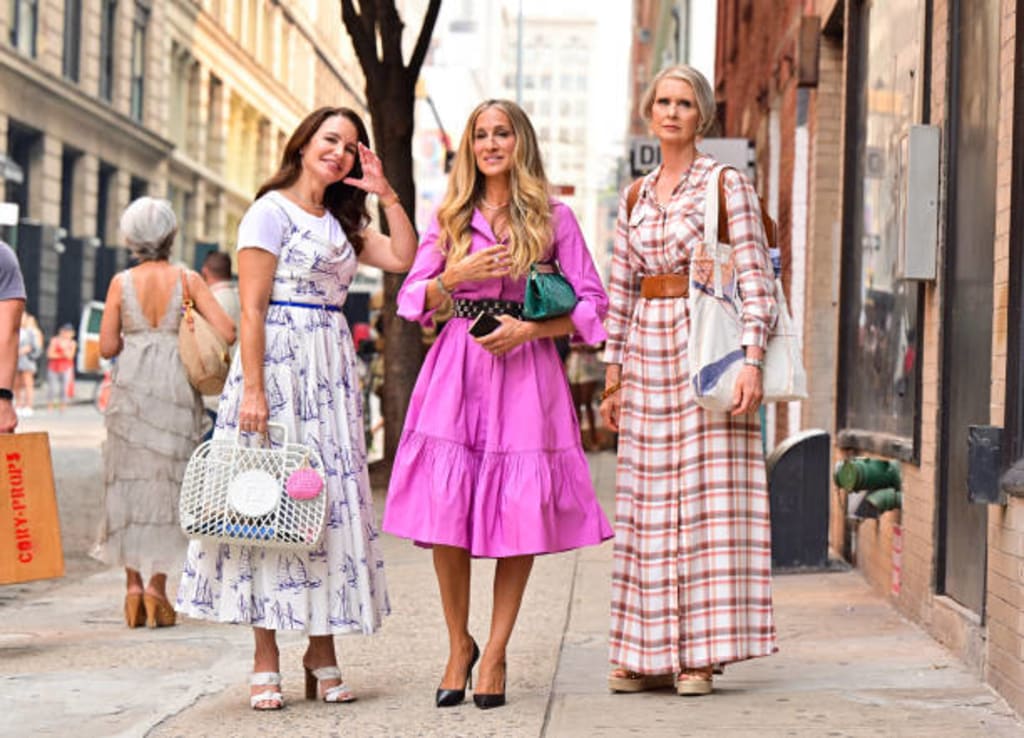
I don’t have HBO Max, so it took me a while to get to the 10-part sequel and reboot of the iconic Sex and the City, which ran on HBO from 1998-2004 and become a cultural touchstone. Its uninhibited look at career women in their thirties who made Manhattan their playground was not only fairly groundbreaking at the time but marvelously entertaining as well. I was able to stream the reboot in one weekend of apartment-sitting in a high-rise overlooking the city that seldom sleeps.
At the time SATC was on the air, I was a gay man with three male friends around the same age as the girls, and we joked that we were the Sex and the City boys. For a time, we were all single and sharing our exploits over drinks or dinners at our favorite city hangouts. Two of us were pretty well off and two of us were financially struggling, but none of us were near the upper-upper middle class that the girls enjoyed in the series.
Today, all but one of us has moved out of the city. I thought I’d be there forever (I was Carrie) but I moved to the country during the pandemic. I am the only one still single. I am fairly regularly in touch with Mark (our Samantha), but I’ve drifted away from the other two. We all thought we would be friends forever.
And that brings me to the reboot, And Just Like That . . . . In general, the critics have not been too kind about the new series. The main criticism has been that it tries too hard to be “woke” to the realities of today that were not evident in the original series. But wasn’t that a valid criticism of the original series? That it was an unrealistic, glamorized, and whitewashed view of downtown?
Most of my friends my age who loved the original also love the new series. Maybe because we grew up in the same time frame, we recognize the issues the ladies are dealing with in their mid-fifties.
SATC was all about the dating and sex lives of the four women. And when you think about it, although all were highly accomplished in their careers, the storylines were almost always about the drama around the men they were dating. Not exactly progressive, if you ask me.
However, in the new series, the women’s lives have expanded. Among Carrie, Miranda, and Charlotte, the issues they are dealing with include raising teenage children, mid-life crisis, career changes, and death. Samantha has moved to London; friendships don’t last forever, despite our good intentions. (And frankly, considering the way Kim Cattrall—Samantha—publicly trashed Sarah Jessica Parker in the run-up to the new series, the scenes of Carrie’s texts with Samantha were handled in such a lovely way.)
I was surprised that I did not miss Samantha. The other three characters more than held their own, and the introduction of the new characters Che (Sara Ramirez), Seema (Sarita Chowdhury), and Nya (Karen Pittman) brought fresh excitement to the series.
While New York City seemed full of promise and frolic in my thirties, our fifties bring new realities, which the new series captures really well. Guess what? Loved ones die unexpectedly. We question our career choices and ponder new possibilities. We struggle to remain relevant and youthful in the awakened world around gender and race issues.
I have adopted the “they” pronoun in much of my writing to avoid gender-specific markers, but when a few college students tell me they do not want to be referred to as “he” or “she”, it’s a difficult transition. With writing, I can think about it, but in the heat of a classroom discussion, I’ve continued with “he” and “she.” So, I know what Charlotte and Miranda are dealing with.
Some critics have complained that Miranda should be more “woke” than she is portrayed in the show. Let me tell you. I spent many years working as a paralegal and proofreader in some of the most famed New York law firms. Those places are about the most un-woke places on Earth, way behind most other corporations in their racial and gender diversity and I’d be surprised if there is one transgender lawyer working in a high-profile firm. And this is where Miranda spent thirty years of her life. I get her awkwardness.
In the original series, Miranda was my least favorite character; now she is my favorite. Back then, she was playing by the rules and a pretty dour woman. Now, she is finding out who she is and embarking on a relationship with non-binary Che. Some have said Steve, Miranda’s long-suffering husband, deserved better treatment. He is a nice guy but—reality check—he was never the right person for Miranda. I was not surprised that they had a sexless marriage. It’s likely more common than we think.
Charlotte has lived a privileged life on the upper east side, but she hasn’t escaped the troubles of a teenager questioning their gender or the uncomfortableness of realizing they have surrounded themselves with nearly all white friends. I was lucky to have workplaces and social outlets that were very diverse when I lived in New York, but now that I’m in a small rural town, I think about how “white” everyone is when I throw a small party. I suspect the high-rises of the wealthy on the upper east side are still pretty segregated.
Finally, there is Carrie, who has always been the center voice of the narrative—although, in the new show, she is not actually doing voiceover narration as she did in the first show. I feel that she has gracefully stepped into her new maturity and is appreciating the small blessings, even in the midst of her profound loss. At the end of the ten-part series, she is single but not complaining.
These three consummate actresses step right back into their characters with such ease. We immediately recognize them, but we also appreciate the silver glow that aging has brought to them—still outwardly beautiful and wealthy, but struggling. Money can’t fix the conundrums that aging brings and that we all will face if we are lucky enough to make it this far.
The original series was one long party, full of cocktails and wisecracks and stories and romantic dramas. The new series is a Thanksgiving meal with your lifelong friends. There may have been disagreements along the way, but at the end of the day, love and gratitude are the lingering, deeper feelings.
About the Creator
Kevin Scott Hall
I blog. I write songs. I sing. I speak. I'm the author of the novel "Off the Charts!" and the memoir "A Quarter Inch From My Heart." I have taught theater and English at CUNY since 2005. Here, I'll be offering commentary on the arts.
Keep reading
More stories from Kevin Scott Hall and writers in Geeks and other communities.
Adele's "Easy On Me" Reaches Ten Weeks at #1
This week, Adele’s “Easy On Me,” fell to number 2 on the Billboard Hot 100, which means that—provided it doesn’t step back up to number 1—it ties her hit “Hello” for ten weeks at number 1, her longest reign on the singles chart.
By Kevin Scott Hall4 years ago in Beat
NFL in Australia for free
The NFL, or National Football League, is the premier professional American football league in the United States, featuring 32 teams divided into the AFC and NFC conferences, competing in a season that culminates in the championship Super Bowl game. Founded in 1920, the NFL is the highest level of professional football globally you can also watch NFL in Australia with VPN.
By David Cook5 days ago in Geeks
The steps to losing a child
Step One: Lose a child. Not what anyone wants to happen and nothing you can do to change it, but you can go through steps to becoming happy again. You can go through steps to loving again. You can go through steps to become a new you because after losing a child you will never be the same person you once were.
By Tabitha Hinkley4 days ago in Fiction


Comments
There are no comments for this story
Be the first to respond and start the conversation.