

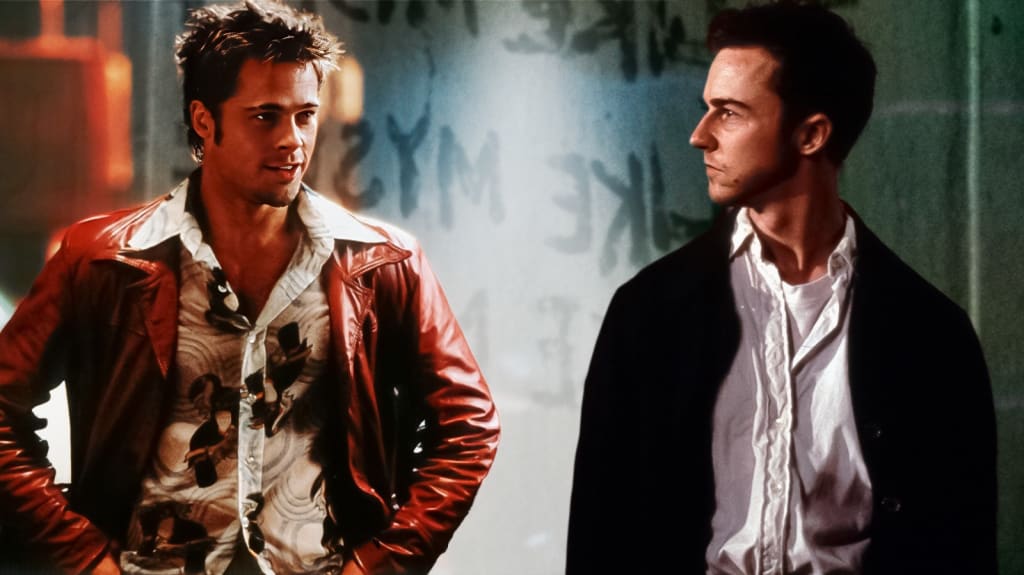
"If you wake up at a different time in a different place, could you wake up as a different person?"
The term "Transgressive Fiction," which I dare not translate, signifies a relatively new literary genre and is the hardcore version of a blend of movements such as splatterpunk, noir, and erotic fiction. It is a type of writing that explores extreme violence, aberrant sexual practices, drug abuse, mutilation, torture, and sadism; in short, manifestations that push the boundaries of human body destruction. Chuck Palahniuk's novel, which the film Fight Club faithfully adheres to with commendable rigor, is representative of this orientation and is a great editorial success, and according to the author's statements...the film adaptation surpasses the book.
However, for film production, the choice seems to be a big mistake. The film's title, as well as its promotion solely in areas related to organized fights, have caused major damage to the artistic endeavor, one that actually caters to the opposite consumer segment; a segment that itself represents a major achievement, rehabilitated late and recovered with great efforts by those who understood it and followed the wrong path it had taken.
Because, presented in shabby packaging, Fight Club is a masterpiece of a film and a cinematographic gem that is quite isolated within its chosen milieu, and through the means of expression it employs.
It is the story of an insomniac madman who composes a neutral world by randomly juxtaposing fragments of reality from everyday life. The way the film portrays the delirium of this alienated character, the resolutions of certain stages, the madness itself, and last but not least, the completely unexpected purpose of the entire plot, are true artistic blows delivered in rapid succession, forming a solid and captivating storyline.
Even the cinematography is not overlooked. From the excess of oversaturated colors to the abuse of chiaroscuro effects, to the complex choreography of fight scenes, constructed in a cinéma vérité style (i.e., one that does not cater to spectacle), Fight Club is configured as a raw, relentless, and uncooperative spectacle. The narration manages to remain cold, distant, and impersonal on all channels of message transmission, and this is a rare occurrence in the world of film.
For a long time, the production does not captivate you...minutes on end, none of them gratuitous, the atmosphere stagnates into something that you are tempted to categorize as dark, incoherent, and banal. But it is not so. The film returns to each of its frames, all of which have a purpose that gradually unfolds when the time comes, in loops that form a story that becomes increasingly interesting as it progresses.
Yes, absolutely. Fight Club is a film that demands special attention from the viewer in order to capture all the ingenious and subtle details of the story. From the subliminal presentation of the character played by Brad Pitt, who appears suggestively and anticipatorily before his official debut in the story, to the use of a narrator who intersects with the characters on screen and gradually discovers the tangled threads of a plot with which he initially disagrees, all these elements contribute to the genius and complexity of the film.
Moreover, the idea of using a narrator who interacts with the characters on screen and discovers, with surprise, the tangled threads of a plot with which he initially disagrees, is simply brilliant.
David Fincher, known for his work on films like Se7en, The Curious Case of Benjamin Button, and The Social Network, recorded Fight Club for a staggering 139 minutes of footage, equivalent to three regular films (over 1500 reels). Approximately 35% of the shots required more than 20 takes, with some scenes requiring over 40 takes. The post-production phase involved a monumental amount of work, with sequences being "assembled" from separately selected images amidst the vast amount of footage.
Like parables and metaphors are not having a field day at their own discretion, the production is literally packed with signs, symbols, and meanings.
About the Creator
Andreea Sorm
Revolutionary spirit. AI contributor. Badass Engineer. Struggling millennial. Post-modern feminist.
YouTube - Chiarra AI
Keep reading
More stories from Andreea Sorm and writers in Geeks and other communities.
Disconnect - Henry Alex Rubin (2012)
"Communication is the key to understanding, and technology can either bring us closer together or tear us further apart." "Disconnect" is a modest film. The subject starts with communication and technology, soon becoming a true case study. There are three common storylines that intersect, each reaching its announced conclusion, bordering on the mundane. There is nothing spectacular here, although the story of the stripper initially promises a more winding path, and the storyline involving a suicide attempt has significant potential. We tend to believe that the advantages of virtual connectivity are being put on trial, even if the indictment is indirect.
By Andreea Sorm3 years ago in Geeks
Villainess Blown Opportunity: A Villainous Liz Hurley Cancelled by NBC (Wonder Woman)
You know, NBC's done a lot of things over the years that has pissed me off. And no, I'm not talking about losing the NHL coverage. I'm grateful to NBC for basically resurrecting the NHL following the lockout, how they promoted the sport, and how they elevated it during a time where apathy towards hockey was at its worst. NBC delivered 16 great seasons of NHL coverage. I'm grateful for that, and plus, someone had to go to make way for the NHL's debut on Turner and their return to ESPN.
By Clyde E. Dawkinsabout 24 hours ago in Geeks




Comments
There are no comments for this story
Be the first to respond and start the conversation.