

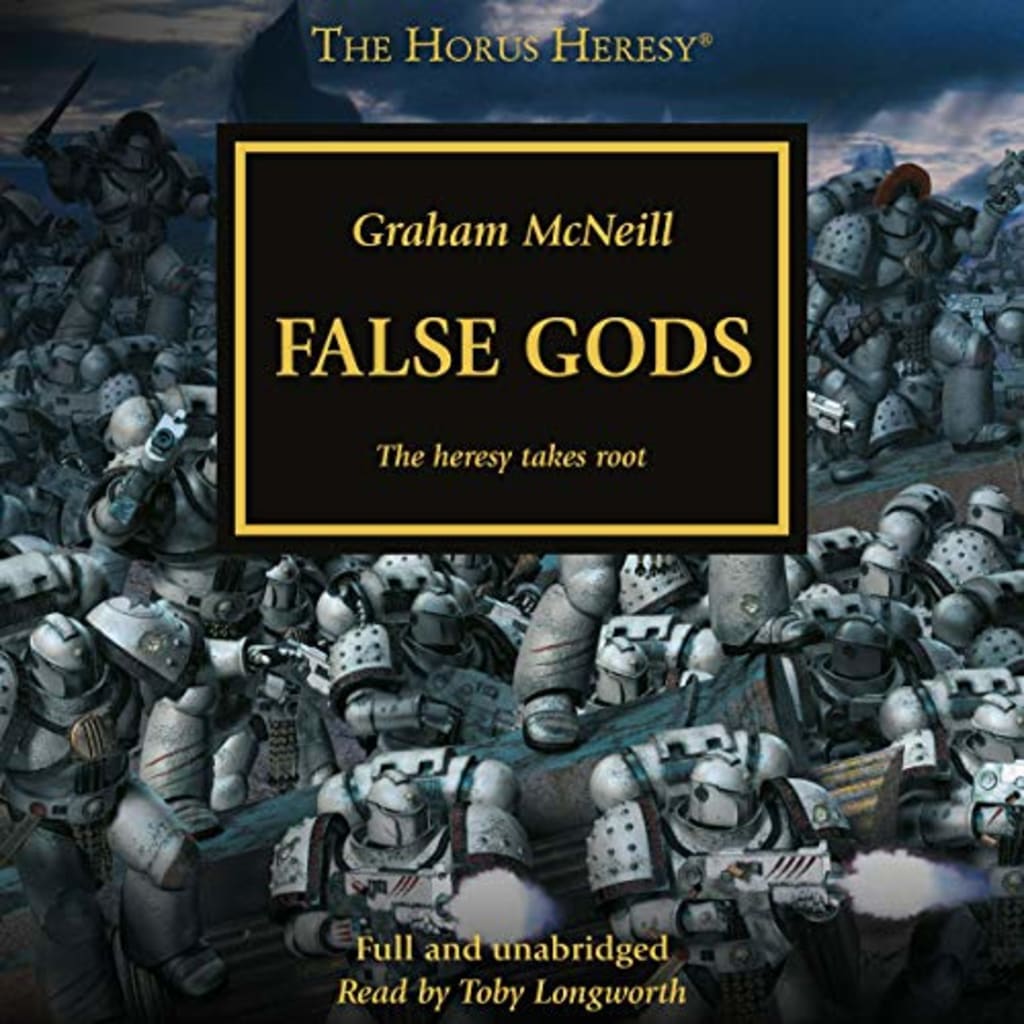
False Gods by Graham McNeill is book 2 in the Horus Heresy series and continued directly on from book 1 - Horus Rising.
Once again I am absolutely blown away by the level of character detail maintained in this book. Despite being written by a different author, McNeill has managed to seamlessly preserve and develop the key characters from the first. Loken and the others of the Mournival are presented with some incredibly difficult situations and McNeill does a wonderful job of challenging and growing these characters as the sinister nature of the Heresy takes root.
Following in aspects of the epic tradition laid down by Abnett for this series, McNeill continues to make good use of foreshadowing and repetition of certain events and lines. Once again, this book opens with the most alluring "I was there the day Horus fell", and this is used with wonderful effect towards the end of the novel too. Without wishing to give too much away, details like this really make it feel like a traditional retelling of actual events, rather than the grim dark science fiction series it actually is.
Where Horus Rising was a reasonably linear plot, False Gods starts to bring many unspoken paths to light, and starts us off down yet more. We see a lot more in reference to the character of the Emperor, and while it comes from an incredibly unreliable narrator much of it rings true when compared with what has been printed on 'future' events. This carefully crafted level of doubt runs perfectly in sync with what Horus must also be feeling when he encounters these 'revelations'. Like us, he knows that the Emperor has outright denied and punished those that would claim he is a god, yet the scenes he is presented with show the dark future where that is all he is known as. He is also aware that things are not as they seem to be, and despite the reader knowing that Horus will give in to the temptations of power there are moments where I genuinely thought things could turn out different this time.
False Gods is laced with tantalising opportunities for Horus to turn away from the path he seems destined to walk down and often reminds me of Faustus in this regard. The series is definitely shaping up to be something of an epic tragedy, both in the way it is told and the nature of the story itself, and I really appreciate the level of attention that Abnett and McNeill have given to this element of the series. It gives it a classic feel, despite being a story about the rise and fall of post-humans fighting a war in space.
Running parallel to this heresy, another is also brewing within the souls of the human elements. McNeill continues to explore how humanity reacts to the fall of their idols, in this case with the rise of the belief that the Emperor is actually divine. It is perhaps startlingly honest that a society supposedly set firmly on the path of science and enlightenment would fall so quickly back to superstition, yet it is mixed with the fact that in this universe there certainly would seem to be powers beyond the explanation of science.
Like Horus rising, False Gods finishes with a lead into the next book in such a way that it maintains the feeling of being a natural ending point to the novel, while still keeping us interested enough to immediately look for where the next book is on our shelves. Luckily for us, unlike all those years ago when it first started, we have no waiting time before continuing this epic saga!
About the Creator
Keep reading
More stories from David Heyman and writers in Geeks and other communities.
Soul Hunter by Aaron Dembski-Bowden
Warning - this review contains some minor spoilers in the form of plot outlines, though no key details are revealed. Having recently purchased the reprinted collectors' edition of the Night Lords trilogy, it seemed like an ideal time to leap into this highly acclaimed series by Aaron Dembski-Bowden. As an aside, the book itself is absolutely stunning to behold with a cloth-covered binding and gold lettering on the front cover and spine. The legion's icon has also been laminated onto the front cover and looks appropriately foreboding. The pages themselves are edged with a very eye-catching blue and white lightning bolt, and inside you have a full-size version of the original paperback cover art.
By David Heyman5 years ago in Geeks
A Knight of the Seven Kingdoms Series Review (Season 1)
As one of the biggest properties in fantasy, A Song of Ice and Fire remains immensely popular with audiences. After reaching far into the past with House of the Dragon, a second spin-off was on the cards. A Knight of the Seven Kingdoms serves up a bite-sized slice of action and drama, but it still claims a spot among the best small-screen titles.
By Robert Cain7 days ago in Geeks
📢 Raise Your Voice Thread: 03/05/2026
Our “Raise Your Voice Threads” are hosted most alternating Thursdays at 12PM ET to offer creators more avenues to uncover exceptional stories on Vocal. As we are continuously searching for fresh creators and inspiring stories, this thread provides an opportunity to exchange and discuss the stories that have moved and motivated us on Vocal.
By Raise Your Voice by Vocala day ago in Resources


Comments
There are no comments for this story
Be the first to respond and start the conversation.