
Exploring Interstellar (2014): A Comprehensive Summary, Commentary.
Interstellar (2014)


Exploring Interstellar (2014): A Comprehensive Summary, Commentary!
Interstellar, directed by Christopher Nolan and released in 2014, is a film that challenges its audience both intellectually and emotionally. With its stunning visuals, complex narrative, and thought-provoking themes, it has earned its place as a modern science-fiction classic. In this article, we will explore the film’s intricate plot, examine its underlying themes, and discuss why experiencing it in its original English language is essential to fully appreciate its depth.
Introduction:
Set in a near-future Earth on the brink of ecological collapse, Interstellar follows former pilot Cooper (Matthew McConaughey) as he embarks on a daring space expedition. Tasked with finding a new home for humanity, Cooper joins a secret NASA mission that involves traveling through a wormhole near Saturn. The journey that unfolds is not only a race against time but also a profound exploration of love, sacrifice, and the boundaries of human understanding.

The film is notable for its ambition—melding hard science with emotional storytelling—and for its attention to scientific accuracy, courtesy of consultant Kip Thorne. Yet, it is the human elements intertwined with cosmic questions that resonate most deeply with viewers, making it a rich subject for analysis.
Detailed Plot Summary;
A World in Crisis:
The film opens on a deteriorating Earth, where food scarcity, dust storms, and failing crops signal an uncertain future for mankind. The survival of the human race is at stake, and society has largely turned inward, with dwindling hope for a sustainable future. In this grim setting, we meet Cooper, a former NASA pilot now working as a farmer, who struggles with the loss of the world he once knew and the responsibilities of raising his children, Tom and Murphy.

The Call to Adventure:
Murphy (Mackenzie Foy as a child, later Jessica Chastain), Cooper’s curious and intelligent daughter, becomes fascinated with the mysteries of the universe, even as she grapples with the abandonment of her father. When mysterious gravitational anomalies begin to occur in Murphy’s room, they lead Cooper and his daughter to a hidden NASA facility. There, Professor Brand (Michael Caine) reveals a secret mission: humanity’s survival depends on finding a new habitable planet beyond our solar system.
Journey Through the Cosmos:
Cooper is recruited to pilot the spacecraft Endurance on a mission through a recently discovered wormhole near Saturn—a shortcut to distant galaxies. Alongside a diverse crew, including Dr. Amelia Brand (Anne Hathaway), Romilly, Doyle, and the robots TARS and CASE, Cooper embarks on a perilous journey into the unknown. Their mission involves visiting several potential worlds orbiting a supermassive black hole named Gargantua, where the effects of time dilation become a critical, and often heartbreaking, factor.

Encountering Relativity and Loss:
One of the most compelling segments of the film is the visit to the water planet, where time moves so slowly that every hour on the surface equates to years on Earth. This encounter forces the crew to confront the heavy price of exploration, as well as the personal sacrifices required to secure a future for humanity. The emotional weight of these decisions is felt not only by Cooper but also by the audience, as the passage of time underscores the inevitable loss and change experienced by all.
The Paradox of Love and Science:
As the mission progresses, Interstellar blurs the lines between scientific rigor and emotional intuition. The film posits that love might be a dimension as tangible as time or space—a force that transcends conventional understanding. Cooper’s relationship with his daughter Murphy serves as a poignant reminder that, despite the vast cosmic scales at play, the human heart remains at the center of our existence. This duality is a cornerstone of the film’s narrative, inviting viewers to ponder whether emotions can influence the fabric of reality.

The Climactic Revelation:
In one of cinema’s most memorable sequences, Cooper’s journey takes a surreal turn when he finds himself inside a tesseract—a four-dimensional space constructed by future beings. Here, time becomes a physical dimension, and Cooper is able to communicate with Murphy across different moments of her life. This sequence not only resolves the mystery of the gravitational anomalies but also reinforces the film’s central message: that hope and human connection are eternal, transcending the limits of time and space.
Resolution and New Beginnings:
The narrative eventually circles back to Earth, where an older, wiser Murphy plays a pivotal role in humanity’s survival. Cooper’s ultimate sacrifice and the knowledge he imparts from the tesseract help pave the way for a future where humans can flourish among the stars. The film concludes on an ambiguous yet hopeful note, suggesting that while the journey is fraught with hardship, the quest for a new home is a testament to the indomitable human spirit.
Thematic Commentary;
1. The Intersection of Science and Emotion:
At its core, Interstellar is a film about the balance between the cold, methodical nature of science and the warmth of human emotion. Nolan’s narrative challenges the audience to consider how empirical data and gut feelings can coexist. The scientific principles—such as relativity, wormholes, and gravitational time dilation—are presented with meticulous detail. Yet, it is the personal stories of love, loss, and redemption that render these complex ideas accessible and deeply moving.
2. Time as Both an Adversary and an Ally:
Time is a recurring motif throughout Interstellar. The film explores time as a relative and mutable force, where moments of joy can be fleeting and moments of grief can span decades. This treatment of time as both an adversary and an ally is particularly evident in the scenes on the water planet and in the tesseract sequence. It emphasizes that while time can rob us of our moments, it also provides the structure within which we grow, learn, and ultimately find meaning.

3. Human Resilience and the Will to Survive:
Despite the seemingly insurmountable challenges faced by humanity in the film, Interstellar is ultimately a story of resilience. The characters—especially Cooper and Murphy—embody the relentless determination to survive and thrive against all odds. Their journey is symbolic of the broader human struggle to overcome existential threats, whether they be environmental, cosmic, or internal.
4. The Power of Love:
Perhaps the most profound and debated theme in Interstellar is the power of love. The film posits that love is not just a sentimental emotion but a fundamental, perhaps even quantifiable, aspect of the universe. This idea is exemplified in the bond between Cooper and Murphy, which transcends time and physical separation. It suggests that love might be the key to unlocking mysteries that science alone cannot solve.

Visual and Auditory Brilliance;
Interstellar is a feast for the senses. The visual effects, particularly those depicting the wormhole and the black hole Gargantua, are both scientifically inspired and artistically breathtaking. The use of practical effects, combined with state-of-the-art CGI, creates a visceral experience that draws viewers into its otherworldly landscapes.

Complementing the visuals is Hans Zimmer’s evocative score, which masterfully underscores the film’s emotional highs and lows. The music, characterized by its deep organ tones and sweeping orchestral movements, not only heightens the tension but also evokes a sense of wonder at the vastness of the cosmos. Together, the cinematography and the score create an immersive atmosphere that reinforces the film’s central themes.
Why Watch Interstellar in English?
While Interstellar is celebrated worldwide and has been dubbed and subtitled in numerous languages, there are compelling reasons to experience it in its original English version:

1. Authentic Performances:
The film’s dialogue, delivered by actors such as Matthew McConaughey, Anne Hathaway, and Michael Caine, is laden with nuance and subtlety. The original English performances capture the specific intonations, pauses, and emphases that contribute to the emotional depth of each scene. Watching the film in English allows you to experience these performances as the director intended, preserving the authenticity of the characters’ expressions and interactions.
2. Nuances in Scientific Dialogue:
Interstellar features a substantial amount of technical dialogue related to astrophysics, relativity, and other scientific concepts. The original English script maintains a level of precision and clarity that is sometimes lost in translation. For viewers with an interest in science, hearing these explanations in their original form can provide a more accurate understanding of the complex ideas being presented.
3. Cultural and Linguistic Context:
Language carries with it cultural nuances and context that are often deeply intertwined with the narrative. The English language, with its unique expressions and idioms, contributes to the film’s overall tone and atmosphere. Watching Interstellar in English ensures that you are fully immersed in the cultural context that shaped its creation, enhancing your overall appreciation of the story.
4. Preservation of the Director’s Vision:
Christopher Nolan is known for his meticulous attention to detail, and his films are a product of his distinct creative vision. The choice to present Interstellar in English is part of that vision, and it ensures that every word, pause, and inflection is as intended. By watching the film in its original language, you honor the artistic integrity of the work and experience it in its purest form.
5. Enhanced Emotional Impact:
The emotional resonance of Interstellar is amplified by the authenticity of its dialogue. The heartfelt exchanges between characters, the poignant monologues, and even the silent moments are all rendered more powerfully in English. The nuances of the language add layers of meaning that might not be fully captured in translations, allowing for a deeper emotional connection with the film.

Conclusion;
Interstellar (2014) stands as a testament to the power of cinema to blend scientific inquiry with profound human emotion. Its intricate narrative, stunning visuals, and evocative score combine to create an experience that challenges the mind and touches the heart. Through its exploration of time, love, and survival, the film invites us to reflect on our place in the universe and the enduring strength of the human spirit.
Moreover, watching Interstellar in English is crucial to fully grasping the nuances of its dialogue, appreciating the original performances, and engaging with the scientific and cultural context that informed its creation. It is an invitation to experience the film exactly as Christopher Nolan envisioned—a journey that is as intellectually stimulating as it is emotionally moving.
Whether you are a fan of science fiction, a lover of deep, character-driven narratives, or simply someone who appreciates the magic of cinema, Interstellar offers a rich tapestry of ideas and emotions that will continue to inspire and provoke thought long after the credits roll.

About the Creator
Daniel
I love football, history, and music. Football brings excitement, history teaches valuable lessons, and music is my escape. These passions inspire me daily and shape my view of the world.
The Post-Credits Wedding, Benedict and Sophie's Romance, and What Comes Next in the Bridgerton Season 4 Finale
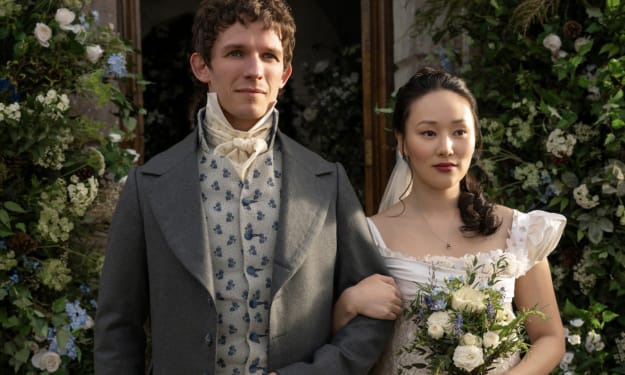
A post-credits wedding scene that delighted fans and teased the Regency drama's future while reigniting discussions about identity, representation, and narrative evolution on Netflix's hit show Bridgerton came to an end in a moment that was both romantic and unexpected. The conclusion of Season 4's second episode not only brings the love story between Benedict Bridgerton and Sophie Baek to a close, but it also sets the stage for what's to come. The central plot of the fourth season, adapted from Julia Quinn's "An Offer from a Gentleman," follows Benedict Bridgerton (played by Luke Thompson) and Sophie Baek (played by Yerin Ha) through a grand arc resembling that of Cinderella, with significant creative changes.
By Raviha Imran4 days ago in Geeks


Comments (1)
Great review!