
Every The Simpsons Treehouse of Horror - Rated and Ranked (Part One)
The Simpsons Treehouse of Horror I-VI


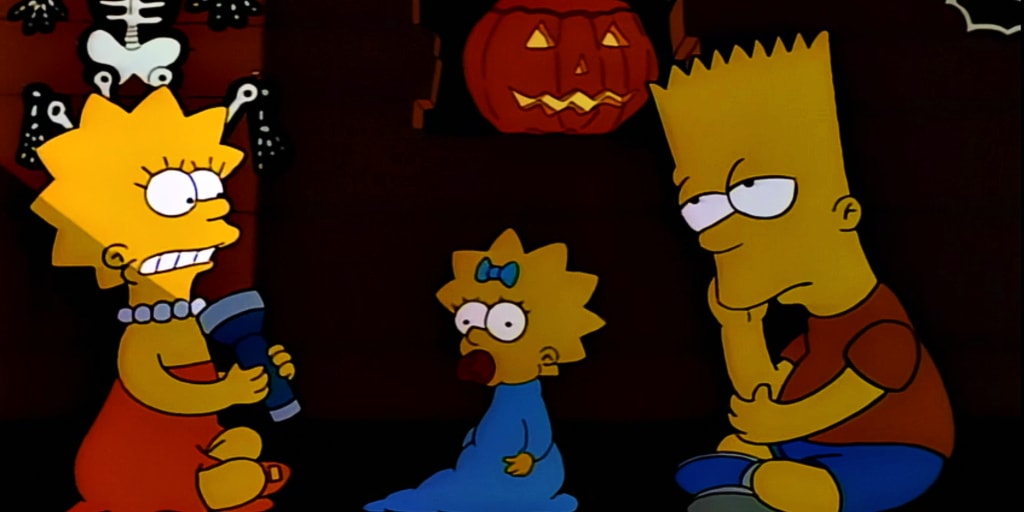
In the time since its premiere back in 1989, The Simpsons has amassed nearly 800 episodes, and while the long-running animated sitcom rarely retreads the exact same stories, fans know that they can always look forward to a new Treehouse of Horror every single year.
So far, The Simpsons has produced a total of 36 Treehouse of Horror episodes, not counting two specials that pay homage to some of the most beloved genre entries of all time. And, with the latest Treehouse of Horror having just arrived and Halloween right around the corner, there has never been a better time to revisit The Simpsons' most iconic anthology series.
Over the next week, I will be breaking down each Treehouse of Horror, examining their strengths and weaknesses and, ultimately, ranking every single one of them. So join me in celebrating The Simpsons' spookiest stories, and be warned of some decades-old spoilers to come.
Treehouse of Horror I (Season 2, Episode 3)

The very first Treehouse of Horror premiered in 1990, and not only was this episode a product of its time, it was quite possibly the most self aware of them all. The episode begins with Marge stepping out onto a theater stage to offer viewers a warning of things to come, which perfectly encapsulates the lingering Satanic panic that gave way to worries that violent video games would turn the world's youth into deranged serial killers.
From there, Treehouse of Terror transitions to the Simpson family's literal treehouse, where Bart and Lisa are busy exchanging the episode's three tales of terror. This is one of my absolute favorite parts of the episode, and one of the few motifs that I really wish the series kept.
The first story of the episode, "Bad Dream House," is home to plenty of classic Simpsons dynamics that fans have watched wane over the years, though it still stumbles on occasion. For the most part, this is a muddled mash-up of Poltergeist and The Amityville Horror where the most innocuous jokes shine brighter than the rest, with the grave of Mahatma Gandhi being set amidst the rest of those in the "ancient Indian burial ground" completely stealing the show.
Following a brief treehouse interlude, viewers are whisked into "Hungry are the Damned," a retelling of the classic The Twilight Zone episode "To Serve Man." While the story as a whole is fairly middling, there is no doubt that "Hungry are the Damned" help define a vast swathe of The Simpsons' universe thanks to the introduction of Kang and Kodos, the drooling, tentacled aliens whose orange tractor beams were burned into my brain as a child playing the first chapter of Bart vs the Space Mutants for hours on end.
Last up is Lisa's rendition of Edgar Allen Poe's "The Raven," which stands out as not just the best story from the first Treehouse of Horror, but one of the best pieces of The Simpsons media full stop. This is where the fact that each segment in the first Treehouse of Horror had a different director is the most prominent, as well as where David Silverman cemented his place in The Simpsons' history. For everyone who read "The Raven" in school but didn't understand why it was scary, The Simpsons has got you covered.
The first Treehouse of Horror isn't perfect, but it is exceptionally charming. All things considered, I give it a full Kang and most of a Kodos.
Treehouse of Horror II (Season 3, Episode 7)

Treehouse of Horrors II opens with another introductory warning from Marge, which I cannot get enough of. It's just such an endearing little bit of insight into her character. Unfortunately for her, nobody is turning The Simpsons off, no matter how gory or disturbing of an episode she promises it will be.
Treehouse of Horror II jumps right into its first story, a version of "The Monkey's Paw" that also evokes The Twilight Zone's "A Small Talent for War." The segment is a bit slow, but still fun, especially when Flanders gets to steal the spotlight. More importantly, it leads into the episode's overarching motif, which sees various members of the family awaken from nightmares and move into bed with another. In the case of the first interlude, Lisa goes to Bart's room and trades her candy necklace in exchange for making room for her in his bed, which is such an unforgettable moment that I had completely forgotten was born from a Treehouse of Horror.
The second segment, "The Bart Zone," is another fairly slow entry, as well as another adaptation of an episode of The Twilight Zone. This time, "It's a Good Life" is retold with Bart stepping into the shoes of the god-like Anthony Fremont.
Last up in Treehouse of Horror II is The Simpsons' take on Frankenstein, "If Only I Had a Brain." As funny as it is at times, "If Only I Had a Brain" is another plodding, generally forgetful story that stands out the least of the three the episode has to offer.
I really wish I had more to say here, but Treehouse of Horror II doesn't have much weight to throw around. It's getting one Kang and one third of a Kodos, whichever third looks best.
Treehouse of Horror III (Season 4, Episode 5)

Treehouse of Horror III gives audiences a fun Homer intro that pays homage to Alfred Hitchcock's famous vignette of the filmmaker stepping into his own silhouette. While there is a part of me that misses Marge, I can certainly appreciate the charm, even if the homage would be more fitting in an episode that actually pays homage to a popular Hitchcock film
From the short opening sequence, things jump right into the first short, "Clown Without Pity," which references everything from The Twilight Zone's "Living Doll" to Child's Play to, perhaps most importantly, Richard Matheson's "Prey," albeit as it was adapted for "Amelia" from 1975's Trilogy of Terror. Seeing a Krusty the Clown doll take on a murderous intent is more unnerving than it is humorous, which is a testament to both the segment and the episode as a whole.
Breaking things up this time is another set of storytelling interludes, all set within the confines of a Halloween party at the Simpson house. This episode may have missed Marge's warning against watching this particular Treehouse of Horror, but having something to tie each story together lends them all a sense of sincerity that would otherwise be sorely missed.
"King Homer" is a black-and-white retelling of King Kong, with Homer and Marge taking on the roles of Kong and Ann Darrow. "King Homer" is replete with the kinds of unexpected quips and visual gags that made The Simpsons what it is in the first place. To a point, "King Homer" feels like a distillation of every aspect of The Simpsons that fell by the wayside after a certain point to the entire series' detriment.
The final short of Treehouse of Horror III is "Dial Z for Zombies," a simple, equally tragic and funny entry that knows exactly what it is. "Dial Z for Zombies" is also a perfect example of how healthy social commentary used to be in the pre-social media age, which, haha, let's not get into that.
There is nothing special closing out Treehouse of Horror III, and that's a little disappointing, but not enough to detract from the episode itself. This gets a half of a Kang and a full Kodos.
Treehouse of Horror IV (Season 5, Episode 5)

This is the point where I realized that almost every episode labeled as a "Treehouse of Horror" features a "The Simpsons Halloween Special" title card, which is another fun fact that I will not be addressing further. What I will address is the episode's Night Gallery-inspired wraparounds, all written by Conan O'Brien, which find Bart in a dark art gallery where he attempts to kick things off before being interrupted by Marge, who comes bearing another helpful warning about things to come. I love this so much.
The first short, "The Devil and Homer Simpson," is arguably the best appearance of Ned Flanders in The Simpsons' history. This is also a stark reminder that Ned wasn't always an overt evangelical, but rather an irritatingly nice, normal neighbor. Except when he's the Devil. In "The Devil and Homer Simpson," Ned is the Devil, and it is fantastic.
"Terror at 5 1/2 Feet" continues the tradition of adapting stories from The Twilight Zone, specifically the beloved "Nightmare at 20,000 Feet." The stakes may not be the highest, but Bart's panic is palpable, and that is more than enough to carry "Terror at 5 1/2 Feet" through to a successful finish.
"Bart Simpsons' Dracula" is, obviously, an adaptation of Bram Stoker's Dracula, and it is by far one of the greatest Treehouse of Horror segments to date. The animation is stunning, the Lisa-centric story is hilarious, and the fact that it leads into a shocking twist ending that itself leads into the entire cast abruptly slipping into singing soft Christmas music as snow begins falling inside the Simpson's home kitchen is utterly unforgettable.
What's that, you say? Dam Silverman directed this entire episode? Color me unsurprised. Most of a Kang and the whole damn Kodos.
Treehouse of Horror V (Season 6, Episode 6)

Treehouse of Horror V brings Marge back for her harshest introductory warning yet. Not only does Marge assure audiences that the stories to come are too terrifying to be seen, she cuts to 200 Miles to Oregon before Bart and Homer hijack the signal to usher viewers into the first segment, "The Shinning."
"The Shinning" is easily the most memorable Treehouse of Horror segment from the anthology's early years, and not just because it is a retelling of The Shining. Every second of "The Shinning" is brimming with kind of straightforward comedic storytelling that other animated series struggle to employ. Homer's homicidal tendencies are driven far more by a lack of beer and television than they are of any ghostly influence, while Groundskeeper Willie's best attempts to save the day are cut short along with his life courtesy of an axe that continues to land in his back in each segment.
There might not have any interludes, but it maintains its pace by jumping from "The Shinning" right into "Time and Punishment." This second segment begins as a fairly obvious adaptation of Ray Bradbury's "A Sound of Thunder," it quickly spirals into something decidedly unique. "Time and Punishment" is undoubtedly peak The Simpsons, as is the final short of the episode.
"Nightmare Cafeteria" is loosely inspired by Soylent Green, and the worth "loosely" is doing a lot of heavy lifting in that statement. Like "Time and Punishment" before it, "Nightmare Cafeteria" wastes no time in reimagining the most innocuous The Simpsons characters into abject monsters, and it is genuinely horrifying.
The final moments of "Nightmare Cafeteria" cut to an ending involving rolling clouds of Inside-Out Gas, which is just as captivating today as it was when I saw it on television for the very first time at the tender age of seven. Treehouse of Horror V is getting the whole Kang and Kodos.
Treehouse of Horror VI (Season 7, Episode 6)
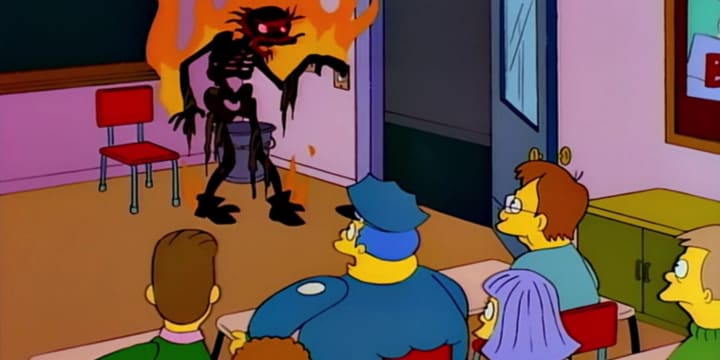
Instead of an opening monologue or wrap-around segment, the beginning of Treehouse of Horror VI simply showcases a Headless Krusty the Horseman who races away toward another Halloween themed couch gag.
The opening segment, "Attack of the 50-Foot Eyesores," sounds like an homage to Attack of the 50-Foot Woman, which it could almost be if viewers didn't really pay attention to it. What audiences get is a piece of commentary on the advertising industry and its affect on consumers, all shrouded behind a thin veil of Springfield's surprising number of oversized mascots going on a rampage across town.
"Nightmare on Evergreen Terrace" takes Groundskeeper Willie from hapless victim to ethereal terror by turning him into The Simpsons' stand-in for Freddie Krueger. Giving Bart and Lisa a fighting chance alleviates some amount of tension, yet taking it away proves once more that Treehouse of Horror episodes aren't wary of upsetting audiences where they can.
"Homer3" ensures that another Treehouse of Horror adapts another The Twilight Zone episode. Where "Little Girl Lost" was unsettling, "Homer3" was a truly stunning display of what CGI animation was capable of, at least at the time of its release. "Homer3" is also funny and heartwarming in equal measure, not to mention infinitely intriguing as it ends the episode by literally dropping Homer into the real world, where he immediately stumbles into an erotic cake shop.
Notice I never discussed the interludes in Treehouse of Horror VI. There aren't any. It's losing part of a Kodos for that, but it still gets the whole Kang.
-
Six down, 32 to go. Check back tomorrow for part 2 of my review of every single Treehouse of Horror episode of The Simpsons (so far), and keep coming back when I rank them all just in time for Halloween.
About the Creator
Keep reading
More stories from John Dodge and writers in Geeks and other communities.
A Review of He Lost His Keys in Space
On September 30, indie comic fans everywhere finally got the chance to pick up their very own copies of He Lost His Keys in Space by Luke Milton and Lizzy Lang. This new, irreverent sci-fi comedy has been hotly-anticipated since it was announced with an original release date scheduled for June.
By John Dodge5 months ago in Geeks
A Knight of the Seven Kingdoms Series Review (Season 1)
As one of the biggest properties in fantasy, A Song of Ice and Fire remains immensely popular with audiences. After reaching far into the past with House of the Dragon, a second spin-off was on the cards. A Knight of the Seven Kingdoms serves up a bite-sized slice of action and drama, but it still claims a spot among the best small-screen titles.
By Robert Cain7 days ago in Geeks
Doctor Who: My Top Picks For The Next Doctor
We expect it isn't for at least another few months until we find out who our next long-term Doctor is. Unless that big regeneration twist from last year's "The Reality War" means we won't find out until Christmas Day.
By Christopher Hales2 days ago in Geeks
Who is your "Person"?
It's important to recognize that you cannot go through life as easily on your own. My name is Elizabeth and I'm a survivor of child abuse and horrific trauma. Healing from trauma is not a quick fix and recognizing that it will take time, is part of the struggle.
By Elizabeth Woods4 days ago in Psyche


Comments (1)
Such beilliant fun , perfect for the season too, but I can watch them any time