
Emma!
This article will explore why Emma from The Promised Neverland is the greatest protagonist ever written...spoilers ahead!

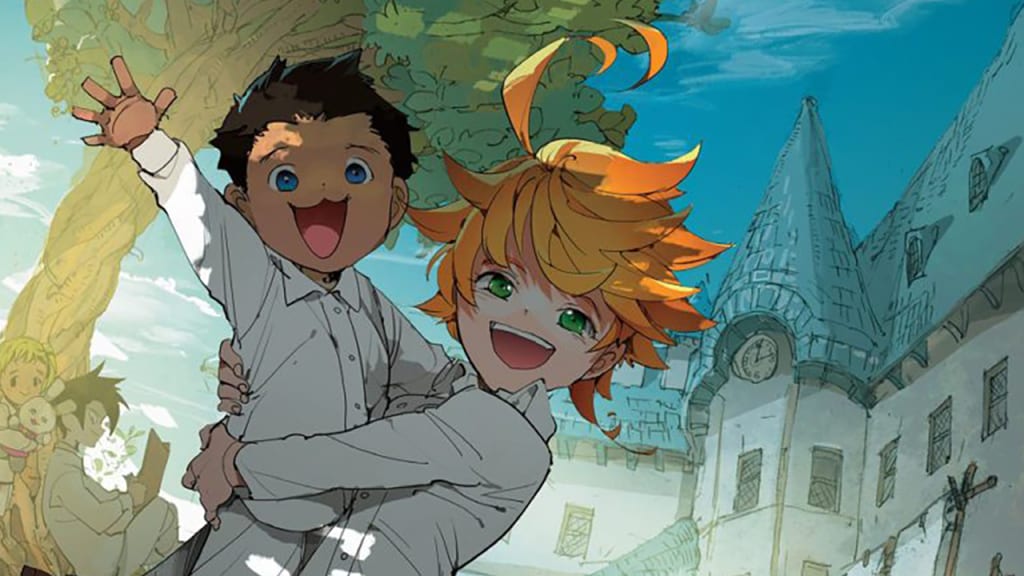
Emma from the Promised Neverland is the greatest female character ever written. To give context, The Promised Neverland is a story about a group of kids who discover the true intentions of their existence; to be food for monsters called demons. The children live in an orphanage raised by a woman named Isabelle, or at least they think it’s an orphanage. The reality is that these children are being raised on a farm as free range livestock, or farm children. According to the demons, the smartest children have the tastiest meat, but only up to a certain age. When Emma and her friend Norman accidentally stumble across this knowledge, they, along with their friend Ray, do everything in their power to escape, with Emma as the lead.
Even with two other male main characters, Emma is still the strongest despite being a female in a Shōnen Jump comic. Normally, a male protagonist is the norm in Shōnen Jump works. Emma, Norman, and Ray all want to escape, the only difference between them is Emma knows that they will make it, where Norman and Ray seem to have given up. Ray, the biological child of Isabelle, has known about the secret of the farm since he was a baby, and throughout his life, has made deals with Isabelle in order to secure his safety, but even that failed once Isabelle betrayed him and promised to ship him off to the demons. Norman is scheduled a ship date for the demons, and he accepts that fate. Emma on the other hand, accepts nothing and continues training the other, younger children in secret as she heals both from a broken leg (thank Isabelle for that), and a broken heart from seeing Norman be sent away to his death. With extreme secret training and determination lead by Emma, both her and Ray escape with the oldest children, leaving the babies behind as they would without a doubt slow them down. It was Ray who demanded the babies be left behind and forgotten, but it was Emma who made a vow to come back in two years to rescue them.

Emma’s strength and determination branch out in two main ways; her overwhelming motherly instincts, and her physical strength. At the “orphanage," Emma was one of the oldest children, and she naturally took care of her younger siblings by getting them up and ready in the morning and feeding them. Emma’s motherly instincts were so powerful that Isabelle even asked her to train to become a Mother one day, a role given to a select few girls. Of course, Emma refuses this offer and instead rescues the children instead of sending them off to their secure deaths. Emma’s motherly instincts help her to love and value all of her siblings, a feeling that Ray has a hard time learning.
Emma’s physical strength is a bit surprising considering she is a tiny, innocent girl. Emma is strong enough to run away from demons while strategizing a plan to escape, climb walls with a rope, and learn to use a gun. Emma is always willing to learn, she has to in order to survive. So when the opportunity arises to handle a gun, she jumps right into it. If she has to run for her life from enemies, she’s already 100 steps ahead by the time you blink, if she has to run while carrying a child on her back, she’ll do it even though she’s tiny herself, and if there was an opportunity to eradicate all the demons, she would choose to save them, which is exactly what happens.

Without spoiling too much from the manga, the children find a way to eliminate the demons, and everyone is on board, except Emma. Throughout the manga, the children form groups and dress up to blend into demon society, and what they find is that the demons are really no different from them. The demons have families and social ranks and houses, and like the children, are being lied to by the higher ups.
For this next part, I will be spoiling things from the manga.
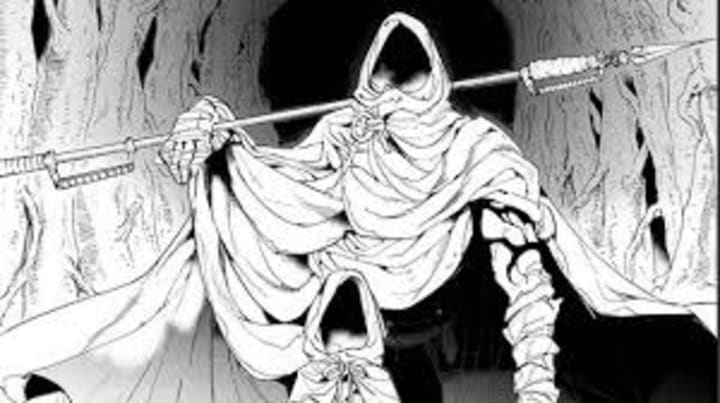
The children are told they are going to loving homes, and the demons are told they need to consume human meat in order to keep their form. In demon society, demons are able to hold their humanoid shape by eating humans, and revert back to a monster-like state when consumption is halted. This isn’t not true, however, it’s not the whole truth. The demon society’s most powerful family own the farms, and they’ll get paid for as long as they’re (the farms) open. The higher ups lied and told the other demons that human meat is the way to keep your dignity and shape, but that’s a lie. Early in their travels, Emma and the rest of the children meet two demons who don’t consume human meat, yet hold a humanoid form. The blood of the girl demon (I’m not sure what her actual name is because every unofficial translation I’ve come across was different) holds special properties that allows demons to keep their shape and not eat humans anymore. The higher ups know this, and want to kill her because she’s a threat. Emma persuades the escaped children to hold a coup d'etat and eventually they overtake the demon queen and win. The child farms are abolished and a new monarch is established.
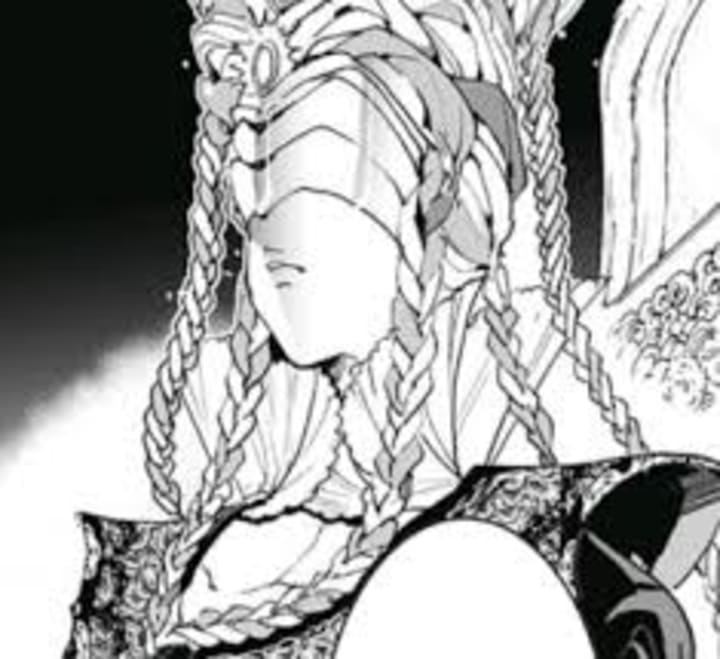
Despite the child farms existing for years, and despite the inhumane cruelty at the hands of the demons, Emma still finds it in her heart to save the demons. Emma put herself in their shoes and determined that they too were victims. It’s awesome to me that this eleven year old child is strong enough to escape a death camp with a dozen other kids, learn the basics of a gun, witness unimaginable horrors, accept the deaths of her friends, and still find it in herself to allow these monsters to live.
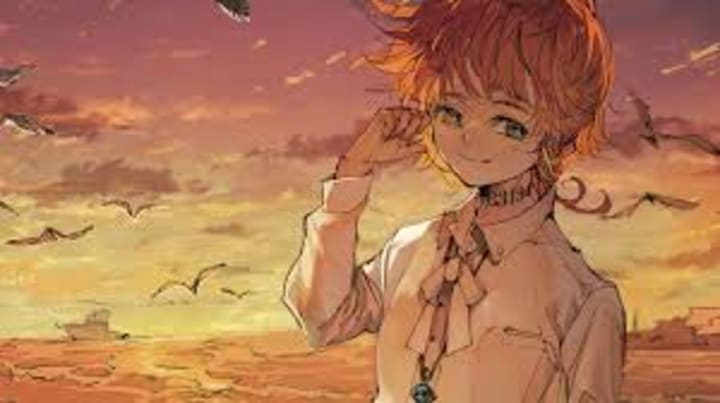
I also would like to point out the way the illustrators draw the children in The Promised Neverland. The children are always in appropriate garb and none of them have augmented features meant for an adult. My point is that these children aren’t sexualized at all nor do they display adult relationships. Emma, the eleven year old main female protagonist of a Shōnen Jump comic is never, ever sexualized. There is never a moment that acts as an excuse to unclothe her, or anyone else. No characters ever form romantic/sexual relationships, and yes Norman did have a crush on Emma, but that’s all it was, an adolescent crush. Not all Shōnen Jump comics feature female characters without featuring fan service of some sort, so it’s exceptionally refreshing to have a work like the Promised Neverland.
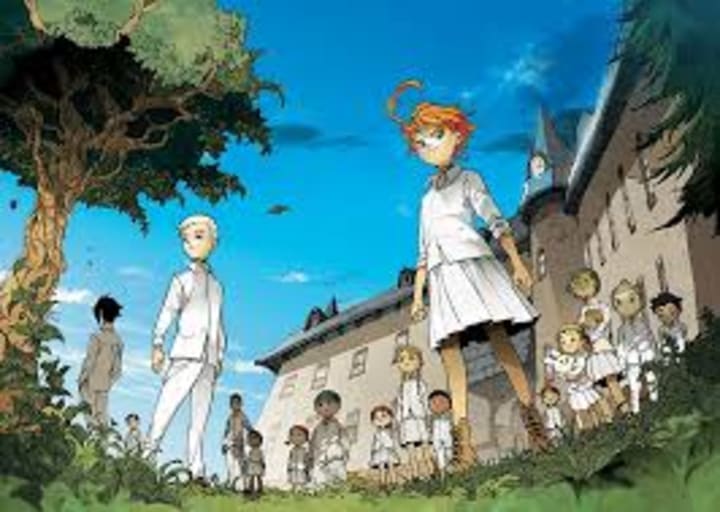
Emma is amazing for so many reasons. For one, she has extreme determination to save everyone. Her motherly instincts drive her to keep fighting even if the situation is dire. Giving up is never an option, and she constantly puts her life on the line for others. Emma is always willing to learn and adapt and fight for the liberation of the farm children. She is the main character of a Shōnen Jump work, yet she is never exploited sexually or forced into an unnecessary relationship/love triangle despite her two best friends being males of the same age and intelligence. Emma is worthy of the title “main character," and hopefully she’ll inspire more female characters in anime/manga who exist outside the typical realm of fan service and sexualization. She’s an eleven year old girl, and the hero of a Shōnen Jump comic, and that’s awesome.
About the Creator
Jenuine Travel
Hello there! In the past I've written about different graphic books that I enjoyed, but now I'm moving in the direction of writing about my travel experiences! Enjoy!
Keep reading
More stories from Jenuine Travel and writers in Geeks and other communities.
Chainsaw Man
I read all of Chainsaw Man in three days and it was a totally awesome experience. When I first started reading, I honestly had no idea what I was in for. The series first piqued my interest on Tumblr when I started seeing different panel illustrations on certain blogs that I follow. I liked the artwork because it gave me a Tokyo Gxhoul-esque vibe, and that was enough for me to start. At first, I thought the story would revolve around Denji, the main character, and his escapades in his involvement with the Japanese mafia. I quickly realized after chapter one that this was not the case, not even a little bit. After being killed by the mafia, Denji forms a contract with his devil dog, Pochita, and revives in the form of the chainsaw devil, known as Chainsaw Man. Denji is soon meant with a plethora of other characters and becomes a Public Safety Devil Hunter. Soon after Denji accepts the PSDH position, chaos ensues.
By Jenuine Travel5 years ago in Geeks
IMDB Trivia is a Hive of Scum and Villainy: A Movies of the 80s Debunk
A viral IMDb trivia claim says Kim Basinger and Kevin Costner were passed over for Purple Hearts (1984) in favor of Cheryl Ladd due to nepotism. The story is compelling — but the evidence says it never happened.
By Movies of the 80sa day ago in Geeks




Comments
There are no comments for this story
Be the first to respond and start the conversation.