
Disney’s Deleted Threads Prompt: When “Magic” Met a Manifesto
How a simple social media engagement post turned into a viral moment about resistance, corporate caution, and unexpected fan expression.

Trigger Warning: Discussions of fascism, authoritarianism, political content, corporate moderation decisions, and social media backlash.
On January 17th, 2026, the Walt Disney Company posted what appeared to be an innocuous social media prompt from Threads:
“Share a Disney quote that sums up how you’re feeling right now!”
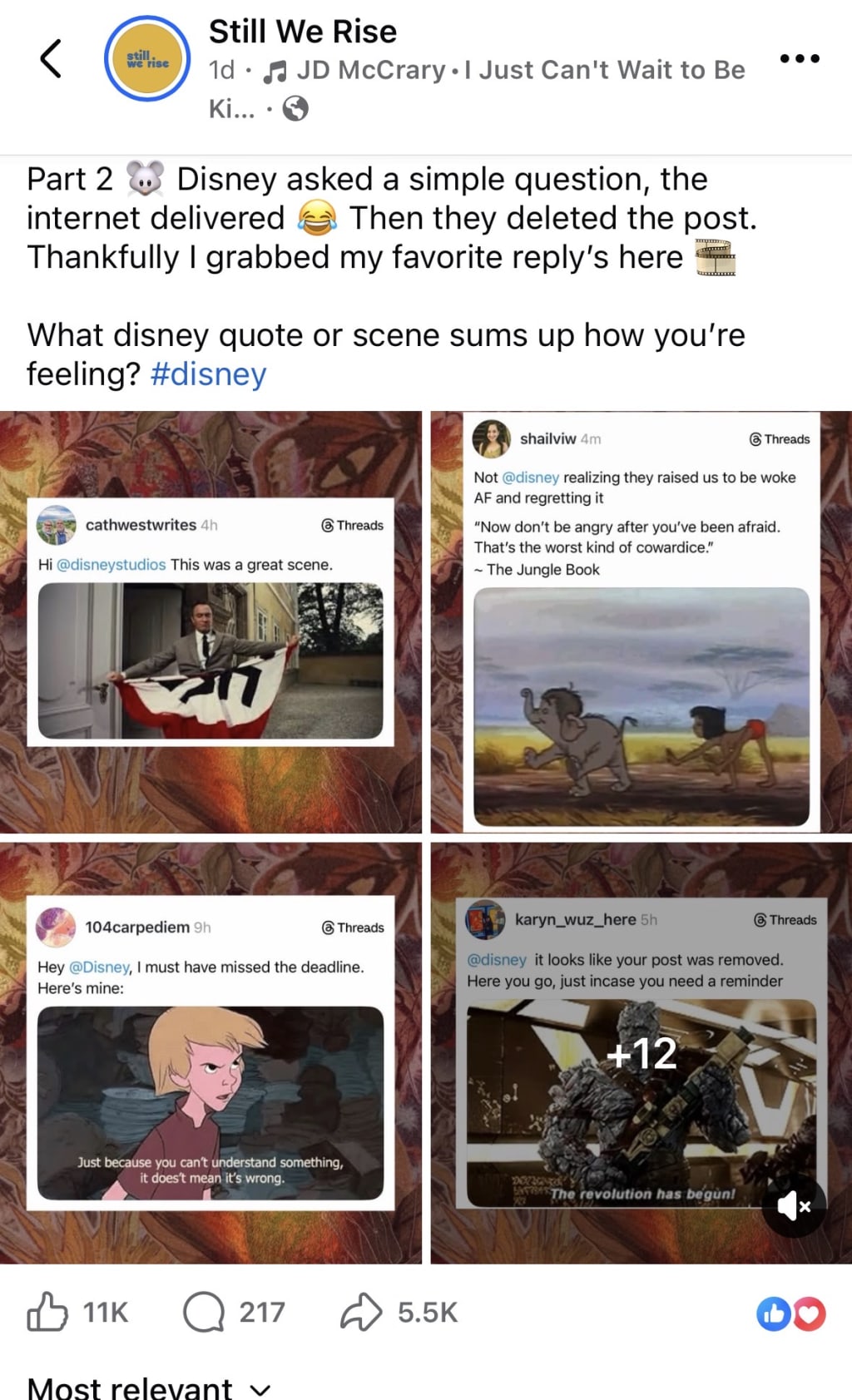
What followed was anything but lighthearted. Instead of responses about nostalgia, whimsy, or smiles, users flooded the thread with quotes from Disney films and shows that highlighted themes of resistance, anti-authoritarianism, and anti-fascism. Within hours, Disney deleted the post, a decision that transformed what was likely intended as playful community engagement into a viral moment and renewed debate about corporate messaging and audience expression.
The Prompt That Didn’t Stay Light
Corporate social media teams often use prompts about favorite quotes to drive engagement, tap into nostalgia, and encourage users to interact with the brand. Here, Disney’s official Threads account, which has millions of followers across social platforms, invited fans to share a quote that reflected how they felt about the world.
Rather than offering lines like “This is the way”, “Hakuna Matata”, “I am Groot”, or “Just keep swimming”, the thread was quickly filled with quotes that users seized to express anxiety about societal and political tensions. Many drew from the Disney universe’s most politically resonant lines, such as.
- The Andor manifesto: “The Empire is a disease that thrives in darkness; it is never more alive than when sleep”.
- Captain America: “I don’t like bullies; I don’t care where they’re from.”
- A Bug’s Life: “You let one ant stand up to us, then they all might stand up…”
- X-Men’97: “Most other nations don’t allow a terrorist to be their leader. Yet so many allow their leaders to be terrorists”.
- The Lion King II: “Them? Look at them. They are us. What differences do you see?”
- The Hunchback of Notre Dame: “You can lie to yourself and your minions. You can claim that you haven’t a qualm. But you can never run from nor hide what you’ve done from the eyes. The very eyes of Notre Dame.”
- The Black Panther: "More connects us than separates us. But in times of crisis, the wise build bridges while the foolish build barriers. We must find a way to look after one another as if we were one tribe”.
- The Mandalorian: “Mandalorians are stronger together.”
Users also reportedly referenced quotes from films like Pocahontas and Mary Poppins to underscore notions of systemic injustice, oppression, and the necessity of resistance–themes often absent from simple “feeling” prompts, but deeply rooted in the emotional texture of their source material.
Why Disney Deleted the Post
Within hours, Disney deleted the entire Threads prompt. The company has not provided a public explanation, but the removal sparked immediate speculation across social media and news outlets. Some observers argued the political tenor of the responses surprised Disney and sought to avoid backlash or accusations of partisanship. Others suggested the decision was rooted in a desire to maintain a posture of corporate neutrality, especially given the high political environment of 2026.
Regardless of the intent, the deletion has the opposite of its intended effect. Rather than disappearing into obscurity, the moment went viral. Screenshots and recordings of the deleted thread proliferated across Threads, X, Reddit, and other platforms, exaggerating the reach of the original prompt in a classic Streisand effect, where attempts to suppress or erase information only make it more visible.
Public Backlash and the Narrative of Censorship
The reaction from social media users was swift and multifaceted. Many accused Disney of censoring fan expression, perceiving the deletion as an attempt to silence political commentary that emerged organically from the community. Critics noted with irony that a company that profited from narratives about rebellion and resistance, most visibly in franchises like Star Wars, would balk at the real-world application of those same themes.
On Reddit, users questioned Disney’s motives directly, with comments such as “If they’re deleting anti-fascist quotes, does that make Disney fascist?” and “Disney asked us how we feel. We told them.” These sentiments illustrate how the moment transcended a simple social prompt to touch on deeper frustrations about corporate control over discourse.
Other critics framed the deletion as a branding misstep: Disney reaped the commercial benefits of stories about courage, moral integrity, and fighting oppression, yet appeared uncomfortable when its own storytelling was used to articulate contemporary concerns.
Analysts suggest that Disney’s deletion was an example of prioritizing brand safety, a practice that involves avoiding any content that might be interpreted as political or divisive. In today’s media landscape, where consumer sentiment and activism heavily influence public perception, brands often err on the side of caution. But in doing so, they risk alienating audiences whose emotional investment in stories includes deeper reflections on power, justice, and resistance.
The Lesson for Brand Engagement in 2026
The incident underscores a core challenge for brands in the age of participatory media: once you invite open-ended engagement, you cede control over interpretation. Audiences will bring their own contexts, histories, and beliefs to their responses, and those will not always align neatly with corporate intentions.
For Disney, a company whose global narratives often grapple with moral dilemmas and systemic conflict, the moment serves as a case study in how storytelling and socio-political expression intersect in unexpected ways. What may have begun as an innocent pursuit of nostalgia quickly became a collective exercise in cultural interpretation.
Conclusion
Disney’s deleted Threads prompt became more than a social media mishap; it became a viral cultural moment that revealed how audiences engage with the values embedded in their favorite stories. Users didn’t just answer a prompt. They used Disney’s own words to articulate how they see the world, especially in relation to power, injustice, and resistance.
By deleting the post, Disney inadvertently amplified the very discourse it may have sought to avoid. The company’s attempt to navigate corporate neutrality collided with the undeniable reality that its narratives have become part of how people talk about the world, for better or for worse.
In 2026, brands can no longer assume control over how their stories are used once they invite public participation. Disney’s deleted threat is a reminder that engagement isn’t just about likes or comments. It’s about giving audiences a platform and being prepared for the range of voices that will show up there.
About the Creator
Jenna Deedy
Just a New England Mando passionate about wildlife, nerd stuff & cosplay! 🐾✨🎭 Get 20% off @davidsonsteas (https://www.davidsonstea.com/) with code JENNA20-Based in Nashua, NH.
Instagram: @jennacostadeedy
Keep reading
More stories from Jenna Deedy and writers in Geeks and other communities.
What if the Inhumans Were Never Missing?
The Marvel Cinematic Universe has never suffered from a lack of ideas. What it has suffered from, increasingly, is congestion—too many concepts competing for narrative oxygen, too many histories forced to coexist without the space to breathe. Few properties exemplify this problem more clearly than the Inhumans, a civilization introduced with enormous mythological potential and then effectively abandoned, left dangling somewhere between canon and apology.
By Jenna Deedy2 months ago in Geeks
A Knight of the Seven Kingdoms Series Review (Season 1)
As one of the biggest properties in fantasy, A Song of Ice and Fire remains immensely popular with audiences. After reaching far into the past with House of the Dragon, a second spin-off was on the cards. A Knight of the Seven Kingdoms serves up a bite-sized slice of action and drama, but it still claims a spot among the best small-screen titles.
By Robert Cain14 days ago in Geeks
Oscar Prognostication 2026
DONOVAN’S OSCAR PROGNOSTICATION 2026 Oooo, a fun new theme for the Oscar films this year: generational trauma. A lot of dads (and some moms) making movies in 2025, doing therapy on film and trying to work through their fears as a parent (and hoping their kids don’t end up hating them and writing a book about them). As usual, it makes for such a fun crop of movies. So get comfortable for our session, while I lay on a couch and rant about my 27th annual Academy Award predictions. (We'll both probably need therapy by the time this is over.)
By Ryan Donovana day ago in Geeks
Lycan Lore
As the students of my 10am mythology class take their seats, I decide to steer the day's curriculum away from Greek and dive into a Western European discourse on the misaligned beliefs of the Werewolf. A tale of truth or fiction. No one really knows.
By Lamar Wigginsabout 20 hours ago in Fiction


Comments (1)
Some excellent, interesting points about how companies say they want to engage and then run off when things don't go as they expect