
Did Vic Morrow Know He Was Going to Die on the Set of Twilight Zone: The Movie?
Premonition or Experience? Did actor Vic Morrow know he was going to die that night in 1982 on the set of Twilight Zone: The Movie.


It has become part of the lore surrounding the horrific accident that killed Vic Morrow and child actors Myca Din Le and Renee Shin Ye Chen that Morrow somehow predicted his own death.
The story usually begins the same way: Vic Morrow was afraid of helicopters. He had spoken openly about that fear years before accepting the role of Bill Connor, the racist who learns a brutal lesson in John Landis’ segment of Twilight Zone: The Movie. Add in a few ominous quotes from the night of the accident, and the tragedy begins to feel supernatural—like fate announcing itself in advance.
But Vic Morrow didn’t predict his death.
What he did have was a lifetime of experience—experience that taught him exactly how dangerous the situation he was walking into truly was. And tragically, everything in his life conspired to place him on that soundstage on the night of July 23, 1982.
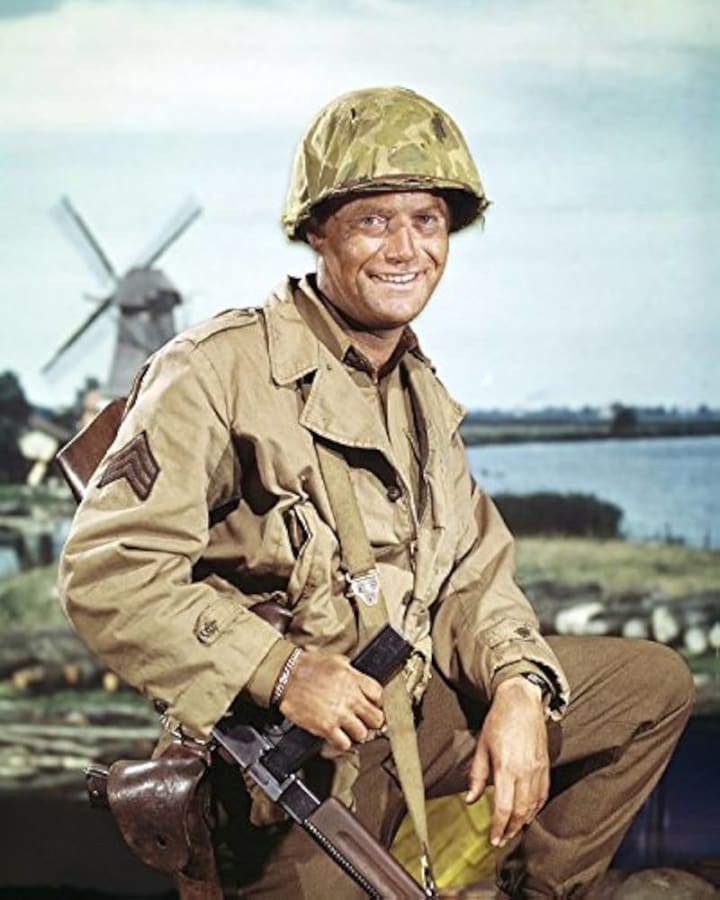
Who Was Vic Morrow?
Vic Morrow was born Victor Morozoff on February 14, 1929, in the Bronx, New York, to Russian Jewish immigrant parents. His father, Harry, was an electrical engineer, and Morrow grew up in a stable, middle-class household—but restlessness came early.
He dropped out of high school at 17 and joined the U.S. Navy. It was there, through a chance encounter with a stage production while attending Florida State University, that Morrow discovered acting. He moved to New York, worked on stage, and broke into film with 1955’s The Blackboard Jungle.
In 1957, Morrow married actress and screenwriter Barbara Turner. They had two daughters, Carrie Ann Morrow and Jennifer Jason Leigh. Leigh would follow her father into acting, though the two were reportedly estranged for much of her life. Leigh has rarely spoken publicly about her father since his death.
Morrow became best known for his tough, brooding screen presence—an intensity that would both define and ultimately limit his career.

A Fear of Helicopters
It may seem counterintuitive that a Navy veteran would fear helicopters, but in many ways, it makes perfect sense.
Morrow likely had more exposure to helicopters than most civilians. He understood their power, their instability, and—especially in military settings—their mechanical limitations. That awareness followed him into his acting career.
In 1962, Morrow became a household name starring in the WWII television series Combat!. The role perfectly matched his intensity and military background. But success came at a cost. Morrow became locked into the image of the hard-nosed soldier, and when Combat! ended in 1967, his career began a slow decline.
Typecasting would haunt him for the rest of his life.
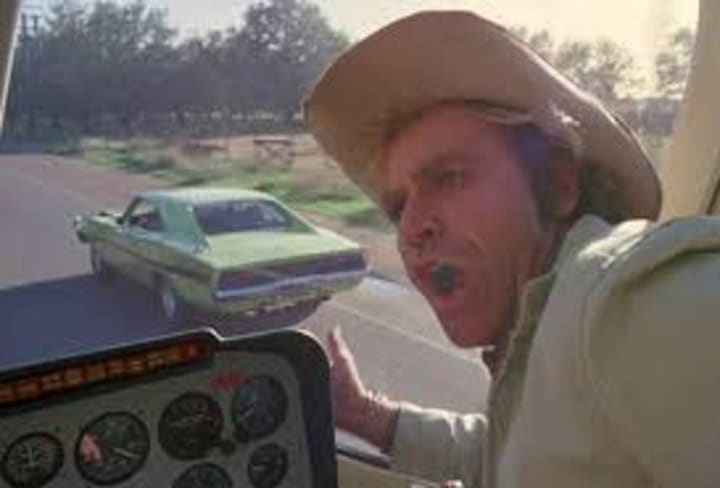
Dirty Mary, Crazy Larry
By 1973, Morrow was struggling for meaningful work when he accepted a role in what appeared to be a low-budget drive-in movie: Dirty Mary, Crazy Larry, starring Peter Fonda and Susan George.
Morrow played Captain Franklin, a relentless county sheriff pursuing two NASCAR drivers after a grocery store robbery. The film was really about cars—muscle cars tearing through the countryside—but Morrow brought his usual commitment to the role.
It was here, nearly a decade before Twilight Zone, that his fear of helicopters became public knowledge.
Multiple on-set accounts describe clashes between Morrow and director John Hough over a helicopter chase sequence. Morrow flatly refused to film it, reportedly saying:
“I have always had a premonition I was going to die in a helicopter crash.”
Eventually, he was persuaded to perform the scene—but only after producers took out a $1 million life insurance policy on him, nearly matching the film’s reported $1.1 million budget.
Dirty Mary, Crazy Larry went on to become the highest-grossing film of 1974, earning over $28 million. But its success did little to revive Morrow’s career trajectory.

Enter Twilight Zone: The Movie
By the early 1980s, Vic Morrow’s career had stalled badly. He was working for Roger Corman, appearing in films like Humanoids from the Deep and the Italian-produced The Last Shark, a blatant Jaws knockoff that was pulled from theaters after Universal sued.
Morrow was drinking heavily. He was disillusioned. And he was hesitant to accept a role in Twilight Zone: The Movie.
The irony wasn’t lost on him. John Landis cast Morrow precisely because of Combat!—the role that had made his career and quietly ruined it. Once again, he was being asked to embody a harsh authority figure.
It was reportedly Morrow’s daughter Carrie, one of his closest confidants, who encouraged him to take the role. The project was produced by Steven Spielberg. This was a chance—maybe the last—to reset his career.
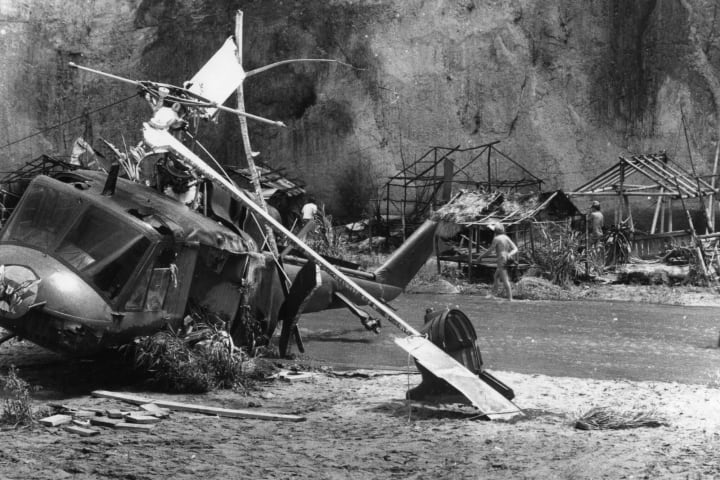
The Night Everything Went Wrong
Vic Morrow knew what kind of set he was walking onto.
Landis ran a chaotic production. Safety standards were loose. The two child actors, Myca Din Le and Renee Shin Ye Chen, were hired off the books, violating labor laws. The scene was shot late at night—another violation. Explosions were staged beneath a low-flying helicopter.
Morrow voiced his concerns.
Accounts from the night include:
• “I must be out of my mind to be doing this.”
• “I’ve got to be crazy to do this shot. I should’ve asked for a double.”
• “There’s something bad in the air, but I don’t know what it is.”
These were not supernatural premonitions. They were instinct.

Instinct, Not Fate
Vic Morrow didn’t have a sixth sense. He had experience.
He had seen what helicopters could do. He had seen how corners were cut on low-budget sets. He knew safety protocols were being ignored. Anyone paying attention would have felt the same dread.
And yet, he stepped into the water.
Why?
Because he was a father. Because he believed—reasonably—that as the star, he would be protected. Because saying no to John Landis on a Steven Spielberg production could end what little chance he had left. Because his entire life had trained him to endure danger and push forward.
I choose to believe Vic Morrow was there because he thought he was in the best position to keep those two children safe.

Bitter, Ugly Irony
Twilight Zone: The Movie was Vic Morrow’s final film—but not his final screen appearance.
He also appeared in 1990: The Bronx Warriors, another Italian exploitation film, playing a villain named Hammer. In his final scene, Hammer is shot and dragged to death behind a motorcycle driven by a character named Trash.
It’s an ugly coincidence in a career filled with them.
Vic Morrow was no stranger to indignities in Hollywood. He didn’t predict his death—but every experience he lived brought him to that moment. His military service. His success. His typecasting. His family. His desire for redemption.
All of it placed him on that set.
And none of it should have ended the way it did.

Subscribe to Movies of the 80s here on Vocal and on our YouTube channel for more 80s Movie Nostalgia.
About the Creator
Movies of the 80s
We love the 1980s. Everything on this page is all about movies of the 1980s. Starting in 1980 and working our way the decade, we are preserving the stories and movies of the greatest decade, the 80s. https://www.youtube.com/@Moviesofthe80s
Keep reading
More stories from Movies of the 80s and writers in Geeks and other communities.
The Director Who Killed His Own Movie: Lawrence Turman and the Most Honest Press Tour of 1983
Hollywood runs on illusion. Directors sell confidence. Producers sell certainty. Even bad movies are promoted like misunderstood masterpieces waiting for their audience to catch up.
By Movies of the 80s2 months ago in Geeks
A Knight of the Seven Kingdoms Series Review (Season 1)
As one of the biggest properties in fantasy, A Song of Ice and Fire remains immensely popular with audiences. After reaching far into the past with House of the Dragon, a second spin-off was on the cards. A Knight of the Seven Kingdoms serves up a bite-sized slice of action and drama, but it still claims a spot among the best small-screen titles.
By Robert Caina day ago in Geeks
SpongeBob Review
The episode "F.U.N." unfolds as a masterclass in character-driven comedy and narrative irony, centering on Plankton’s most hilariously transparent scheme to date. From the opening moments, the Chum Bucket’s oppressive gloom is a stark, almost visceral contrast to the sun-drenched, vibrant chaos of the Krusty Krab, a visual metaphor for the fundamental conflict between cynical ambition and joyful innocence. Plankton, tiny and vibrating with a fury that seems to distort the very air around him, constructs his "Friendship, U & Me, and Anywhere and Anytime" acronym not as a genuine olive branch but as a convoluted trap, his every syllable dripping with insincerity. The scene is a tightly wound spring of tension, as we, the audience, are complicit in the joke, watching SpongeBob—radiating pure, unadulterated optimism—plunge headfirst into the obvious snare with a trusting eagerness that is both exasperating and profoundly endearing.
By Forest Green4 days ago in Geeks
I was in a Toxic Relationship, with my Workplace
“You got that?” My ex yelled. His hands were balled into fists at his side. At six foot three, he towered over me. A normal person would have been afraid, but I looked up a video of George Lopez repeatedly saying, “I got this,” and showed it to him. I had grown used to this treatment, so much so that I didn’t blink when he ripped the phone from my hand and threw it across the room.
By Jade M.2 days ago in Confessions



Comments
There are no comments for this story
Be the first to respond and start the conversation.