
Classic Movie Review: 'Dressed to Kill' Starring Michael Caine
Reflecting on a classic 80s thriller.


Dressed to Kill (1980)
Directed by Brian De Palma
Written by Brian De Palma
Starring Angie Dickinson, Michael Caine, Nancy Allen, Keith Gordon
Release Date July 25th, 1980
Published July 23rd, 2024
Right off the bat, we have to talk about transphobia. Spoiler alert for this more than 40 year old movie. See it for yourself and come back if you don’t want spoilers. I do think the movie is worth seeing even as it is fairly viewed as problematic by many in the LGBTQ community. I am not a trans person and I cannot speak to how trans people feel about Dressed to Kill outside of a few essays I’ve read about this specific topic. I am writing from the perspective of a trans ally. I have trans people in my family and thus I am sensitive to how our popular culture portrays transness. But I will not try to speak on behalf of any trans people, even those I know and love.
Dressed to Kill features a killer, played by Michael Caine, who claims to be a woman trapped in a man’s body. The conceit, according to the screenplay by director Brian De Palma, is that this woman trapped in a man’s body is like a second personality who becomes defensive when the male presenting part of them presents a masculine attraction to a woman, played by Angie Dickinson. This defensiveness is expressed by the female personality emerging, presenting as female, stalking Dickinson’s Kate character, and brutally murdering her.
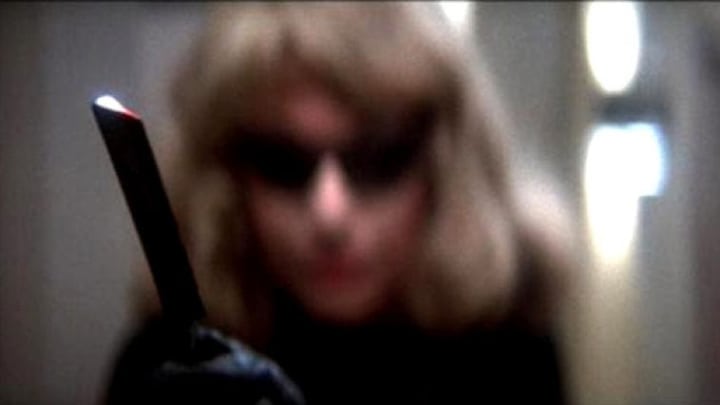
Right away, you can see the issue here. What the film calls a transsexual character is actually someone dealing with multiple personality disorder, among a number of other mental health issues. It’s fair to note that our conception of trans identity is not the same conception that existed in 1980. At that point, the acceptance of trans identity was in its infancy. Trans people have always existed, but our culture had done what our culture typically did and treated it as an exotic novelty, one to be mocked or ignored. The emergence of trans people today, aided by the wider availability of trans media and the influence of prominent trans people, has altered the perception of trans identity far beyond how transness was seen 44 years ago.
I am not intending to use that as an excuse to like a movie that I do like, I am merely trying to include as much context as possible. Brian De Palma was not writing about trans people with the kind of information we have today. It’s fair to say that he’s not writing with the kind of human empathy that all people, but especially those our culture has marginalized, deserves, but I do not believe that he was intentionally linking trans identity to mental illness. If you feel that is what De Palma was doing, I understand where you are coming from. If you are trans and you feel that way about De Palma, I certainly won’t argue with your lived experience of being trans.
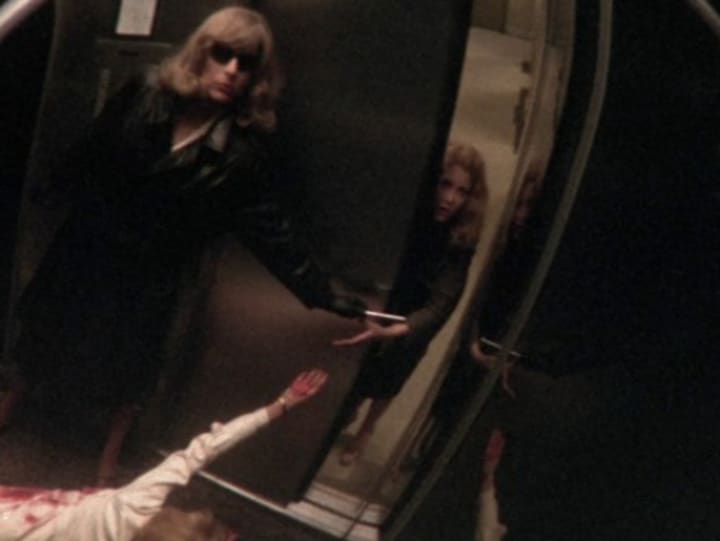
I am making a choice to engage with Dressed to Kill on the specific presentation of these characters. As presented, the character of Dr. Elliott is that of a deeply disturbed individual affected by multiple personality disorder, among other mental illness issues. I am not a doctor, I can only read this character as presented in the movie, and that is my reading. The film gets wrong, and egregiously so, that Elliott is a man trapped in a woman’s body. In that way, yes, the film exhibits a transphobic attitude. No, the character was not trans, not in the sense that actual trans people are trans people.
Gender identity is not a ‘personality.’ Trans people do not have multiple identity disorders. If anything, a trans person knows all too well who they really are and it’s society inflicting upon them the notion that something is wrong with them. Take away the persecution of bigots and the built in societal prejudices against LGBTQ people in general, and trans people may still struggle with their identity but that struggle would be lessened if they had safe space to explore who they are and come to terms with themselves. It’s an openly hostile society that makes the exploration of identity and the understanding of gender a more difficult struggle.

Dr. Elliott was not going to simply transition to become a woman and have all of his problems solved. Clearly, while displaying his feminine identity, known as Bobbi, he was deeply ill and inclined toward violence. A kinder, more empathetic society wasn’t going to prevent Dr. Elliott/Bobby from expressing their mental illness. Transitioning would not have helped Dr. Elliott or Bobb because the underlying illness has nothing to do with gender identity and everything to do with an untreated mental illness. Dr. Elliott’s gender identity could not possibly be dealt with until the underlying mental illness was treated. And, given the fact that Dr. Elliott is into middle age carrying this mental illness mostly untreated, gender identity was not an issue he would be dealing with any time soon.
With my context established, let’s talk about the movie, Dressed to Kill. Written and directed by master of suspense, Brian De Palma, Dressed to Kill stars Angie Dickinson as Kate, a deeply dissatisfied housewife. The film opens with the soft focus of an early 80s shampoo commercial. The softness of the image is purposeful, we will learn that this is a dream sequence. Before we learn that however, we see Kate in the shower beginning to pleasure herself. As the camera lingers and leers at her, the reverie is interrupted by a stranger appearing behind Kate, taking hold and assaulting her. She tries to cry out to who we assume to be her husband, but cannot, the steam from the shower prevents him from seeing what is happening.

It’s a nightmare but one fueled by a connection to reality. Upon waking up, Kate is having sex with her husband, Mike. She goes with it and tries to appear willing and excited. And yet, once again, she’s denied sexual release as Mike simply finishes, rolls off of her, and the encounter ends with her unsatisfied, just like in the dream. This is a recurring motif, Kate’s desires are continually thwarted. After the dream and the terrible sex with Mike, Kate flirts with her therapist, Dr. Elliott (Michael Caine), who rejects her advances. He tries to preserve her ego by mentioning his wife, but he’s curiously not wearing a wedding ring. He advises Kate to confront her husband but she’s dubious of that idea.
Next, Kate goes to a museum and here, Brian De Palma asserts his style to further the motif surrounding Kate, her continued sexual frustration. In this lengthy sequence, Kate meets a strange man. He takes a seat next to her on a museum bench. She waits for him to flirt but he makes no move. When she begins to make a move, he leaves. She then follows him around the museum with De Palma’s camera following after. In a series of unbroken, constantly moving takes, we follow Kate as she follows this mysterious stranger. Finding him, she’s embarrassed to have been caught and attempts to leave only for him to follow her.

Cutting to the chase, this bravura sequence of stylistic filmmaking is a form of filmic foreplay. Its building intensity through the camerawork, the shifting emotional stakes, and the brilliant score by Pino Donaggio, reaches a crescendo as Kate is tugged into a cab with the stranger who proceeds to digitally penetrate her in full rear view of the cab driver. The excitement of the chase and this cab ride assault finally gives Kate sexual release. She then joins the man in his apartment for a full afternoon of sex. Then, much like the pop moralizing of a classic horror movie, or some Hayes Code Era film, having had sex out of wedlock and reached a climax, Kate’s punishment is immediate and forceful.
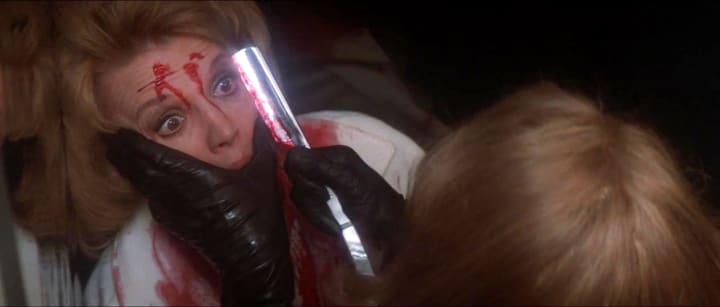
Here, De Palma offers a bit of misdirection. The punishment, which a trained filmgoer might be anticipating, isn’t what we expect. As Kate is leaving a message for her new lover, she finds evidence that shows the man has some form of STD. We are led to believe, at this moment, that Kate’s punishment is that she now has the same STD as this mystery man. She flees the apartment but, in the process, she forgets her wedding ring. Returning to the apartment, Kate is met at the elevator for the actual, more forceful, biblical punishment, a horrific death. A man in drag, mistaken by those in the movie as a blonde woman, slashes Kate to death a la Janet Leigh in Psycho. Our protagonist character is gone and the movie becomes an investigation of her death.

It’s mostly downhill from here. Not that Dressed to Kill becomes a bad movie after Dickinson’s departure, rather, the film becomes more familiar as a thriller. It leaves the suburban trappings for the urban setting of New York City and we take on characters who are familiar from thrillers. This includes a sex worker played by Nancy Allen who witnessed Kate’s murder, Dr. Elliott, who becomes slightly more prominent as part of the investigation into who killed Kate, he was among the last to see her alive, and a stereotypical New York Detective, played by Dennis Franz.
And then there is Kate’s son, Peter, played by Keith Gordon. Peter is an industrious, ingenious character who is well used by De Palma as a light in Kate’s life and as a plucky young protagonist whose clever wits push the plot along to our twisty conclusion. De Palma uses this character remarkably well. He reveals a sympathetic side of Kate that would be missing if we only saw the angry and unsatisfying side of her life via her thwarted sexual desires and her cutting back and forth with Dr. Elliott in the therapy scene.
Peter is goodhearted and likable, easily sympathetic in his youth and the grief over his mother’s death. Pairing him with Nancy Allen’s Liz makes her more sympathetic by extension. Not that Allen doesn’t do well to make Liz likable, but rather that Peter’s innocence and care for Liz forces you not to be judgmental over her chosen profession, if you are inclined to be so judgmental. The team of the plucky kid and the proverbial ‘hooker with a heart of gold,’ turn out to be a terrifically entertaining and engaging team. They are a terrific counterpoint to our villain, who will be revealed to be Dr. Elliott in a dress.
Dressed to Kill is an incredibly well accomplished thriller. The mastery of filmmaking technique on display, the exceptional acting, especially the underrated performance of Angie Dickinson as Kate, and Pino Donaggio’s complicated and essential score, all work together to make Dressed to Kill more than just another thriller. This is an exercise in pure filmmaking. Yes, it’s also pervy, transgressive, and weird, but that is part of the film’s charm. De Palma disarms you with the trappings of B-Movie schlock while dazzling you with the tools of filmmaking to craft a movie that gets under your skin.

Dressed to Kill is simply unforgettable. It’s also the classic on the next edition of the I Hate Critics Movie Review Podcast. With the 44th Anniversary of Dressed to Kill on July 25th, 2024, we decided to highlight the film simply because it is so memorable and iconic. We will be talking about Dressed to Kill along with the horror movie, Oddity, and the blockbuster sequel Twisters, on the July 24th edition of the I Hate Critics Movie Review Podcast. You can listen to myself, and my co-host Jeff talking about these movies wherever you listen to podcasts.
Find my archive of more than 20 years and more than 2000 movie reviews at SeanattheMovies.blogspot.com. Find my modern review archive on my Vocal Profile, linked here. Follow me on Twitter at PodcastSean. Follow the archive blog on Twitter at SeanattheMovies. Listen to me talk about movies on the I Hate Critics Movie Review Podcast. If you have enjoyed what you have read, consider subscribing to my writing on Vocal. If you'd like to support my writing, you can do so by making a monthly pledge, or by leaving a one time tip. Thanks!
About the Creator
Sean Patrick
Hello, my name is Sean Patrick He/Him, and I am a film critic and podcast host for the I Hate Critics Movie Review Podcast I am a voting member of the Critics Choice Association, the group behind the annual Critics Choice Awards.
Keep reading
More stories from Sean Patrick and writers in Geeks and other communities.
A Knight of the Seven Kingdoms Series Review (Season 1)
As one of the biggest properties in fantasy, A Song of Ice and Fire remains immensely popular with audiences. After reaching far into the past with House of the Dragon, a second spin-off was on the cards. A Knight of the Seven Kingdoms serves up a bite-sized slice of action and drama, but it still claims a spot among the best small-screen titles.
By Robert Cain14 days ago in Geeks


Comments
There are no comments for this story
Be the first to respond and start the conversation.