
Cells at Work! – An Educational Journey into the Human Body
(This article contains educational content inspired by the anime “Cells at Work!” and was drafted with assistance from AI, then revised for accuracy and style by the author.)

Introduction
When it comes to blending science and storytelling, Cells at Work! (Hataraku Saibō) is an exceptional example of how entertainment can become a powerful educational tool. This Japanese anime series, based on Akane Shimizu’s manga, anthropomorphizes the body’s cells, turning them into relatable characters with human emotions and personalities. Through engaging narratives and visually dynamic scenes, the anime not only entertains but also educates viewers about the complexity and beauty of human biology.
This article takes a closer look at the science behind Cells at Work!—exploring the biological accuracy, artistic liberties, and educational value it brings to audiences worldwide.
⸻
From Manga Panels to Science Lessons
Cells at Work! debuted as a manga in 2015 and quickly gained popularity for its unique approach: representing immune cells, red blood cells, platelets, and bacteria as living characters in a bustling city-like environment—the human body. The anime adaptation, which began airing in 2018, expanded its audience globally, making the intricate world of human physiology accessible to people of all ages.
At first glance, the series appears to be a lighthearted action-comedy. However, its foundation is grounded in actual medical science. Each episode focuses on a specific physiological process or medical condition, ranging from common ailments like influenza to more serious issues like cancer cell proliferation. This narrative framework allows complex scientific topics to be broken down into memorable, easy-to-understand episodes.
⸻
Biological Accuracy and Artistic License
One of the show’s greatest strengths lies in its commitment to accurate biological representation—albeit with creative flair. For instance:
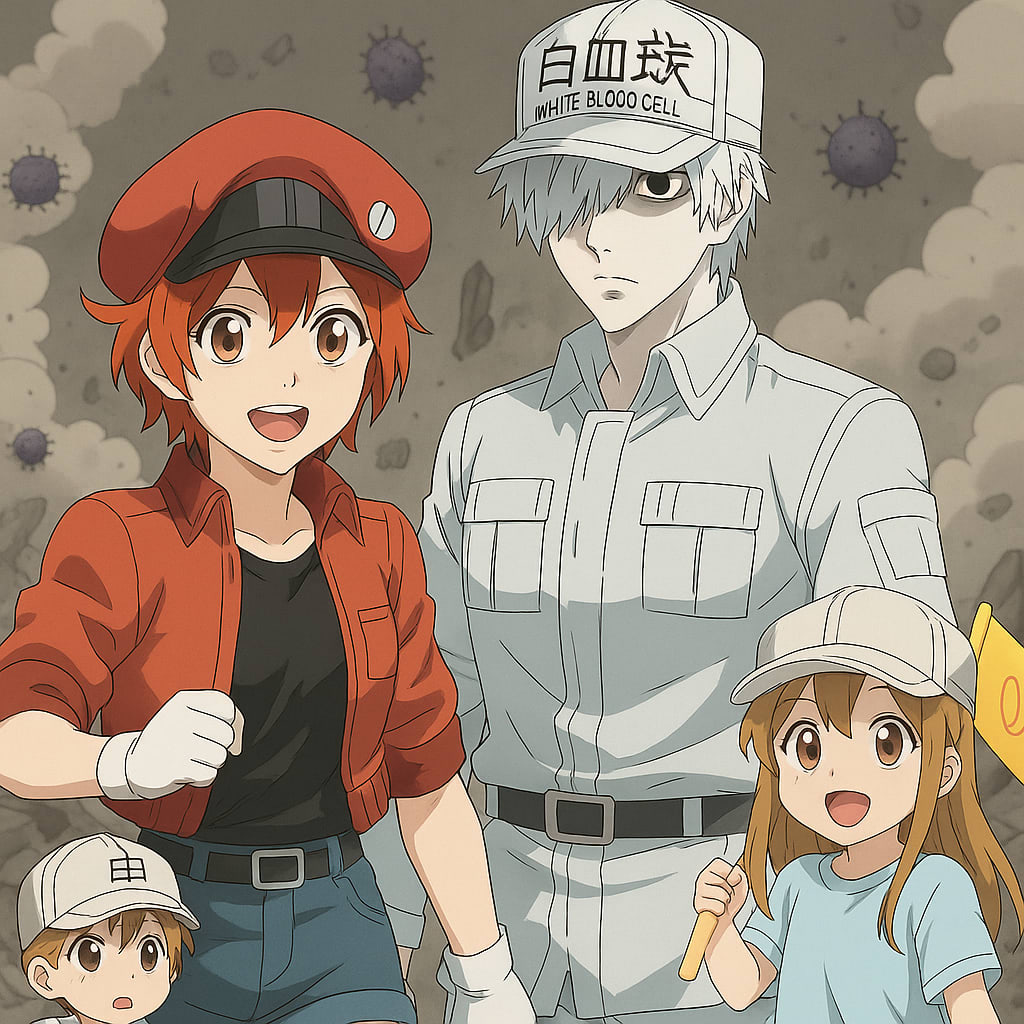
• Red Blood Cells (Erythrocytes) are depicted as cheerful couriers delivering oxygen throughout the body and carrying carbon dioxide back to the lungs.
• White Blood Cells (Neutrophils) appear as relentless warriors, eliminating pathogens with precision.
• Platelets—shown as adorable children—represent their role in clotting and repairing wounds.
While the personalities and dramatic battles are exaggerated, the underlying science is correct. The series simplifies complex processes like immune response, coagulation, and pathogen invasion without sacrificing accuracy, making it both entertaining and educational.
That said, certain liberties are taken for storytelling purposes. For example, the speed and scale of immune reactions are accelerated to fit episode timelines. In reality, some immune processes occur over hours or days, not minutes.
⸻
The Educational Value
From an academic perspective, Cells at Work! functions as an unconventional yet effective teaching aid. Educators have noted that students who watch the show often retain scientific concepts better, thanks to its vivid characters and clear cause-and-effect storytelling.
Key educational benefits include:
1. Visualization of Abstract Concepts – Immunology can be difficult to grasp from textbook diagrams alone. The anime transforms these diagrams into dynamic, memorable scenarios.
2. Narrative Reinforcement – By attaching a story to each biological event, viewers can recall processes more easily.
3. Multidisciplinary Learning – Beyond biology, the show touches on epidemiology, pathology, and even mental health, such as how stress affects the immune system.
⸻
Impact on Public Health Awareness
Interestingly, the series has also contributed to public health awareness. Episodes addressing influenza, allergies, and food poisoning subtly encourage viewers to adopt healthier habits, like proper hygiene and nutrition. During the COVID-19 pandemic, many fans revisited the series as a way to understand viral infection and immune defense in a simplified yet scientifically sound format.
⸻
Scientific Criticism and Limitations
While the anime is widely praised, it is not without criticism. Some medical professionals caution that anthropomorphizing cells might lead to oversimplification or misconceptions. For example, the portrayal of cancer cells as malicious villains, while emotionally engaging, does not fully convey the complex biochemical triggers behind uncontrolled cell growth.
Nevertheless, as long as viewers understand that Cells at Work! is a science-inspired narrative rather than a documentary, these risks are minimal.
⸻
Cultural and Global Reach
The educational impact of Cells at Work! extends far beyond Japan. Subtitled and dubbed versions have made the show accessible to audiences across North America, Europe, and Asia. It has inspired fan art, online discussions, and even classroom adaptations. In some biology courses, teachers use selected episodes as supplementary learning material, blending entertainment with education in a way that traditional lectures often cannot.
⸻
Conclusion
Cells at Work! is more than just an anime—it’s a gateway into the wonders of human biology. By merging accurate science with engaging storytelling, it transforms complex physiological processes into memorable, emotionally resonant experiences. Whether you’re a student, an educator, or simply a curious viewer, the series offers both entertainment and education in a single package.
In an era where science communication is more important than ever, Cells at Work! demonstrates how creative media can bridge the gap between academic knowledge and public understanding. And perhaps, after watching an episode or two, you’ll find yourself appreciating your own body’s cells—the tireless workers that keep you alive—just a little bit more.
⸻
Author’s Note: This article was drafted with assistance from AI for research and structure, and was subsequently revised and fact-checked by the author to ensure compliance with Vocal’s community guidelines and educational value.
About the Creator
Takashi Nagaya
I want everyone to know about Japanese culture, history, food, anime, manga, etc.
Keep reading
More stories from Takashi Nagaya and writers in Geeks and other communities.
🌀 Did These Anime and Manga Really Predict the Future?
🧭 Introduction: What if fiction wasn’t just imagination—but a warning? Japan’s anime and manga have always pushed boundaries, blending futuristic visions with human questions. Some, however, go beyond fiction. They foresee patterns, events, or technologies that arrive decades later. Here are three eerily prophetic works that continue to resonate as our world catches up to their imagination.
By Takashi Nagaya6 months ago in Geeks
Marvel Zombie
The last entry into our 2025 superhero projects catalogue is Marvel Zombies. This was a show that was anticipated by absolutely no one and it disappeared from the public consciousness as quickly as it was released. There was nothing special about the project that made it a must see, or a must remember. In fact if anything it's a must forget.
By Alexandrea Callaghan18 days ago in Geeks
“Deport Nicki Minaj Back to Trinidad” Movement Continues Amid Growing Outcry
The petition crossed 50,000 signatures in early January, and that number had risen to more than 58,000 at publication. Nearly 60,000 people have signed an online petition demanding that the U.S. government deport popular rapper Nicki Minaj to Trinidad because of what many fans say are her shifting political beliefs.
By Dena Falken Esqabout 7 hours ago in Geeks



Comments
There are no comments for this story
Be the first to respond and start the conversation.