
Building a Multi-Chain NFT Marketplace: Benefits, Use Cases, and Strategic Insights
Exploring the Benefits, Real-World Use Cases, and Strategic Considerations of Multi-Chain NFT Platforms

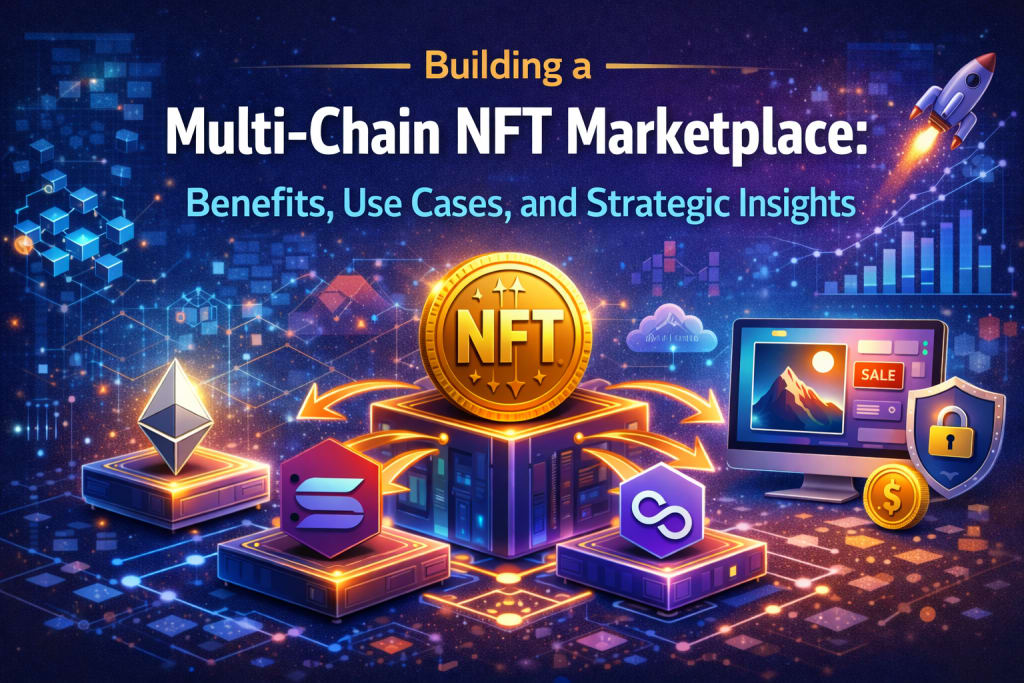
The NFT ecosystem has evolved far beyond its early single-chain roots. What began as a largely Ethereum-centric movement has transformed into a diverse, multi-chain landscape where creators, collectors, and developers operate across multiple blockchains simultaneously. As transaction costs, scalability demands, and user expectations continue to shift, multi-chain NFT marketplace development has emerged as a strategic necessity rather than a technical luxury.
Today’s NFT users no longer ask whether a marketplace supports multiple blockchains they ask how seamlessly it does so. Platforms that fail to adapt risk fragmenting liquidity, alienating creators, and losing relevance in an increasingly interconnected Web3 economy. This article explores the core benefits, practical use cases, and strategic considerations involved in building a multi-chain NFT marketplace, offering insights grounded in real-world implementations and market behavior.
Why Multi-Chain NFT Marketplaces Matter
The Shift From Single-Chain to Multi-Chain Ecosystems
In the early days of NFTs, Ethereum’s dominance made single-chain marketplaces viable. Liquidity was concentrated, standards were consistent, and most users were willing to tolerate high gas fees in exchange for network trust and composability. However, as NFT adoption expanded, Ethereum’s limitations—particularly scalability and transaction costs—became more apparent.
This led to the rapid rise of alternative blockchains such as Solana, Polygon, BNB Chain, Avalanche, and Flow. Each ecosystem brought distinct advantages: Solana offered high throughput and near-zero fees, Polygon delivered Ethereum compatibility with lower costs, and Flow focused on consumer-friendly experiences for mainstream brands. The result was a fragmented NFT market, with liquidity and communities spread across multiple chains.
Multi-chain marketplaces emerged as a response to this fragmentation. Rather than forcing users to choose a single ecosystem, these platforms aim to unify access, enabling users to mint, list, trade, and manage NFTs across chains from a single interface. This approach reflects a broader Web3 trend toward interoperability and abstraction of underlying infrastructure.
Core Benefits of Multi-Chain NFT Marketplace Development
One of the most significant advantages of a multi-chain approach is expanded market reach. By supporting multiple blockchains, a marketplace can tap into distinct user bases, creator communities, and liquidity pools that would otherwise remain siloed. This is particularly important in regions where gas fees or preferred chains differ due to economic or cultural factors.
Cost optimization is another major benefit. Users can choose blockchains that align with their transaction frequency and budget. For example, a creator minting a large collection may prefer a low-fee chain, while collectors trading high-value art may still opt for Ethereum’s security and prestige. Multi-chain platforms empower users with choice, reducing friction and increasing engagement.
From a strategic perspective, multi-chain marketplaces are also more future-proof. Blockchain ecosystems evolve rapidly, and dominance can shift over time. Platforms that are architected to integrate new chains more easily are better positioned to adapt to emerging technologies, regulatory changes, and user trends without requiring complete redesigns.
Liquidity Aggregation and Network Effects
Liquidity is the lifeblood of any marketplace. In single-chain NFT platforms, liquidity is inherently limited to the activity on that chain. Multi-chain marketplaces, by contrast, can aggregate liquidity across ecosystems, increasing trading volume and improving price discovery.
Blur and OpenSea’s cross-chain expansions illustrate how liquidity aggregation strengthens network effects. When buyers know they can access a wider range of assets and sellers know they can reach a broader audience, both sides are incentivized to remain active on the platform. Over time, this creates a reinforcing cycle that strengthens market dominance.
However, liquidity aggregation is not merely a UX feature it requires careful backend design. Cross-chain indexing, real-time metadata synchronization, and consistent royalty enforcement are all critical components that determine whether liquidity feels unified or fragmented from a user’s perspective.
Segment 2: Use Cases, Architecture, and Strategic Considerations
Key Use Cases for Multi-Chain NFT Marketplaces
One of the most prominent use cases for multi-chain NFT marketplaces is creator diversification. Artists, game studios, and brands increasingly operate across multiple ecosystems to reach different audiences. A gaming studio, for instance, may deploy in-game assets on a high-speed chain while offering premium collectibles on Ethereum. A multi-chain marketplace enables such strategies without forcing creators to manage multiple platforms.
Another major use case is cross-chain NFT trading and portfolio management. Advanced collectors often hold assets across several blockchains. Marketplaces that provide unified dashboards, valuation tools, and analytics across chains significantly improve user experience and retention. This capability transforms the marketplace from a transactional platform into a portfolio management hub.
Enterprise and brand-driven NFTs also benefit from multi-chain strategies. Global brands entering Web3 often prioritize scalability, regulatory clarity, and user accessibility over ideological chain loyalty. Supporting multiple blockchains allows marketplaces to tailor infrastructure to specific campaign needs, whether it’s a mass-market NFT drop or a limited-edition premium release.
Technical Architecture and Interoperability Challenges
Building a multi-chain NFT marketplace introduces architectural complexity that goes far beyond adding wallet connectors. At the core lies the challenge of interoperability ensuring that assets, metadata, and transactions remain consistent across fundamentally different blockchain environments.
Most successful platforms adopt a modular architecture, separating chain-specific logic from core marketplace functions. Smart contracts handle on-chain operations, while off-chain services manage indexing, search, analytics, and user profiles. This separation allows teams to integrate new blockchains without disrupting the entire system.
Bridges and messaging protocols play a crucial role, particularly for cross-chain asset transfers. However, bridges are also among the most exploited components in Web3, accounting for a significant share of blockchain-related hacks. As a result, many marketplaces limit direct cross-chain transfers and instead focus on unified listings and discovery, reducing security exposure while still delivering multi-chain value.
Governance, Compliance, and Risk Management
Multi-chain marketplaces must also navigate regulatory and governance complexity. Different blockchains may have varying levels of decentralization, validator structures, and compliance implications. Supporting multiple chains means inheriting multiple risk profiles, which must be carefully managed.
From a compliance standpoint, marketplaces must consider how KYC, AML, and content moderation policies apply across chains. A unified policy framework helps maintain consistency, but implementation often requires chain-specific adaptations. Platforms that proactively address these challenges tend to build stronger relationships with payment providers and institutional partners.
Governance models also evolve in multi-chain contexts. Some platforms introduce token-based governance to coordinate decisions across ecosystems, while others retain centralized oversight for faster execution. The right approach depends on scale, audience, and long-term vision.
Strategic Insights for Sustainable Growth
Perhaps the most important insight in multi-chain NFT marketplace development is that more chains do not automatically mean more value. Strategic selection matters. Supporting too many blockchains without sufficient user demand can dilute focus, increase maintenance costs, and complicate UX.
Successful platforms prioritize chains based on user activity, ecosystem health, and strategic alignment. They also invest heavily in abstraction—hiding complexity from users while maintaining transparency and trust. Wallet-less onboarding, gas fee abstraction, and clear transaction previews are increasingly becoming differentiators rather than optional enhancements.
Finally, community engagement remains critical. Multi-chain marketplaces must foster cross-ecosystem communities rather than treating each chain as an isolated silo. Unified branding, shared incentives, and consistent communication help create a cohesive identity that transcends individual blockchains.
Closing Perspective
Building a multi-chain NFT marketplace is as much a strategic endeavor as it is a technical one. The platforms that succeed are those that understand why interoperability matters, where it delivers the most value, and how to implement it without compromising security or user experience. As Web3 continues to mature, multi-chain architectures are likely to become the default rather than the exception.
For founders and developers, the goal should not be to chase every new blockchain trend, but to build resilient systems that connect ecosystems, empower users, and adapt to change. In doing so, multi-chain NFT marketplaces can play a pivotal role in shaping the next phase of the digital ownership economy.
Conclusion
Building a multi-chain NFT marketplace represents a strategic leap toward scalability, inclusivity, and long-term relevance in an increasingly interconnected Web3 ecosystem. By enabling seamless access across multiple blockchains, businesses can unlock broader liquidity, empower creators with greater flexibility, and deliver superior user experiences while remaining adaptable to future technological shifts. However, success depends on thoughtful chain selection, robust security architecture, regulatory awareness, and a strong focus on user-centric design rather than sheer technical expansion. A well-planned NFT Marketplace Development Solution that embraces interoperability while managing complexity positions platforms to not only compete in today’s fragmented NFT landscape but to lead the next phase of digital asset innovation.
About the Creator
Henry james
A specialist in blockchain token development, focusing on secure smart contract engineering and the implementation of robust token economic models.
Keep reading
More stories from Henry james and writers in Geeks and other communities.
Token Development 2026: Innovation, Utility, and the Rise of New Digital Economies
Token Development will have moved from being a technical breakthrough to being one of the largest drivers of the digital transformation of all industries. In 2026, tokens are further beyond speculation, enabling secure, peer-to-peer transfer, decentralized governance, and economic ownership of the real world. Economic activity is increasingly automated and programmatically managed using decentralized technologies. Companies and developers and institutions around the world are building tokenized systems that provide transparency, reduce friction, and enable access to more markets. Infrastructure, policy, and frameworks to help safely grow and develop tokenized ecosystems and networks will become more relevant as the economy based on tokens becomes more common. Token Development will constitute a substantial building block to the development of new digital economies, enabling secure and efficient economic transactions in the next generation of digital economies.
By Henry james5 days ago in Geeks
How Mobile Apps Are Reshaping Legal Tech with AI Automation
You're sitting in a courthouse hallway, ten minutes before your hearing, and you need to pull up a critical case detail. Your laptop's dead. Your briefcase is stuffed with paper. But your phone? That's got everything.
By Samantha Blake6 days ago in Geeks



Comments
There are no comments for this story
Be the first to respond and start the conversation.