
How Mobile Apps Are Reshaping Legal Tech with AI Automation
Legal practice now fits in your pocket. Mobile AI apps are transforming how lawyers work, bill, and research. Here's what changed in 2026 and why it matters.

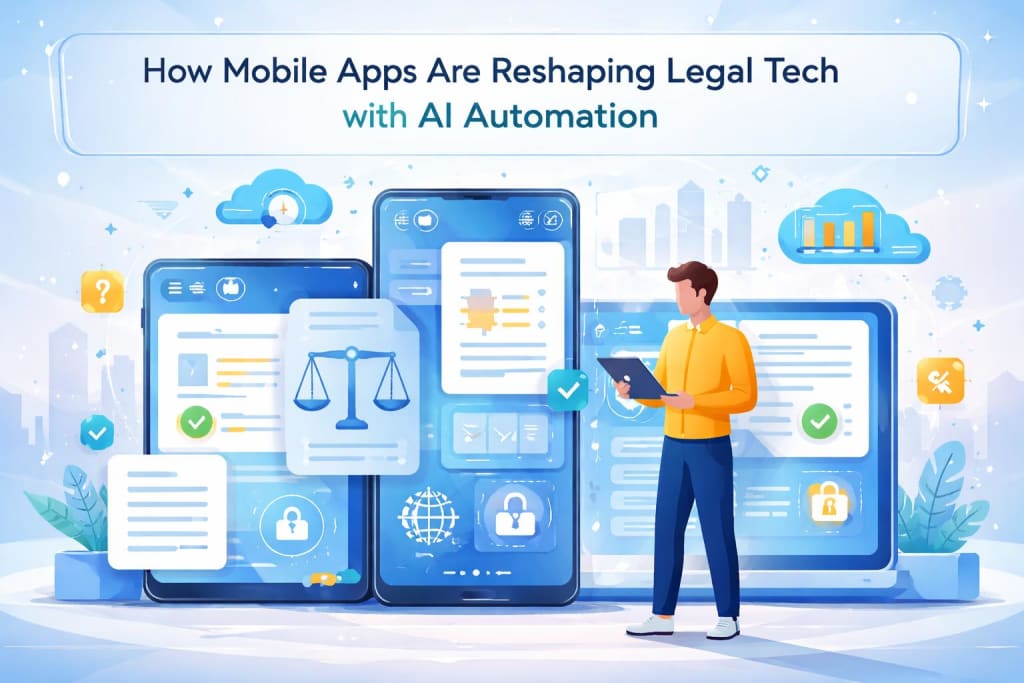
You're sitting in a courthouse hallway, ten minutes before your hearing, and you need to pull up a critical case detail. Your laptop's dead. Your briefcase is stuffed with paper. But your phone? That's got everything.
Welcome to 2026, where legal practice fits in your pocket.
The Shift Nobody Saw Coming
Thing is, lawyers spent decades chained to their desks. The idea of doing serious legal work on a phone seemed ridiculous just a few years back. Now? 40% of lawyers use AI multiple times per day, and mobile devices drive the rhythm of legal work.
The change happened fast. Really fast.
According to research from Harvey, one of the leading legal AI platforms, 80% of lawyers use AI at least weekly for both personal and professional purposes. But here's the kicker: most of that usage is happening on mobile devices, not desktops.
Why Lawyers Finally Embraced Their Phones
Lawyers aren't exactly early adopters. The profession still loves fax machines, for crying out loud. So what changed?
Reality hit hard. Lawyers work everywhere except their desks. They're in courtrooms, at client meetings, conducting depositions, traveling between appointments. Much legal technology still requires desktop access, creating friction when attorneys need information on the go.
The tools finally caught up to the workflow, not the other way around.
Teams working in this space, like those at mobile app development in New York, have been building solutions that actually fit how lawyers work instead of how software companies think they should work.
The AI Revolution in Your Pocket
Mobile legal apps aren't just digitized versions of desktop software anymore. They're powered by AI that's getting scary good at understanding context, maintaining conversations across devices, and delivering accurate results without the lawyer needing to type a dissertation-length prompt.
What Changed in 2026
Avaneesh Marwaha, CEO of Litera, puts it bluntly: "AI embedded in daily tools delivers the highest adoption and greatest efficiency, transforming familiar applications into powerful assistants that improve client outcomes."
The tools disappeared into the background. You're not "using AI" anymore, you're just working, and AI happens to be making everything faster and smarter.
Here's what that looks like in practice:
- Record and transcribe interviews from your phone
- Access case files with the same functionality as desktop
- Review AI-generated summaries while preparing in the courthouse hallway
- Get real-time insights during client meetings
- Track billable hours automatically as you work
Angel Reyes, Managing Partner of Angel Reyes & Associates, sees the writing on the wall. "AI is going to have a huge impact as it's already changing how we draft, research, and review documents. Predictive analytics will also reshape how cases are valued, how juries are analyzed, and how negotiations may unfold."
The Apps Actually Making a Difference
Real talk: not all legal tech is created equal. Some apps are solving actual problems. Others are solutions looking for problems to solve.
The winners in 2026 share common traits. They work seamlessly across devices, they integrate with tools lawyers already use, and they don't require a PhD to figure out.
Document automation has gotten ridiculously good. You can now fill in templates with case-specific details while waiting for your coffee. The AI pulls from your case files, applies your firm's formatting standards, and generates first drafts that don't read like they were written by a robot.
Time tracking finally stopped being painful. Apps now automatically log time spent on activities like drafting and email correspondence. The average lawyer records just 2.9 billable hours of an eight-hour workday, leaving 5.1 hours unbilled. Mobile AI tools are closing that gap.
Legal research moved from the library to your pocket. You can ask questions in plain English and get back actual answers with citations, not just a list of possibly relevant cases to wade through.
The Integration Problem (Or Lack Thereof)
Technology for attorneys must fit into actual legal workflows, not theoretical ones. The goal is to reduce friction and create workflows where information lives in one place, accessible across the tools attorneys actually use.
Firms that figured this out early are crushing it. Those still using five different apps that don't talk to each other? They're bleeding billable hours and talent.
What Nobody's Talking About (But Should Be)
The mobile-AI gap is closing, but it's not closed yet. Many AI tools still assume you're sitting at a desk with a 27-inch monitor. They don't account for spotty courthouse WiFi, the need to quickly context-switch between cases, or the reality that most lawyers are working off devices with smaller screens.
Brent Farese, co-founder of Aline AI, predicts 2026 will be pivotal. "We're building AI for in-house teams so that they can automate things that maybe they would lean more on for outside counsel."
That shift is massive. In-house legal teams are becoming less dependent on outside firms because they've got AI tools that let them handle work internally. 64% of in-house teams now expect to depend less on outside counsel because of AI capabilities.
The Ethics Headache
Let's not pretend this is all sunshine and productivity gains. There are real concerns.
Client confidentiality tops the list. When you're accessing sensitive case information on a mobile app, you better be damn sure that app has proper encryption, access controls, and data residency compliance.
AI hallucinations are still a problem. Over 700 court cases worldwide now involve AI hallucinations, with sanctions ranging from warnings to five-figure monetary penalties. Using AI on your phone doesn't make those hallucinations less dangerous.
Professional competence rules are catching up. The ABA's Formal Opinion 512 makes it clear: lawyers must have a reasonable understanding of AI capabilities and limitations. "I don't know, the app did it" won't fly as a defense.
Where This Goes Next
Junior lawyers see what's coming more clearly than partners do. 90% of junior lawyers expect AI to moderately or significantly reshape their workflows in the coming year.
They're right. The firms that embrace mobile-first, AI-powered workflows will pull ahead. Those that resist will find themselves competing on price alone, and that's a race to the bottom nobody wins.
The future of legal practice isn't about replacing lawyers with AI. It's about giving lawyers tools that let them focus on the parts of their job that actually require human judgment, empathy, and strategic thinking, while automating the parts that don't.
Your phone's already smarter than the computers that put humans on the moon. Might be time to let it help with your legal practice too.
About the Creator
Keep reading
More stories from Samantha Blake and writers in Geeks and other communities.
What Breaks First in Mobile App Development Austin Builds Today?
I remember the third sprint review like a foggy afternoon — nothing felt dramatic. Commits were landing. The team reported on progress. Features slid into the staging branch. I nodded. I didn’t see anything that looked like a fire.
By Samantha Blake6 days ago in Geeks
Matt Taylor and the NASA Moment That Changed a Career Forever
Sometimes a name becomes larger than the person behind it. Matt Taylor learned this in a single day, when a moment meant to celebrate scientific success turned into a worldwide conversation about behavior, judgment, and public accountability. Before that day, he was known only within academic and space science circles. After it, millions of people who had never followed space exploration suddenly knew his name. Searching for “matt taylor” now brings up more than a career. It brings up questions about intent, consequence, learning, and how fast public opinion can reshape a life. This article looks closely at who Matt Taylor is, what happened, and why his story still matters years later.
By Muqadas khanabout 8 hours ago in Geeks
Rachel Reviews: Lunch Tales: Teagan by Lucille Guarino
Well, I did enjoy this! Sometimes, all you need is just great storytelling and this is what Lucille Guarino delivers here. There's no big message to this book; it's just about folks and families, living their lives and coping with everything that's being thrown at them and finding their way. But when it's done well, like it is here, then you have characters to whom you can relate, tension which leaves you rooting for a better outcome, attraction which has your heart racing and an urge, as a reader, to see the characters happy with the people with whom they belong.
By Rachel Deeming3 days ago in BookClub


Comments
There are no comments for this story
Be the first to respond and start the conversation.