
Book Review: "W or The Memory of Childhood" by Georges Perec
5/5 - a giant allegory of many different levels...

I have read a few books set in the time of the Holocaust, or about the Holocaust in some way and most of the time, I have found myself in tears. I mean, Diary of a Young Girl by Anne Frank was one of my first encounters with people who actually lived and died through it when I was a lot younger than I am now. I was about thirteen when I became pretty obsessed with The Complete Maus by Art Spiegelman and then went on to reading more of these books such as but not limited to: Night by Elie Weisel, The Book Thief by Markus Zusak, Schindler's Ark by Thomas Keneally and obviously, my mother's favourite book of all time, The Boy in the Striped Pyjamas by John Boyne. Books about the experiences of the Holocaust never fail to amaze me.
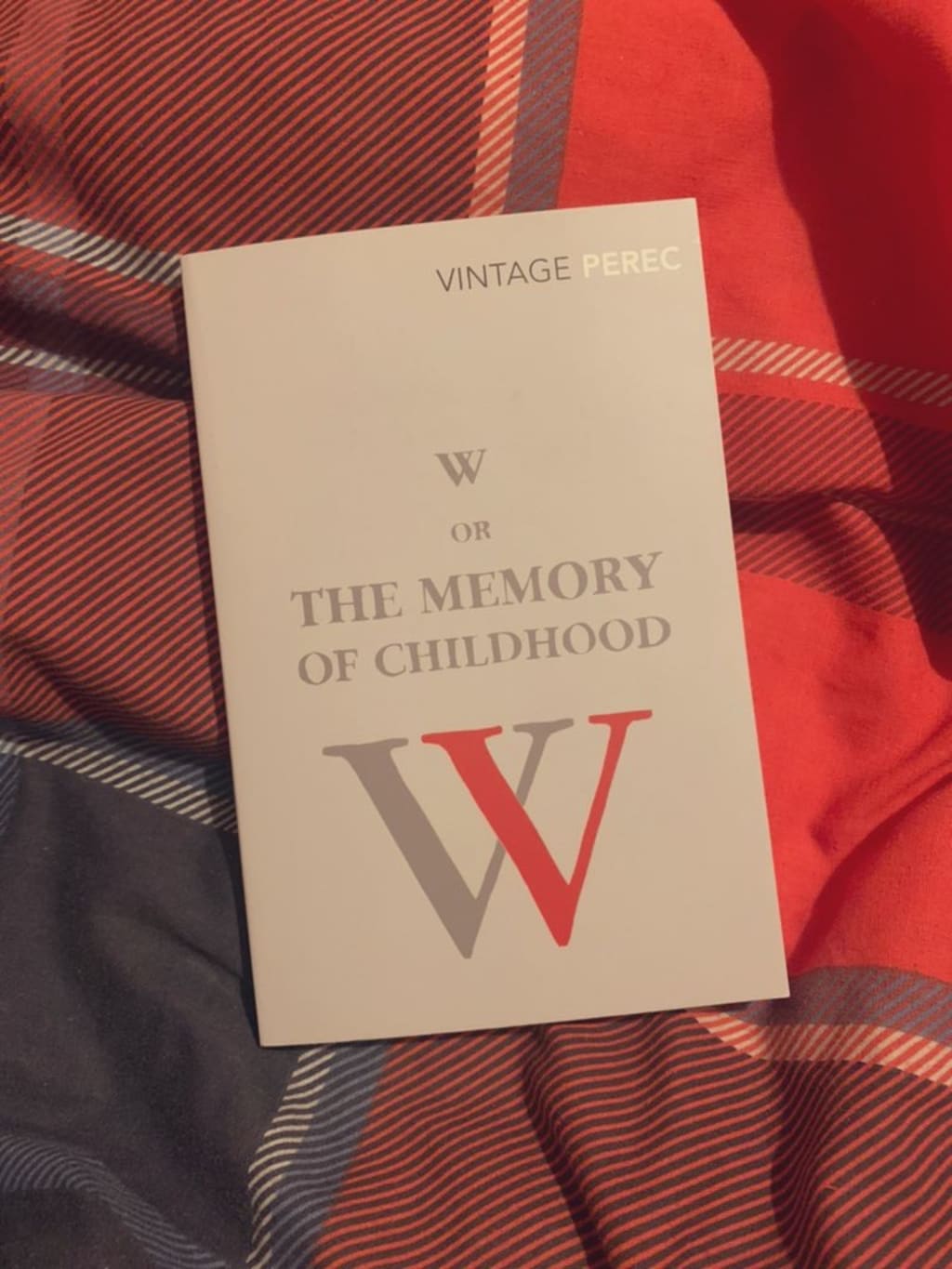
A semi-autobiographical novel, W or The Memory of Childhood is a short but beautifully written account of a fairly odd character living in a turbulent historical period. The first section of the book deals with a shipwreck in which a boy is rescued, the boy is also deaf. Named Gaspard Winkler, the boy has apparently deserted the army and there is a question about whether his identity has been entirely forged or not. It is a strange way to start an autobiography, but the use of wordplay, atmosphere and personal, emotive language makes it all worthwhile.
I felt like the second part was supposed to be an extended metaphor for a dictatorship because of the way the story is told. We have a teenager who seeks out to be an Olympian and respects the Olympic Sports and their training regimes. Looking towards the Olympians as living in some form of utopia from the outside, he is excited and overwhelmed with the idea. But, when he gets on to the inside of it, he understands that there is much more to be undersood since there really is no utopia. The Olympic Regime is rigid and covered with rules on every aspect of life. It is nothing how he imagined. The turn from being on the outside to being on the inside could be an extended metaphor for the difference between utopia and dystopia in the real world. From the outside everything looks fine, but from the inside everything is falling apart.
The final section is about the Nazi Death Camps in which Georges Perec's own mother was murdered. This is the way we discover what the rest of the book is actually about through this third section in which we see what the Death Camps actually entailed and the allegory that is related to them throughout the course of the text. I was actually really surprised I did not figure this out earlier, and I think it is because it is so well hidden.
The clues are in the text: the loss of identity, the desertion of the army by people who didn't agree with the system, the shipwreck of a nation, the dystopia from the inside, the rules in the regime like a dictatorship, then we get to the Nazi Death Camps. This is truly a grand work of fiction compressed into little over on hundred pages.
To conclude, I think I will read this again purely to go through and pick up more of those clues on the allegorical nature of the first two volumes in relation to the last one. When I say I was surprised, I mean that I knew very little about this book before I read it. The only thing I knew is that there was something about the Holocaust in there. This has been an interesting journey.
About the Creator
Annie Kapur
I am:
🙋🏽♀️ Annie
📚 Avid Reader
📝 Reviewer and Commentator
🎓 Post-Grad Millennial (M.A)
***
I have:
📖 280K+ reads on Vocal
🫶🏼 Love for reading & research
🦋/X @AnnieWithBooks
***
🏡 UK
Keep reading
More stories from Annie Kapur and writers in Geeks and other communities.
5 Great Books I Read in December '21
As we come to the end of the year, I wanted to share with you the five books that have really made an impact in this cold December. Yes, I like my seasonal reads, but there are books I have discovered this month that move beyond my wildest imaginations and I cannot believe I have been without them for so long. Hopefully, these books can have an impact on you as well. They are, at the end of the day, absolutely brilliant. I hope you enjoy them as much as I did. They will be in no particular order. Have a great 2022 and I look forward to the new things I am going to bring - hopefully, giving my writing a leg-up a bit as well.
By Annie Kapur4 years ago in Geeks
Marvel Zombie
The last entry into our 2025 superhero projects catalogue is Marvel Zombies. This was a show that was anticipated by absolutely no one and it disappeared from the public consciousness as quickly as it was released. There was nothing special about the project that made it a must see, or a must remember. In fact if anything it's a must forget.
By Alexandrea Callaghan25 days ago in Geeks
Can you watch Premier League in USA
The 2025–26 Premier League season is underway, marking the 34th edition of the competition and the 127th year of top-flight English football. Liverpool start their title defense with confidence after lifting their second Premier League trophy last season, but the return of Leeds United, Burnley, and Sunderland ensures fresh rivalries – including the long-awaited Tyne–Wear derby, back for the first time since 2015–16.
By David Cook5 days ago in Geeks
Smart phones, Humans and Aliens.
WARNING. I will be tapping into one of your favorite creative tensions: The absurdity of humans worshipping their glowing rectangles as if they were tiny oracles. There’s something deliciously poetic about that contradiction, and it lends itself beautifully to an instructive proviso.
By Novel Allen4 days ago in Poets


Comments
There are no comments for this story
Be the first to respond and start the conversation.