
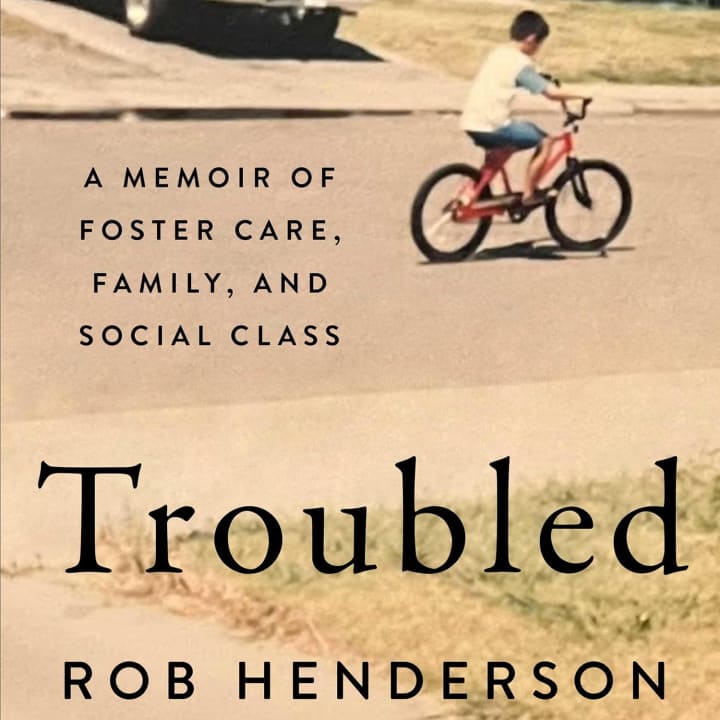
Book Review: "Troubled" by Rob Henderson
5/5 - a powerful, honest memoir complete with a lesson in self-respect and redemption...


I ran into this book after seeing a discussion between the author and Dr Jordan Peterson on YouTube, where the author goes through his horrific upbringing and how his book was being shadow-banned by bookstores. (That's basically where bookstores deliberately place the book in awkward places so that readers won't find it, or put stickers over vital information that the book gives to the readers so that they won't pick it up). The fact that an autobiography of a guy who has gone through the foster care system in America is being shadow-banned and Boris Johnson's autobiography is right there in front of us, really does show us what the commercial world of publishing actually cares about and it's ironic as hell.
Rob Henderson was born to a South Korean mother who came to America to study but ended up doing drugs in an apartment with her three-year-old son tied to a chair so that he wouldn't bother her. One day, the police showed up and took the toddler who never knew his father, away from his mother - his mother was deported back to South Korea and he would never see her again. This backstory is only the beginning of what would become one of the most shocking true stories of a child I would ever read. It turns out he would move so many times across so many different homes whilst in a broken foster care system.

It's not just that though. Rob Henderson goes through the way in which the foster care system makes a mockery of the children who go through it with the adults around them trying to deflect the blame of failing the children off themselves by medicalising everything for the kid. This is horrifying but, in our own school systems, we can see it everywhere - adults, refusing to take accountability. As Rob grows up, he begins to develop defence mechanisms which would keep coming back even by the time he had a 'stable' home and then, moved into high school.
When we see him move into his working era, he begins working in a restaurant and then as a bag boy in a supermarket. He finds himself feeling glad for earning his own way and takes it now as a lesson in growing up, but admits that at the time between school, hanging out with friends and work, he thought he barely had time for anything at all and felt himself constantly running out of energy. He turned during his younger years to energy drinks in order to combat his tiredness. This is something I think every young person can relate to - turning to high caffeine drinks. Myself especially, who would use energy drinks not just to combat not sleeping well but to feel like I was always on the ball.
I liked the part where he described entering the army and feeling conflicted about it. There was a section where he talks about his friend going to San Quentin prison for driving whilst drunk and when he meets the friend again they have this comparison between being in the army and being in prison. It's weird but the narrator of our story doesn't see it that way but the friend does and the reader realises the difference is not in the perspective but in the mentality of the two men sitting in front of us. One has been to jail and now, has few prospects other than feeling sorry for himself and the other is in a regime he chose in order to become better for himself. Both though, admit they are still flawed human beings. It is a fascinating part of the book because of how the exchanges reveal to us more about our narrator than descriptions can.
The faults of the USA's foster care system can also be seen in the failures of the social care system in the UK and the idea of 'luxury beliefs' is something that I became quite captivated by, looking at myself I think now 'damn, I have it pretty good'. A lesson in being grateful for what you have is essential to understanding this book but what is even more essential is understanding how the adults often fail the children around them without ever even acknowledging it. That is by far the worst thing. To tell you I cried would be an understatement.
About the Creator
Annie Kapur
I am:
🙋🏽♀️ Annie
📚 Avid Reader
📝 Reviewer and Commentator
🎓 Post-Grad Millennial (M.A)
***
I have:
📖 280K+ reads on Vocal
🫶🏼 Love for reading & research
🦋/X @AnnieWithBooks
***
🏡 UK
Keep reading
More stories from Annie Kapur and writers in Geeks and other communities.
Book Review: "Into the Wild" by Jon Krakauer
I heard about this story when I was growing up, especially during the times when I started reading Emerson and Thoreau during the first year of university. The first time I ever heard the story I thought it was really quite a stupid endeavour but, as I kept looking at it, I started to wonder what exactly was going through the head of this kid when he left his life behind to go and live in the wilderness. As much as I try, I cannot fathom what was racing in that brain and yet, I have drawn some similarities between the two of us. The first (and probably the most important) is that we both like to read. But, where I enjoy the indoors far too much to venture outside, this boy may have taken Jack London a bit too seriously...
By Annie Kapurabout a year ago in Geeks
Marvel Zombie
The last entry into our 2025 superhero projects catalogue is Marvel Zombies. This was a show that was anticipated by absolutely no one and it disappeared from the public consciousness as quickly as it was released. There was nothing special about the project that made it a must see, or a must remember. In fact if anything it's a must forget.
By Alexandrea Callaghan26 days ago in Geeks
Emma Watson, Sir Lenny Henry and Sir Elton John lead British Diversity Awards
The prizes will be handed out at a glittering ceremony in London on March 25 2026 and Harry Potter actress/activist Watson will compete with Henry and John for the top gong of Media Personality of the Year with the musician competing alongside his husband David Furnish.
By Dena Falken Esq6 days ago in Geeks



Comments (1)
This is a powerful and insightful review. You've captured the essence of the book, highlighting the author's harrowing experiences and the systemic failures of the foster care system. Your personal reflections on the themes of the book, such as the impact of energy drinks and the importance of gratitude, add depth and authenticity to your review. The contrast between the narrator's perspective and his friend's is particularly poignant, shedding light on the choices we make and the paths we take in life. Your observation about the role of adults in shaping the lives of children is spot on, and it's a reminder of the responsibility we all have to create a better world for future generations. Thank you for sharing your thoughts on this important book.