
Book Review: "The Portable Atheist" ed. by Christopher Hitchens
5/5 - a philosophical anthology of great ideas...

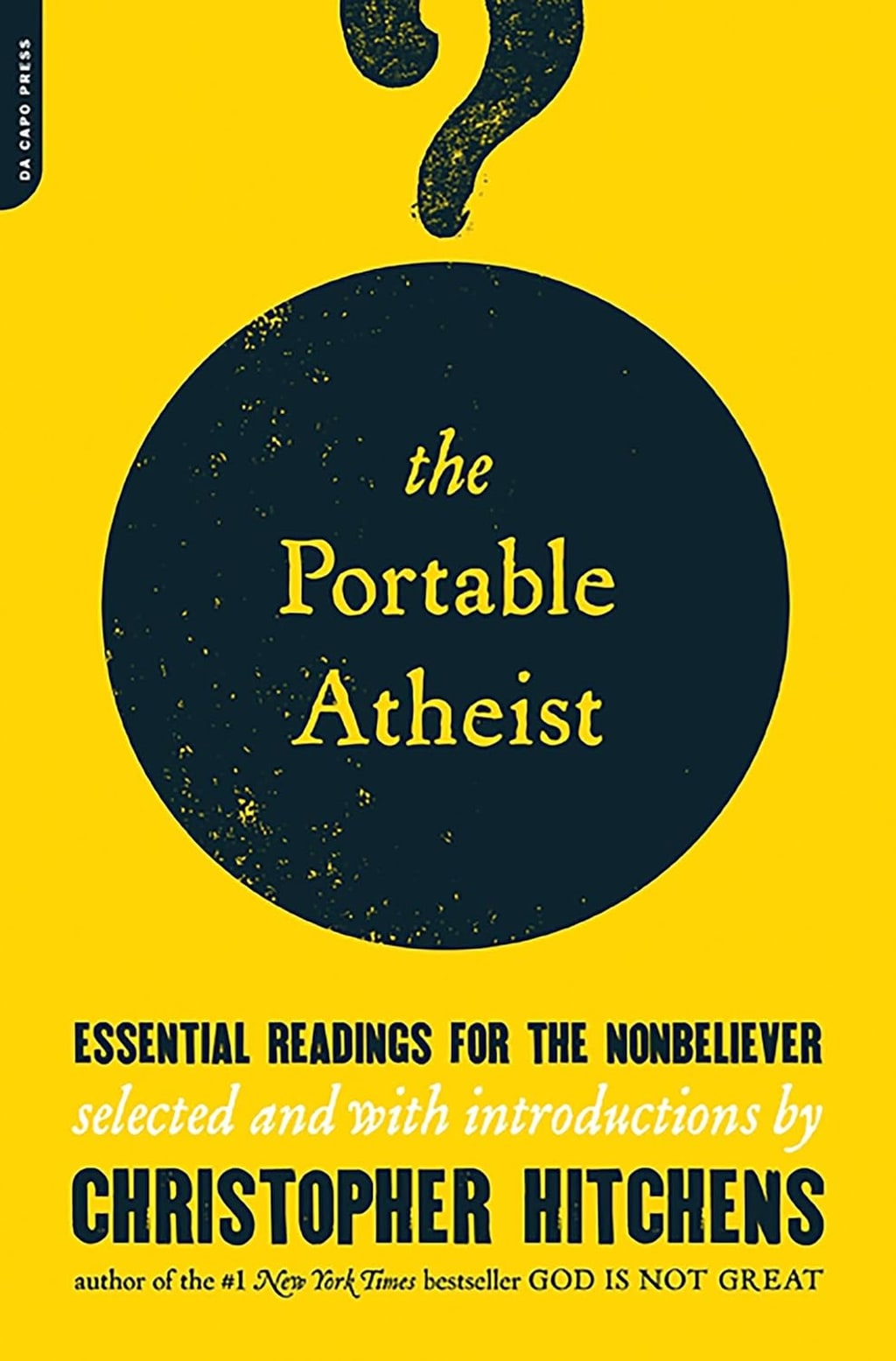
It's almost June 2025 and that means it's almost halfway through the year. You can expect another article at the end of the year on 'The Best Books' and 'The Literary Entirety' and I've made my job easier by starting it at the beginning of the year and adding to it every so often rather than trying to collate it at the end of the year (I don't know why I ever did it that way to begin with). But this is one of the books you might se pop up here and there, I've definitely found some stuff I can use in some upcoming 'sleepless nights' articles. So, let's take a look at the ideas expressed in this anthology of essays entitled The Portable Atheist compiled by Christopher Hitchens.
I don't think I could expect anything less from Hitchens than the very idea that religion is man-made and not divinely inspired and so, is inherently flawed. He obviously takes this idea from Thomas Paine, who is also included in the anthology and comments on the very texts themselves. Rather than being transcendent, the texts are tribal, violent, and authoritarian which are indicators of their human authorship. I think I can agree with Hitchens on this, but I also see the fact that there is probably some sort of fable humans are meant to learn from as well - whether this means they are to do, or are not to do something. Many of these learnings have been twisted over time to actually be people arguing about why certain vile stories are contained in the texts rather than accepting that this might be a lesson in human evils and how to avoid them.
There are a few people who argue on the basis of morality not being dependent on religion or belief. These are mainly Bertrand Russell, A.J. Ayer, and Sam Harris. They tend to take the stance that it is more likely for religiously-inspired morality to take the side of outdated doctrine over equalities of faith, gender and sexuality. For example: it is far more likely for someone who is religious to be against the LGBTQA+ movement on the basis of religion and argue it is immoral. A nonreligious person is more likely to take the stance of adults are allowed to make their own decisions and therefore, the requirement of equality of lifestyle is more able to be met. Another part of the argument is that morality should be grounded in empathy and understanding rather than a book that was written by a bunch of scribes a few thousand years ago because it works on human autonomy rather than doctrine. Therefore, secular ethics, shaped by evidence and compassion, can adapt and improve over time, whereas religious morality is constrained by dogma.
Essays by David Hume, Daniel Dennett, and others dismantle traditional arguments for the existence of God, including the cosmological, teleological, and moral arguments. David Hume definitely dislikes the notion of divine intervention and supernatural happenings on order of probability. He rightfully states that it not only sounds improbable, it is pretty impossible on all accounts. Dennett critiques the “design” argument by pointing to natural selection as a better explanatory framework. Their persistence, these essays suggest, owes more to tradition and emotional comfort than logical rigour. I can honestly say the same. Back when I was a religious person, I did try to comfort myself with religion rather than actually believing in it with all of my heart. You can probably imagine how well that went down. Here's a hint: I ended up on SSRIs for a certain amount of time until I drop-kicked it all out of my life.

A belief in life's fragility and the importance of doing what you enjoy is best appreciated by those who are not religious because they aren't locked in by doctrines and aren't guilt-tripped by authoritarians. This is something that Carl Sagan explains. Life, limited and improbable, gains urgency and value when not treated as a mere preparation for the afterlife. Secular humanism posits that meaning is something we create through relationships, creativity, knowledge, and empathy. This is something that also leads us to accept that maybe, purpose is not told to us from above. Argued even further by Emma Goldman and Sigmund Freud, it is stated that by demanding obedience to divine commands, often mediated by clerical elites, religion undermines personal autonomy. It dictates morality, sexuality, identity, and even thought. I mean, I could not today imagine living under this metaphorical rock.
Religious apologists often claim that without religion, society would collapse into fragmentation and moral decay. I can say that as much as I like listening to Jordan Peterson, this seems to be something he implies through his constant wavering towards faith in whatever he is talking about. A lot of the essays highlight examples of art, literature, science, and collective values arising from nonreligious sources - including those that critique religion and its ideas. It is true that even though religion as an institution may not be something I agree with, but as an idea or a philosophy where people can argue freely about what goes in and what comes out - that might mean we're on to something. Dawkins seems to talk about it as an barrier to intellect and though it is something to be discussed, it is still about reading a philosophy. It only becomes a barrier if you base your entirely life on the notions - something which I think is much stronger in certain parts of the USA than in England (and that's me, having been to a Catholic school growing up).
All in all, I thought this was a brilliantly compiled anthology. It gives us a lot to think about over the years and definitely gives us people who probably would have been punished (for example: Percy Bysshe Shelley, who was punished) for publishing atheistic pamphlets and ideas. It's a wonderful collection of ideas over the years and I recommend everyone, religious or not, to read it.
About the Creator
Annie Kapur
I am:
🙋🏽♀️ Annie
📚 Avid Reader
📝 Reviewer and Commentator
🎓 Post-Grad Millennial (M.A)
***
I have:
📖 300K+ reads on Vocal
🫶🏼 Love for reading & research
🦋/X @AnnieWithBooks
***
🏡 UK
Keep reading
More stories from Annie Kapur and writers in Geeks and other communities.
Book Review: "Dublin Palms" by Hugo Hamilton
As of now, it is the middle of May 2025 and I can honestly say that I have been diving into some pretty good books lately. I got this one from the library again, their stand for these books was called 'I can't remember what it was called but the cover was blue'. Dublin Palms is a great tale of language and identity written in an almost stream-of-consciousness way. It contains some beautiful language about...well, language. And it has various meditations on culture which, as the story gets underway, become more and more important. If you're in a reading slump at all and want to appreciate some really beautiful writing, then I would definitely recommend picking up this relatively short, but wonderful book.
By Annie Kapur9 months ago in Geeks


Comments (2)
This is going right on my to-read list! An amazing review!
As a recovering Cathoholic, many of the writers and thinkers he included helped me se things much more clearly.