
Book Review: "The Literature of Terror" by David Punter
5/5 - one of the best books ever written on the subject...


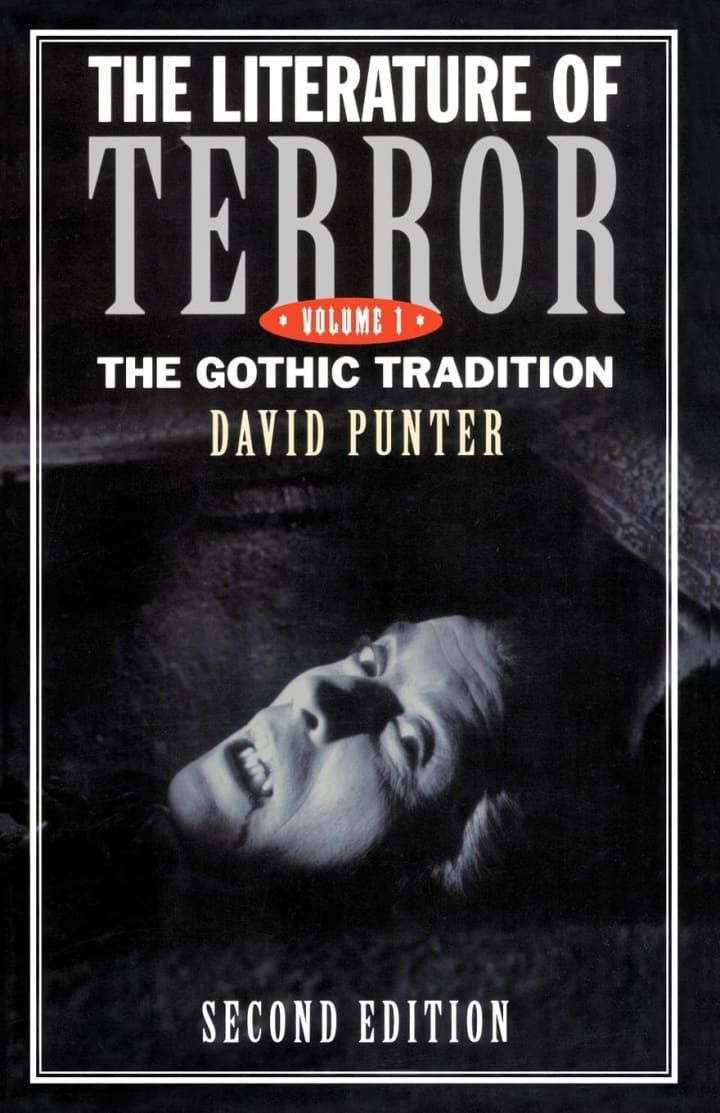
Yes, we are back with another bygone university read. I actually wanted to re-read this book and realised I didn't have my copy anymore. I went out in search of it and found it at the library and thus, I got transported back to a time when I was intensely studying the gothic and having the absolute time of my life. David Punter's Literature of Terror is one of the most expansive books you'll read whilst studying gothic literature. This would usually be the case alongside books such as David Punter's own Companion to the Gothic published by Blackwell's and also a personal favourite: The Gothic Vision by Dani Cavallaro. Let's take a bit of a dive into what makes David Punter's Literature of Terror a very special book.
First of all, it is one of the most comprehensive studies of Gothic fiction, tracing its evolution from the 18th century to contemporary horror literature. The author examines how the Gothic tradition emerged as a reaction to Enlightenment rationality, offering a space where suppressed fears, anxieties, and desires could manifest through fiction. Punter begins with Horace Walpole’s The Castle of Otranto (1764), often considered the first Gothic novel, which introduced key tropes such as haunted castles, mysterious family secrets, and supernatural elements. He then moves on to key figures like Ann Radcliffe, whose works such as The Mysteries of Udolpho developed the ‘explained supernatural’, where seemingly supernatural occurrences are rationally explained, while also solidifying the Gothic heroine archetype.
A central theme in Punter’s analysis is the connection between the Gothic and the concept of the sublime, as articulated by Edmund Burke (another man I recommend you read going into your gothic studies - he is a genius). Gothic literature, he argues, often evokes feelings of awe, terror, and grandeur, using vast landscapes, looming ruins, and overpowering emotions to unsettle the reader. Punter contrasts two strands of Gothic fiction: the ‘terror Gothic’ (Radcliffean) and the ‘horror Gothic’ (Lewisian). While Radcliffe’s novels relied on suspense and psychological unease, Matthew Lewis’s The Monk (1796) embraced grotesque horror, violent deaths, and supernatural malevolence. Punter sees this divergence as foundational to later horror fiction, where psychological dread and explicit horror would continue to co-exist.
One of the most important chapters in The Literature of Terror is Punter’s discussion of Mary Shelley’s Frankenstein (1818). He situates the novel at the intersection of Gothic tradition and emerging concerns about science, identity, and the limits of human ambition. Shelley’s creature, he argues, embodies the fears of unchecked scientific progress, alienation, and societal rejection, themes that continue to resonate in contemporary horror and science-fiction. Punter also examines Frankenstein in relation to the Romantic movement, highlighting how the novel reflects the anxieties of its time, particularly fears of the unknown and the consequences of overreaching ambition. Yes, it really gets "Shakespearean tragedy" up in the gothic. He connects Shelley’s themes to later works that explore the boundaries between human and monster, such as Robert Louis Stevenson’s Dr Jekyll and Mr Hyde and H.G. Wells’s The Island of Doctor Moreau.
Moving into the 19th century, Punter explores how Gothic literature evolved alongside Victorian anxieties. While early Gothic novels were preoccupied with crumbling castles and supernatural terrors, Victorian Gothic fiction shifted its focus to urban horror, doubling identities, and social repression.He analyses Dr Jekyll and Mr Hyde (1886) as a key text in this transformation, arguing that the novella reflects fears of degeneration, hidden vice, and the fragile nature of respectability. Similarly, he examines Bram Stoker’s Dracula (1897) as a novel steeped in contemporary anxieties about sexuality, immigration, and the collapse of British imperial power. The vampire, Punter suggests, is a potent symbol of both repressed desire and external threats, making Dracula one of the most enduring Gothic figures. This is something I have to say: the more you look into Dracula, the more messed up it becomes. I love that.
Punter dedicates significant attention to Edgar Allan Poe, whose influence on Gothic literature and horror cannot be overstated. Unlike British Gothic, which often dealt with externalised fears in grand settings, Poe’s Gothic was deeply psychological, exploring madness, guilt, and the fragmented self. Analysing stories such as The Fall of the House of Usher and The Tell-Tale Heart, Punter emphasises Poe’s use of unreliable narrators and interior horror. This psychological depth, he argues, shaped later horror fiction, influencing writers such as Henry James (The Turn of the Screw), H.P. Lovecraft, and modern horror authors. He also explores how American Gothic differs from its British counterpart, highlighting how authors like Nathaniel Hawthorne and William Faulkner used the genre to address historical traumas such as Puritanism, slavery, and the legacy of violence in the American South.
There's so much more in here including cosmic horror and the movement into film's contemporary depictions of horror. This was a book I perhaps read a couple of times on my degree cover to cover and I will be perfectly honest when I say this: you will find few who can articulate this with a depth of study like David Punter. This is a highly recommended read for anyone studying the gothic, or simply interested in the topic.
About the Creator
Annie Kapur
I am:
🙋🏽♀️ Annie
📚 Avid Reader
📝 Reviewer and Commentator
🎓 Post-Grad Millennial (M.A)
***
I have:
📖 280K+ reads on Vocal
🫶🏼 Love for reading & research
🦋/X @AnnieWithBooks
***
🏡 UK
Keep reading
More stories from Annie Kapur and writers in Geeks and other communities.
Book Review: "Exhausted" by Anna Katharina Schaffner
It's currently mid-May and yet again, it's pretty warm in the country. I mean, apart from that I have had this book sitting around on my Kindle for some time now and totally forgot about it. It's a book about dealing with burnout and though I find it makes some good points, they are points that other people have already made. However, they are also workable - not a lot of them feel like they are coming from a place of privilege and she definitely sees the reality and the irony in the fact that everyone hates their jobs and yet, nobody can actually leave them. If you're like me and you believe that the fat cats at the top are, by design, keeping the people beneath them tired and miserable so that they continue consuming stuff made by the same (or similar) fat cats - you will love this book.
By Annie Kapur8 months ago in Geeks
The Rachels - 2025
Much to my surprise, I have kept a list of the films I‘ve seen this year. I daresay it isn’t complete. There will be films that snuck in on a late night in front of the TV that I would’ve forgotten to note. Or others, that I went to watch at the cinema, but then had a red wine and promptly forgotten about. But it’s not a bad approximation of the films I’ve seen this year. In total, there are 53 films listed, so an average of one a week and one for good luck.
By Rachel Robbins26 days ago in Geeks
Kartik Aaryan suffers first major setback after minor dating controversy
Kartik Aaryan recently suffered first major setback after getting caught in a controversy of dating a minor. It all started when the 35-year-old actor’s newly released film, Tu Meri Main Tera Main Tera Tu Meri, became a box office bomb.
By Dena Falken Esq5 days ago in Geeks



Comments (2)
This does seem to be a fascinating read and it's right up my alley. But the fact that it's a non fiction discussing works of fiction makes it not my cup of tea. I really enjoyed your review!
I've read Punter's book. It's a great study of Gothic fiction, tracing its evolution over the centuries. The connection between Gothic and the sublime is fascinating. Burke's ideas add depth to the analysis.