
Book Review: "The Human Mind" by Paul Bloom
5/5 - a fantastic and in-depth view of everything we have come to know and how we have come to know it...

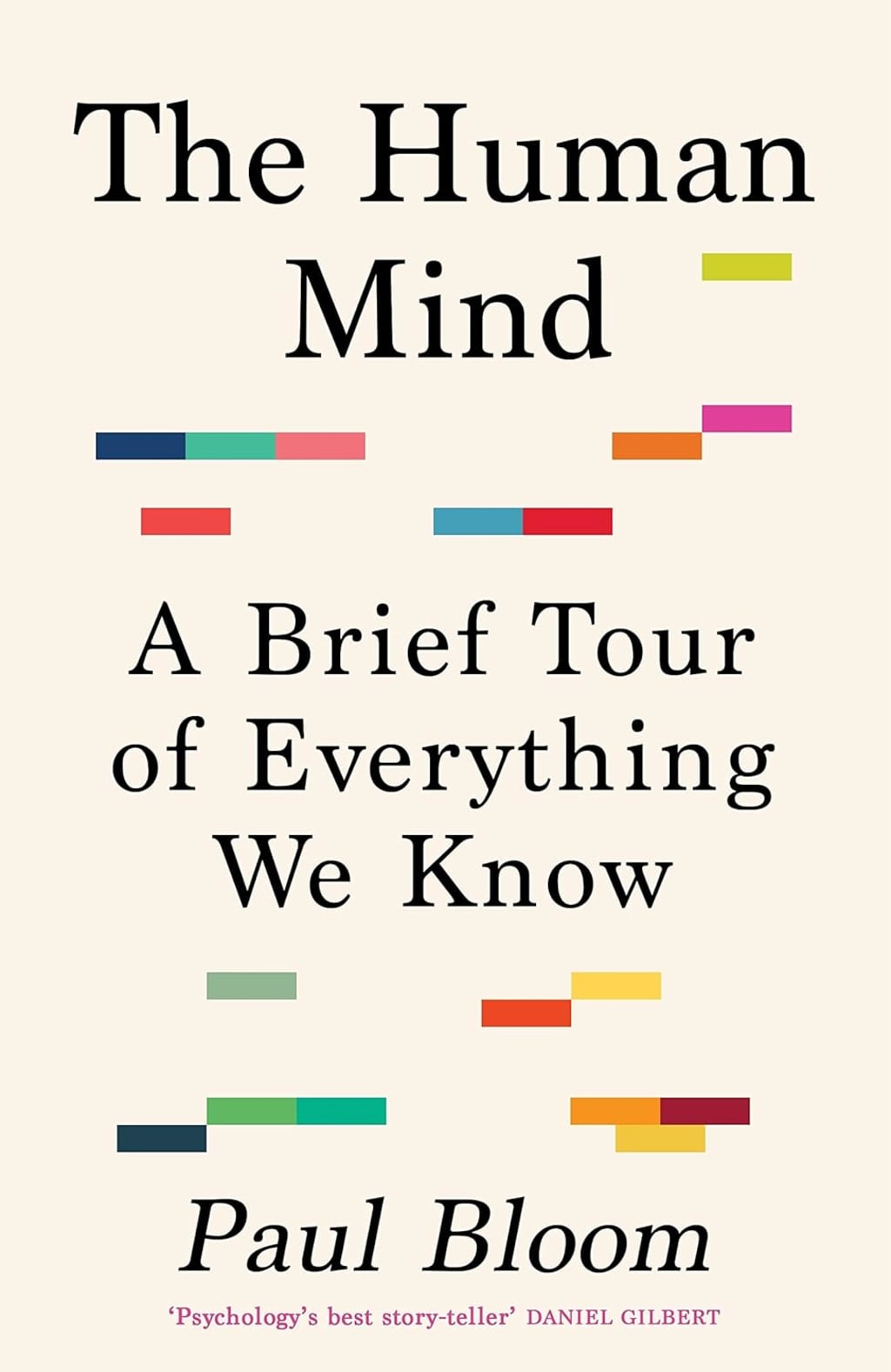
As you know I'm on a binge-read of all things mental health nonfiction and in fiction, I'm reading about disasters on the sea (this is as of the 13th of December and today is the 20th of December). It's getting closer to Christmas and I'm proud to be saying that in a couple of days I will be returning to my hometown for a bit in order to spend time with my family. This is where my Kindle can come in handy because it has everything I would like to read in that time on there. I even read this book on my Kindle entitled: The Human Mind by Paul Bloom. Taking a deeper dive into the brain, this book is the perfect accompaniment to reading about mental health and its sufferings. It really does explain everything.
Bloom introduces the human mind as a paradoxical entity, capable of immense intellectual achievements yet deeply fallible. He explores the coexistence of logic and irrationality, where the brain's capacity for abstract reasoning is often undermined by cognitive biases, such as confirmation bias or the Dunning-Kruger effect. This duality, Bloom argues, underpins many human endeavours, from science and art to social conflict and personal relationships. I found this quite interesting, especially when he adds in the fact about people thinking that the brain is the most interesting and complex organ only to be reminded of which organ gave them that thought in the first place.
The book dismantles the false dichotomy between nature and nurture by presenting human behaviour as the product of their intricate interplay. Bloom provides examples of genetically predisposed traits, like temperament and intelligence, and demonstrates how environmental factors—parenting, education, and culture—shape these traits over time. He also addresses epigenetics, showing how external conditions can influence gene expression. The author makes the argument that just as much can come from genetics as can come from environment and that just as much can be picked up from parental behaviours as can be explained by the biological relationships between parents and children.

Bloom reframes emotions not as hindrances to rational thought but as essential components of decision-making. He explores how fear, anger, and joy influence behaviour, noting their evolutionary origins as survival mechanisms. Case studies of patients with impaired emotional processing illustrate how emotions provide crucial context for interpreting risks and making moral decisions, challenging the notion of purely "rational" thought. He uses the example of people being more scared to encounter a man on the street at night time instead of a woman because men are perceived as more threatening by bother genders due to their increased propensity (but not over-propensity) in comparison, to commit an act of violence against another person. Therefore, this would make someone perhaps behave differently in this one situation to the other.
The book takes a deep dive into the philosophical and neurological debates surrounding free will. Bloom argues that much of human behaviour is driven by unconscious processes, including habits, reflexes, and deeply ingrained cultural norms. He discusses experiments in neuroscience that reveal how decisions are often made before we become consciously aware of them, yet he cautions against fully abandoning the concept of free will due to its ethical and societal significance. I read a book a long time ago which argues for how free will is basically non-existent and I remember thinking about the implications of dismissing such a philosophically important idea in favour of a purely neurological one. But, as Bloom makes a point of saying - just because one exists, it does not discount the other's possibilities of existence.
The dual nature of empathy is explored in depth. Bloom acknowledges empathy's role in fostering compassion and connection but warns of its limitations, such as favouritism, tribalism, and emotional burnout. He contrasts empathy with rational compassion, advocating for a broader moral framework that extends beyond personal connections. Real-world examples, such as humanitarian aid and justice systems, illustrate these concepts. I have always thought that empathy is both an underrated and underestimated quality amongst human beings. I have heard my fellow woman say that men have no empathy and yet, I think a lot more men have a lot more empathy than we care to realise. Also, when it comes to how empathy is viewed amongst society, I think it should be seen more as an intricate quality that most poeple are capable of. Don't believe me? Read the book Better Angels of Our Nature by Steven Pinker.
Bloom identifies a growing disconnect between the ancient design of the human brain and the demands of contemporary life. He discusses how modern stressors—constant connectivity, sedentary lifestyles, and social comparison—exacerbate issues like anxiety, depression, and loneliness. He integrates research on mindfulness, cognitive-behavioural therapy, and lifestyle changes as tools to counteract these challenges, emphasising their evidence-based effectiveness. Though I don't really agree that cognitive behavioural therapy does any good, it is perhaps better than taking medications and pills that have been proven not to be very effective.
All in all, this book is an in-depth analysis of the workings of the human mind and how it differs to what we know about the human brain. It is about the way in which it is perhaps the most complex of all organs and yet, it is still being discovered and rediscovered every day and with every turn of the clock of society. With each change, we change with it.
About the Creator
Annie Kapur
I am:
🙋🏽♀️ Annie
📚 Avid Reader
📝 Reviewer and Commentator
🎓 Post-Grad Millennial (M.A)
***
I have:
📖 280K+ reads on Vocal
🫶🏼 Love for reading & research
🦋/X @AnnieWithBooks
***
🏡 UK
Keep reading
More stories from Annie Kapur and writers in Geeks and other communities.
Book Review: "You Are Not Alone" by Dr Ken Duckworth
I think that this Christmas holiday has been really great for getting some reading done. So far, I have attached myself to books about seafaring and sinking ships, nonfiction about mental health and honestly, I think I'm shifting into the realm of Vintage Earth novels and Virago Modern Classics. I go on these reading binges a lot when a very particular sub-topic becomes my whole personality. In nonfiction as of 19/12 it is mental health and recovery texts, especially those published by Penguin Nonfiction Books. So, here we go into a very interesting text not just about mental health and its pitfalls, but about real advice on how to get better.
By Annie Kapurabout a year ago in Geeks
Marvel Zombie
The last entry into our 2025 superhero projects catalogue is Marvel Zombies. This was a show that was anticipated by absolutely no one and it disappeared from the public consciousness as quickly as it was released. There was nothing special about the project that made it a must see, or a must remember. In fact if anything it's a must forget.
By Alexandrea Callaghan26 days ago in Geeks
Emma Watson, Sir Lenny Henry and Sir Elton John lead British Diversity Awards
The prizes will be handed out at a glittering ceremony in London on March 25 2026 and Harry Potter actress/activist Watson will compete with Henry and John for the top gong of Media Personality of the Year with the musician competing alongside his husband David Furnish.
By Dena Falken Esq6 days ago in Geeks




Comments
There are no comments for this story
Be the first to respond and start the conversation.