
Book Review: "The Dream of Reason" by Anthony Gottlieb
4/5 - one of the better books on the evolution of Western Philosophy...

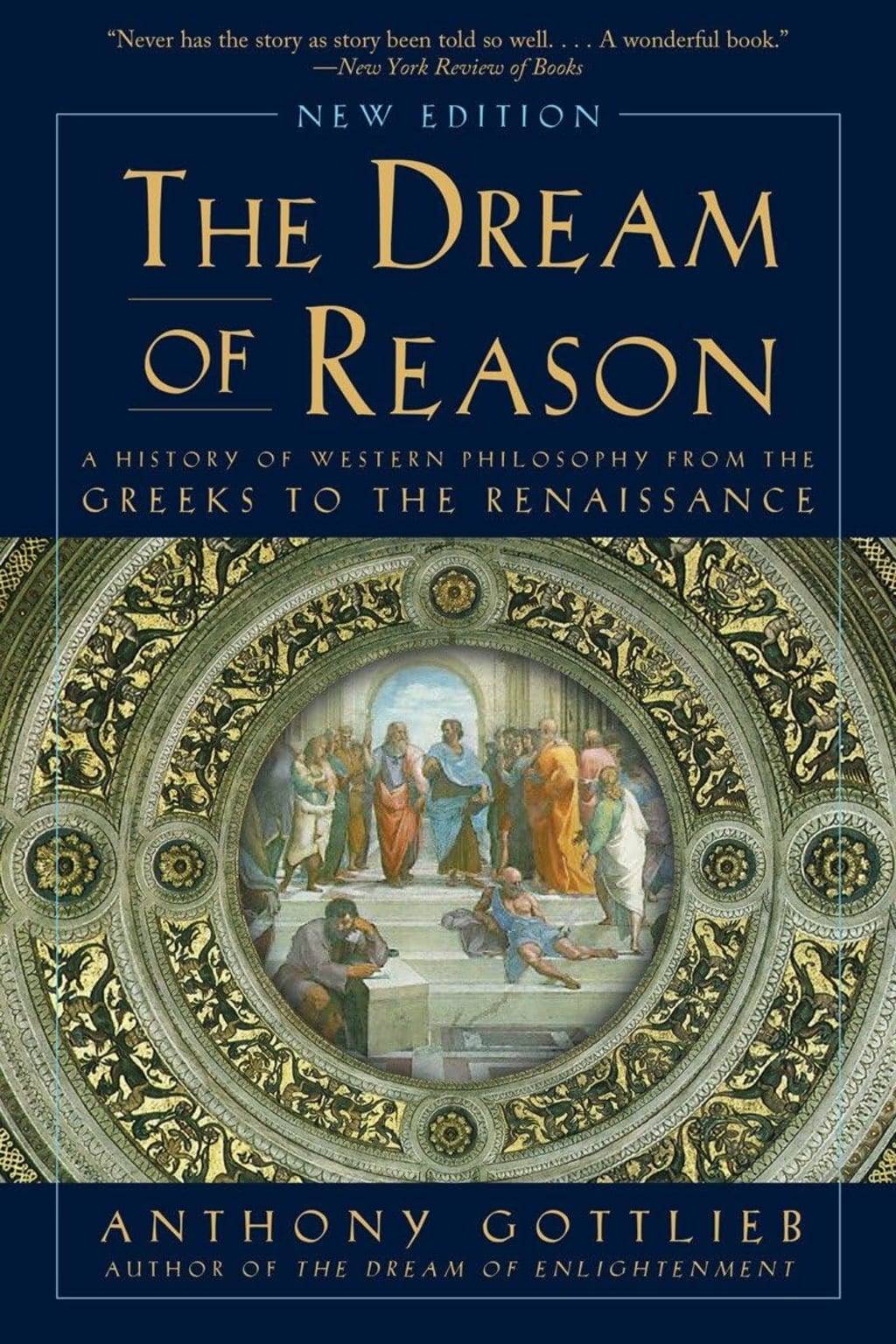
Sometimes I like to read philosophy books and especially if they are cheap. This is one of the first books read and finished in 2026 (does it count because I started it a few days before in 2025?). Well, you're probably surprised that I'm reading this at all. In 2025, one of the better philosophy books I read was The Philosophy of Andy Warhol where you can also read about all the strange stuff I found in the book. Sometimes though, these philosophy books can get a bit heavy and so, it takes me a bit longer to read. This one was one of them...
I get it, the Pre-Socratic school is known for their proximity of being before Socrates and yet, they are just as important. Pythagoras though, ran a cult and you can't convince me otherwise. The whole chapter on Pythagoras tends to tip-toe around the problem that this guy was basically an ancient mix between a millennial vegan and Alaister Crowley - but it does address the fact that there was definitely a fascination with spiritualism as well as mathematics amongst those who followed Pythagoras. But even though it does make that point, it doesn't actually address the evidence regarding the idea that Pythagoras may not have existed at all, though it does make a mention of the Orphic ideas that may have lent its hand rather than the actual hand of Pythagoras (of whom we have no writings). It's a difficult chapter in which I may have pulled a face more than once. I get the fact that the writer was basically saying 'no, he's not really being realistic here' but he is deeply engaged in the idea that Pythagoras was the first of his kind and very much, a real person.
There is a whole section on Socrates (and some of it is about how ugly he was physically which is strange but I'm glad to read he had a sense of humour about it). We get a bit of a look at the court system and how it relies on the best speaker rather than the most evidence. However, when it comes to Socrates, he is also not a great speaker either. In Athens it was pretty much against the law to corrupt the youth and go against the democratic ideas of the city. This, it reads, it what Socrates was doing and so, when he was in court - he seems to have mocked the person accusing him rather than presenting a good argument. Then again, he states that he doesn't really know anything (yes, that famed 'I know that I know nothing') and so could not have taught and corrupted anyone. When Plato wrote about it, there are long and convoluted arguments presented by Socrates whilst when you look at them closely, there really isn't any argument at all. Socrates was of course, sentenced to die. Though I found this chapter to be more about swings and roundabouts, parroting ideas presented (better in my opinion) in the works of Plato and just overly long with lots of filler - it was still quite interesting to read how this writer has portrayed the trial.
The book moves through a lot of things that I had already known before picking up the text. We get philosophers all the way up to the Renaissance. The one issue I have with this is that the book seems to cover more of the philosophers' lives themselves and how they were in their communities and social stature than the actual philosophies. It's weighted one way more than the other. I guess that this is probably due to the fact that this book would have more of an audience with the folks who had actually read most of the books of philosophy mentioned within the text. But, I would like to recommend an alongside reading of sections of the Norton Anthology of Theory and Criticism for those of you who wish to read The Dream of Reason but probably don't have time to read every single book mentioned within this text.
The chapter Voyages of Rediscovery has parts on the neoclassical aspects of the Renaissance, ones which hearkened back to people like Aristotle (who rightly so, gets his own chapter - he's great unless you look up his opinions on women and foreigners. Then he's not so great). But there's so much Aristotelian stuff in Shakespeare's and Marlowe's works and so, I don't mind going over it again.
Even though this book is a bit on the bulky side in terms of its narrative, I can honestly say that I'm glad I read it. It is probably one of the better books on how Western Philosophy evolved in its first half.
About the Creator
Annie Kapur
I am:
🙋🏽♀️ Annie
📚 Avid Reader
📝 Reviewer and Commentator
🎓 Post-Grad Millennial (M.A)
***
I have:
📖 300K+ reads on Vocal
🫶🏼 Love for reading & research
🦋/X @AnnieWithBooks
***
🏡 UK
Reader insights
Nice work
Very well written. Keep up the good work!
Top insights
Easy to read and follow
Well-structured & engaging content
Eye opening
Niche topic & fresh perspectives
Heartfelt and relatable
The story invoked strong personal emotions
Keep reading
More stories from Annie Kapur and writers in Geeks and other communities.
Book Review: "Everything I Know About Love" by Dolly Alderton
Okay so I'm back to reading some Dolly Alderton. I call these sorts of books my 'treat books' because of their lightness and readibility. At the moment I am sitting up in bed, it's the early morning, I've just finished the book and I am in a lot of physical pain. I haven't been sleeping right, my shoulders are killing me and my legs are entirely in knots. I'm not really sure what to do here because I can't move a lot without being in some kind of pain. Anyways, let's have a look at what Dolly Alderton has to say about love...
By Annie Kapur2 months ago in Geeks
Meet the Director Nominated for Two Oscars for Two Different Films
In the highly competitive world of filmmaking, earning a nomination for the Academy Awards is considered one of the greatest recognitions of artistic achievement. For one director, however, the honor arrived twice in a single year — for two completely different films. The unusual milestone has drawn attention across the global film industry and highlighted the creative range of a filmmaker whose work continues to push boundaries. The nominations, announced by the Academy of Motion Picture Arts and Sciences, place the director in a rare category of artists who have managed to captivate audiences and critics simultaneously with multiple projects released within the same awards cycle. While it is common for filmmakers to spend several years developing a single project, this director oversaw two distinct productions, each with its own cast, theme, and visual language. Both films went on to gain widespread critical praise, eventually earning nominations at the prestigious Academy Awards. Industry observers say the achievement reflects not only technical skill but also a remarkable ability to navigate vastly different storytelling approaches. Two Films, Two Worlds The first nominated film is a sweeping historical drama that explores the complexities of identity, power, and personal sacrifice. Set against the backdrop of a turbulent political era, the film combines intimate character studies with large-scale cinematic spectacle. Critics praised the director’s ability to balance emotional storytelling with historical authenticity. Carefully constructed scenes, detailed production design, and powerful performances helped the film resonate with audiences around the world. The second nominated film stands in stark contrast. Rather than historical drama, it is a contemporary character-driven story focused on personal relationships and moral ambiguity. The narrative unfolds in a quieter setting, relying heavily on dialogue and subtle performances. Despite its smaller scale, the film has been described as equally powerful. Reviewers noted the director’s talent for extracting complex emotions from everyday situations, turning ordinary moments into compelling cinematic experiences. Together, the two films demonstrate a rare versatility that has impressed both critics and members of the film academy. A Career Built on Risk The director’s path to recognition was not immediate. Early in their career, they worked on independent productions that struggled to secure wide distribution. Many of those early films were praised in small film festivals but received limited commercial success. Those projects, however, helped shape a distinctive creative voice. Rather than following conventional industry formulas, the filmmaker developed a reputation for taking risks with narrative structure and visual style. Over time, those risks began attracting international attention. Film critics often compare the director’s approach to that of celebrated auteurs such as Christopher Nolan and Alejandro G. Iñárritu, both known for blending ambitious storytelling with strong artistic identity. Although the comparison is flattering, the director’s work remains distinctly their own. The Challenge of Creating Two Films Producing two award-caliber films within the same period is an enormous logistical challenge. Each production requires months — sometimes years — of planning, financing, casting, and post-production work. Film industry insiders say the director’s ability to manage both projects simultaneously speaks to an exceptional level of organization and creative discipline. Crew members involved in the productions describe a collaborative environment where ideas were encouraged and experimentation was welcomed. “Every scene felt carefully planned but also open to discovery,” one cinematographer who worked on the projects said in an interview. “The director had a clear vision, but they also trusted the creative team.” Recognition from the Film Community Since the nominations were announced, the director has received congratulations from filmmakers and actors around the world. Social media has been filled with tributes from colleagues who admire the achievement. Some analysts say the nominations reflect a broader shift within the film industry toward recognizing bold storytelling and diverse perspectives. In recent years, the Academy Awards has expanded its membership and voting body, bringing in a more international and diverse group of filmmakers. That change has allowed a wider range of films to gain recognition. For this director, the moment represents both validation and new expectations. Looking Ahead While awards season attention often focuses on trophies and ceremonies, many filmmakers emphasize that recognition is only part of the creative journey. The director has already hinted at several upcoming projects, including a potential collaboration with major international studios and a smaller experimental film expected to return to their independent roots. Whether or not the Oscar nominations lead to a win, the dual recognition has firmly established the filmmaker as one of the most exciting voices in modern cinema. For audiences, the achievement offers a reminder that great storytelling can take many forms — from sweeping historical epics to intimate human dramas. And for the director behind both films, the moment marks not an end point, but the beginning of an even more ambitious chapter in a rapidly evolving career.
By Fiaz Ahmed a day ago in Geeks




Comments (1)
Intriguing... "The sleep of reason produces monsters." - Goya 🙄