
Book Review: "Slow Productivity" by Cal Newport
3/5 - it makes some good points...too bad that it comes from a place of extreme privilege...

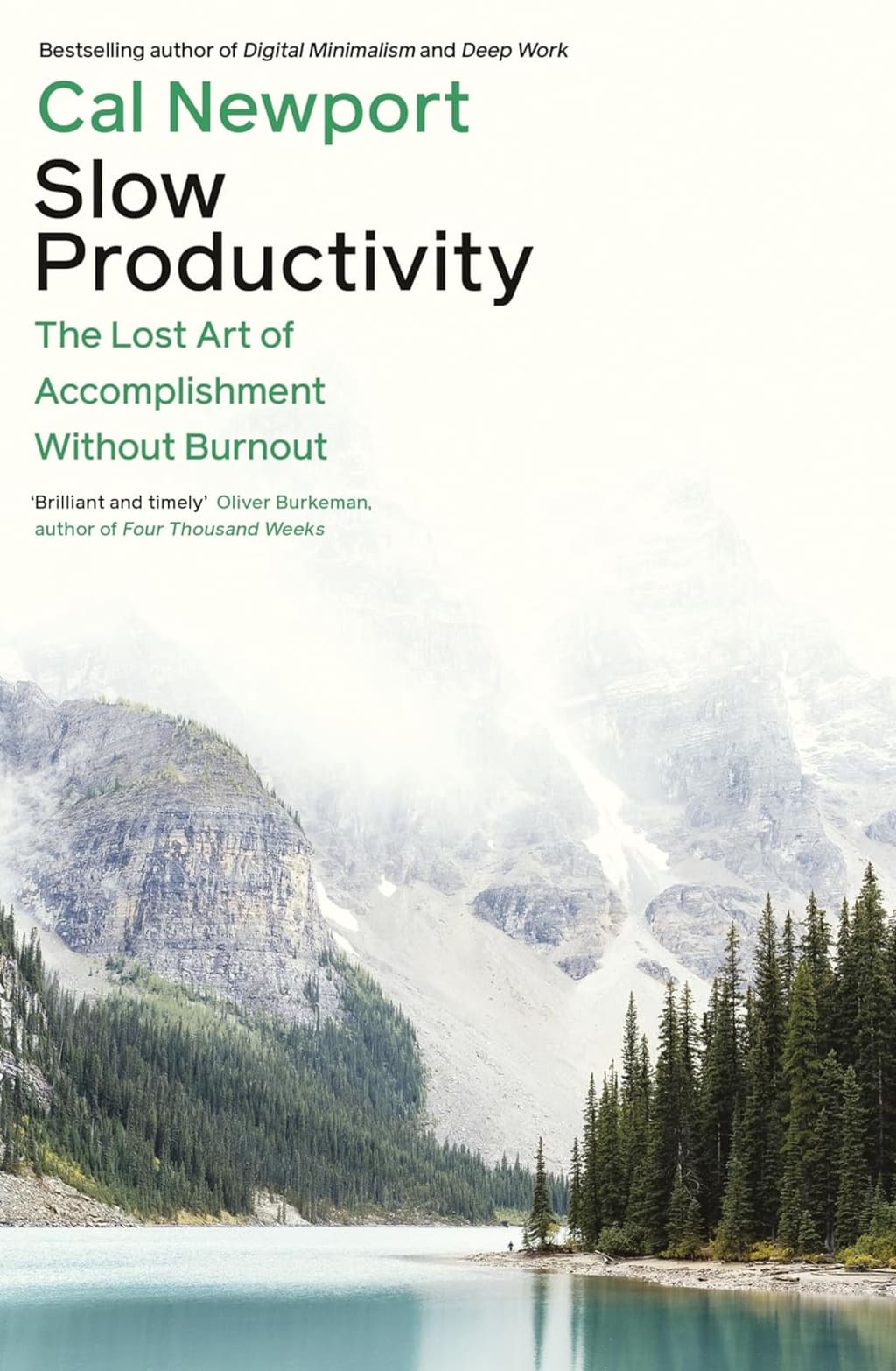
I have to admit I've been trying to avoid this book for a while since it seemed like one of those phoney self-help books that actually only applies to a very small set of people. When I read it, I was glad to discover that I was probably only half-right about that. Slow Productivity covers why we should want quality over quantity when it comes to work and how lowering our work loads can have a net positive impact on our lives. Unfortunately, for us who actually work real everyday jobs, this simply is not a reality and won't work since as workers we are not valued as human beings with lives outside the workplace. However, it does give us something to think about.
Newport begins by diagnosing the root issues of modern work culture, which he describes as being dominated by "hyperactive hive-mind workflows." In this model, tasks are continuously added to an ever-expanding to-do list, while constant communication via email, messaging apps, and meetings keeps employees in a perpetual state of reaction. This approach, Newport argues, creates an illusion of productivity but fails to deliver meaningful results. Instead, it overwhelms workers, leading to cognitive overload, poor decision-making, and a neglect of deep, high-value work.
He traces this phenomenon to technological advancements that have blurred boundaries between work and personal life. The advent of instant communication tools, while initially seen as liberating, has trapped professionals in cycles of busyness. Newport contends that the prioritisation of speed and responsiveness over depth and focus undermines the potential for creativity and innovation. I actually think that this is a really important point seeing as emails and messages can be sent all hours of the day and the expectation to respond is strong. This is why my notifications are switched off. I check it when I feel like it.
One of Newport’s central arguments is the dismantling of the idea that working faster and harder equates to being productive. He notes that many organisations prize immediate results and high output, measured by metrics such as the number of tasks completed or emails sent. However, Newport stresses that these superficial indicators rarely align with meaningful success. Drawing on cognitive science, he explains that human brains are not designed to sustain prolonged periods of intense activity without rest.
When workers prioritise speed, they sacrifice the time and mental energy needed for reflection, problem-solving, and long-term strategising. This leads to a vicious cycle where mistakes or short-sighted decisions create additional work, further compounding the problem. The amount of pointless meetings and emails in the workplace is something that everyone knows too well. I say we cut the crap and only send emails that have something to do with the work. Everything else (such as painful work socials) should be an opt-in. The high output at work, as we can see from statistics, is sacrificing the health of many workers who do not have job flexibility. The problem is, the issue he is addressing is not really a problem for the people he is talking about because they do have job flexibility or, at least can request it. People who physically need to be at work in person doing a very specific set of things everyday, do not have this option and therefore, the 'slow productivity' model doesn't work.
Newport enriches his argument by referencing historical figures and movements that exemplify slow productivity. For instance, he highlights the practices of famous writers, scientists, and artists who achieved groundbreaking work by dedicating extended, uninterrupted periods to their craft. He cites Charles Darwin as an example, noting that Darwin’s revolutionary ideas on evolution emerged not from rushing through tasks but from years of meticulous observation, correspondence, and writing at a deliberate pace.
Similarly, Newport examines the artisanal guilds of pre-industrial Europe, where mastery of a craft often required decades of focused apprenticeship. These examples serve as a contrast to the present-day obsession with instant results, showing that lasting achievements often require patience, reflection, and a slower pace of work. I'm not going to lie, the different examples he gives of slow productivity working are interesting but simply do not apply to real people. They are very exclusive and often cherry-picked cases to support the theory. It's a nice theory, but I don't respect cherry-picking examples.
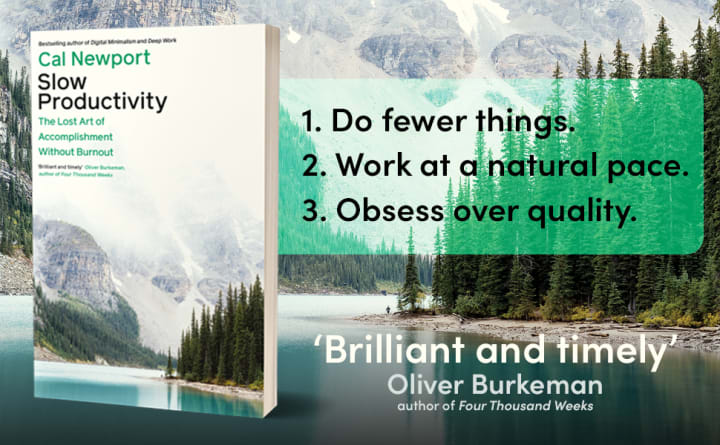
The author acknowledges that embracing slow productivity requires overcoming cultural and institutional barriers. Many organisations remain entrenched in traditional productivity metrics that reward busyness rather than meaningful results. Changing these norms requires both individual initiative and systemic reform. He also highlights the internal resistance many workers feel when stepping away from constant activity. The cultural narrative of work as a measure of self-worth can make it difficult to adopt a slower, more deliberate pace. Newport argues that this mindset must be challenged to foster healthier, more sustainable work practices.
Again, I come back to the majority of workers who simply do not have this flexibility to be able to choose. It must be nice to be able to choose. And so, this little pep-talk he gives to culture sounds like its coming from a place of privilege. I'm not sure what a professor would know about real work that a chartered accountant for a big firm does not. There's a difference: the chartered accountant works for someone where their work is measurable. If the measurements aren't any good, the company gets rid of them. Nobody is going to get rid of a professor because they ended a lecture half an hour early. The deep privilege here is honestly making the book laughably out of touch with reality.
All in all, in Slow Productivity, Cal Newport offers a powerful critique of modern work culture and a vision for a more sustainable and meaningful approach to productivity. Through a combination of historical insights, cognitive science, and practical strategies, he challenges the dominant narrative that equates busyness with success. And this is a pretty brilliant achievement. It's just a shame that it is only applicable to those who perhaps have more flexibility and options than those of us who have real jobs and don't have the options.
About the Creator
Annie Kapur
I am:
🙋🏽♀️ Annie
📚 Avid Reader
📝 Reviewer and Commentator
🎓 Post-Grad Millennial (M.A)
***
I have:
📖 280K+ reads on Vocal
🫶🏼 Love for reading & research
🦋/X @AnnieWithBooks
***
🏡 UK
Keep reading
More stories from Annie Kapur and writers in Geeks and other communities.
We Have Always Lived in the Castle by Shirley Jackson
"We Have Always Lived in the Castle" by Shirley Jackson was published in 1962, marking one of the final works of a prolific and influential writer. Jackson, renowned for her ability to blend the ordinary with the macabre, delivered a novel that encapsulates her signature style of psychological horror and gothic fiction.
By Annie Kapur11 months ago in Geeks
The Rachels - 2025
Much to my surprise, I have kept a list of the films I‘ve seen this year. I daresay it isn’t complete. There will be films that snuck in on a late night in front of the TV that I would’ve forgotten to note. Or others, that I went to watch at the cinema, but then had a red wine and promptly forgotten about. But it’s not a bad approximation of the films I’ve seen this year. In total, there are 53 films listed, so an average of one a week and one for good luck.
By Rachel Robbins25 days ago in Geeks
Super Bowl in Canada: How to Watch
Super Bowl, one of the most exciting sporting nights of the year, is now less than a month away and the excitement is already palpable. Scheduled on February 8, 2026 at Levi’s Stadium in Santa Clara, California, this will be the third Super Bowl held in the San Francisco Bay Area.
By David Cooka day ago in Geeks




Comments
There are no comments for this story
Be the first to respond and start the conversation.